


Creating Powerful, Thriving Digital Communities: Philippe Mistakopulo Of CIFRA On How To Cultivate Connection & Community In A Click-to-Connect World
The internet, at its best, is just the bridge. That night in Seoul, people crossed it.
In our digital age, it’s easier than ever to click “connect” — but much harder to create real connection. As more of our social and professional lives move online, the challenge becomes building meaningful communities that go beyond likes, follows, and shares. What does it take to cultivate thriving digital communities where people feel seen, heard, and supported? In this interview series, we are talking to community builders, digital strategists, tech founders, social media experts, and anyone who is creating powerful, thriving online spaces, and digital communities. We want to explore how to cultivate connection and community in a click-to-connect world, and what it really takes to build digital spaces where people can truly thrive. As a part of this series I had the pleasure of interviewing Philippe Mistakopulo.
Philippe Mistakopulo is a Director of Communications at CIFRA, a UAE-based platform dedicated to media art. He is shaping how artists, curators, collectors, and audiences engage with digital-native creative work beyond the limitations of traditional exhibitions and social media. With more than eight years of international experience across Europe, MENA, and Asia, his work combines strategic thinking with community-centered storytelling, helping organizations build authentic relationships.
Thank you so much for joining us in this interview series! Our readers would love to get to know you a bit better. Can you tell us a bit about your background and how you grew up?
I was born in Moscow, in a neighbourhood still known as “The Artists’ Village” — it’s remarkable how life brought me back to working with artists. As a child, I used to walk along Vrubel Street, convinced I understood everything about his demons.
My family’s story is inseparable from the era of Perestroika. My mother would buy works by Russian artists at open-air markets in small towns — Suzdal, for instance — and bring them to Paris and Prague to sell, so we could put food on the table. Those years were hard, but my mother and grandmother held everything together.
Studying art history wasn’t an option — my mother worried I’d never find work in Russia. So I flew to China to study marketing at Xi’an Jiaotong-Liverpool University in Suzhou. That path eventually led me to Condé Nast, which remains the most formative experience of my career. Everything I know, I carry from those years, and much of what I try to bring to CIFRA today comes from that school of thought. It doesn’t always translate, but I believe anything is possible.
I moved to Dubai, returned to Condé Nast for a time, and eventually found my way to CIFRA. These days, I don’t feel like I work at all — I just get to do something I love.
What inspired you to get involved in building digital communities?
I believe in the power of offline connection — there’s something about human energy that can only truly be read in person. But the post-COVID era has made it impossible to ignore how much of our lives now unfolds online, and I think resisting that would mean losing the ability to reach people where they actually are.
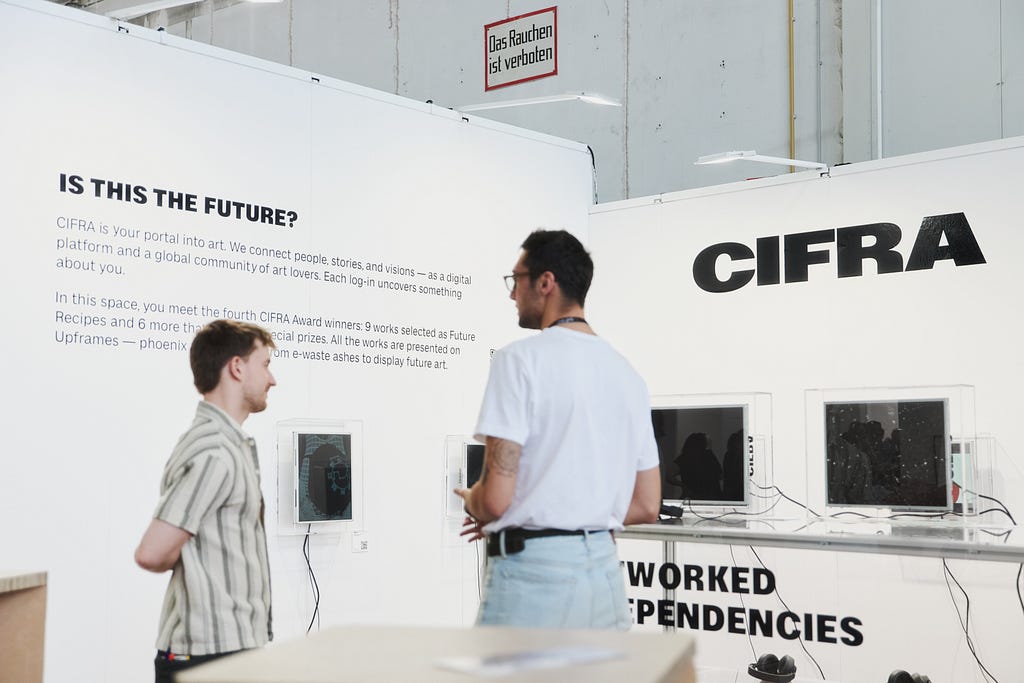
At CIFRA, we’ve built a digital community with that balance in mind. The online space is where we cultivate relationships, share ideas, and keep the conversation alive — but four times a year, that community steps offline. We gather, we meet face to face, we share. For me, that rhythm is what makes it real. The digital layer isn’t the destination — it’s the connective tissue that holds everything together between those moments.
Was there a moment when you realized the power of authentic online connection? Can you share that story?
The moment that stays with me happened in Seoul. CIFRA organised a gathering, and I remember watching the bar fill up with people who had never met each other before. They had found each other through our online community — connected by a shared love of media art — and suddenly they were in the same room, talking, laughing, exchanging ideas.
No one knew anyone. And yet everyone belonged.
That was the moment I truly understood what authentic online connection can do. It’s not about the platform or the follower count — it’s about finding your people. The internet, at its best, is just the bridge. That night in Seoul, people crossed it.
What’s the most important lesson you’ve learned along the way that influences how you operate now?
Three things I’ve learned, and I carry all of them:
Leave places where your opinion isn’t asked for. Not out of ego — but because a voice that’s never invited eventually stops having anything to say.
Don’t confuse work with family. Work is work. It can be meaningful, it can be joyful, but it operates by different rules. Blurring that line usually ends in disappointment.
And perhaps most importantly — if the fire inside you has gone out, stop and ask yourself why. Either find a way to reignite it, or find somewhere new to go. That inner flame is the only real compass I’ve ever trusted.
In your opinion, what defines a thriving digital community?
Two things, and I think they’re deeply connected.
First — the freedom to have a voice. A community where people can’t express a genuine opinion isn’t a community, it’s an audience. The difference matters enormously.
Second — a sense of belonging. The pandemic left a mark on all of us that I don’t think we fully acknowledge. We were so isolated, so alone, that now people are hungry to feel part of something. A thriving digital community answers that hunger. It says: you are not alone, you are seen, you belong here.
When those two things coexist — free expression and genuine belonging — that’s when something real starts to grow.
What are some common mistakes people make when trying to build digital communities?
The most common mistake is building a community in order to sell. People sense that immediately — and they leave.
Trust has to come first. Real conversation has to come first. The question shouldn’t be “how do we convert this person?”, but “why would they ever want to be here?”.
At CIFRA, we have a subscription — CIFRA Club — and yes, it matters to us commercially. But we’ve learned that when someone genuinely wants to support artists, they come to us. They initiate it themselves. Our job is never to push — it’s to show people that media art is so much more than a gallery exhibition. Once they see that, once they feel it, the rest follows naturally.
Sell too early, and you lose the community. Build something worth belonging to, and the support takes care of itself.
I’m going to try a few of your tips, and I’m hopeful our readers will, too. What are your “Five strategies to cultivate a powerful, thriving digital community?’ Please share a story or example for each.
- Honesty over selling
Build trust and real conversation first. People can feel when a community exists just to sell to them — and they leave.
2. Give people a real voice
A community where opinions aren’t welcome is just an audience. Create space for genuine dialogue, not just likes.
3. Keep an offline rhythm
Online connection needs to be grounded in real life. We bring our community offline four times a year — that’s where everything deepens.
4. Find your people, not everyone
Don’t chase scale. The strongest communities form around a shared passion — even a small group united by genuine interest beats a large, indifferent crowd.
5. Lead with belonging
Especially post-pandemic, people aren’t looking for content — they’re looking to feel part of something. Make that feeling the foundation, and everything else follows.
How important is meeting offline, in real life? What is the best way to make that happen? Can you share a story?
Offline meetings are essential. They ground you — pull you out of the endless stream of notifications and back into the present moment, into real human energy.
And honestly, you don’t need much to make it happen. A good playlist, proper invitations, and people willing to show up — that’s it. No fancy technology required. What you actually need is the right mood, the right energy in the room. That’s what makes people stay, talk, and connect.
The Seoul gathering I mentioned earlier is a good example — it wasn’t an elaborate production. It was simply the right people, in the right room, finally meeting face to face. That’s all it takes.
How do you handle negativity, trolling, or disengagement in a digital space?
My principle is simple: negativity usually says more about the person giving it than about you.
Art, especially media art, attracts a lot of opinions — and a fair amount of snobbery. There’s no shortage of harsh takes. What matters is listening, taking what’s useful, and moving forward. The one thing I never do is take it personally. The moment you do, it starts to shape you instead of the other way around.
What are some practical strategies for encouraging real interaction, beyond likes and emojis?
Give people space to actually write.
Try posting something simple — even an empty post — and ask people how they’re feeling today, or what’s on their mind. You’d be surprised how openly people share. In the endless scroll, people forget the most important thing: to stop.
That pause — that small invitation to reflect and respond — is often all it takes to turn a passive scroller into someone who genuinely engages.
What platforms or tools have you found most effective for cultivating meaningful digital engagement?
For CIFRA, Instagram is the platform. It’s where we connect with our community most directly — it just feels like the right space to talk with people, not just at them.
Are there certain types of content or activities that tend to spark stronger connection in online spaces?
Artist interviews, hands down. Every exhibition we run begins with an interview with the artist — that’s where everything you’ll later see in the online exhibition gets unpacked and explained.
There’s something incredible about hearing directly from the artist what’s going on in their head — the thinking behind the work, the intent, the story. That’s the moment people connect not just with the art, but with the person behind it. And that connection carries through everything that follows.
Success is often a matter of perspective. I’ve always resonated with Henry David Thoreau’s quote, “It’s not what you look at that matters, it’s what you see.” How do you see success — or define success — for yourself now?
Honestly, I don’t measure success in career achievements at all.
For me, success is time with my family, weekends at the beach with my dog, the ability to not pick up my phone and just be present, here and now.
I once had someone ask me, “what’s it like working at Vogue at 22 — isn’t that success?”. And for me, it was just a job. CIFRA, despite how much I love what we do — and honestly, much of the time it doesn’t feel like work at all — is still, at the end of the day, work. My success lives elsewhere.
And maybe the truest version of it — as silly as it sounds — is waking up by the ocean with fresh air, and later having lunch at a Greek taverna in Cape Town. That’s success to me.
We are very blessed that some of the biggest names in Business, VC funding, Sports, and Entertainment read this column. Is there a person in the world with whom you’d like to have a private breakfast or lunch with, and why? He, she or they might just see this. 🙂
Oh, there are so many, but I’ll give you three.
First, Kandinsky. His work is part of what first drew me toward art after my time in China. There’s something about how he saw the world that still influences how I think.
Second, Donald Newhouse. Building a media empire the way he did — that’s no small thing. I’d love to understand how he thought about it.
And third, Marina Abramović. As for why, I’ll leave that one a mystery.
What is the best way for our readers to further follow your work online?
You can find me on Instagram at @budetrassvet, which translates from Russian as “there will be a dawn.” Because after every sunset, there’s always a new beginning. That’s the spirit I try to carry with me.
Thank you for these thought provoking insights. Here’s to your continued success!
Creating Powerful, Thriving Digital Communities: Philippe Mistakopulo Of CIFRA On How To Cultivate… was originally published in Authority Magazine on Medium, where people are continuing the conversation by highlighting and responding to this story.