

The arts are not a luxury. They are a necessity. And this movement would make sure the world finally treats them that way.
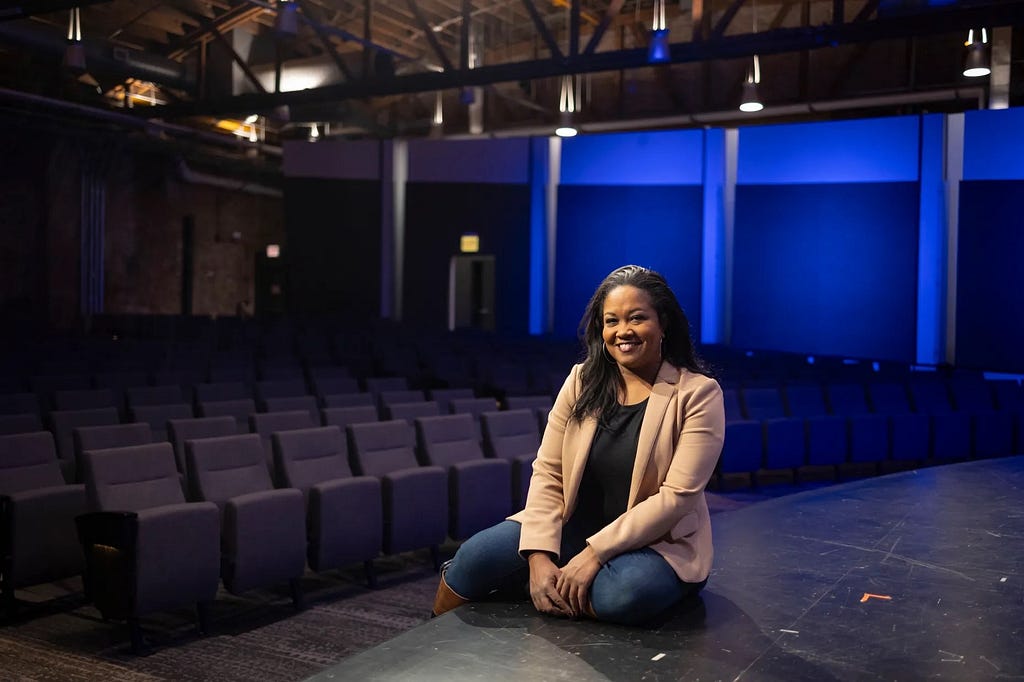
As part of my series about “individuals and organizations making an important social impact”, I had the pleasure of interviewing Sheila Fortson.
Sheila Fortson is an Arts Education Advocate, Child Development Expert, and Social Impact Entrepreneur. As the Founder & Executive Director of the FAME Center (Fortson Arts and Music Education Center), a Chicago-based nonprofit, Sheila expands access to creative education for youth and families. In 2018, after identifying a lack of accessible creative programming in Chicago’s South Loop, Sheila applied her artistic background and entrepreneurial mindset to build a solution. What began as a grassroots initiative in a broom closet has grown into a high-impact community organization, serving more than 950 individuals in 2025 alone through 12 camps, $50,000 in scholarships, and programs on everything from art therapy to creative writing for children. Sheila’s insight was entrepreneurial as much as artistic: that equitable access to arts education isn’t just a cultural issue, it’s a community development issue. Under her leadership, FAME Center has become a cultural and economic anchor in the surrounding underserved communities.
Thank you so much for joining us in this interview series! Can you tell us a story about what brought you to this specific career path?
My path to founding FAME Center was not a straight line, it was a calling. I spent years in music, teaching private lessons, leading choirs, serving communities, and watching the transformative power of the arts up close. But I kept noticing a gap: the children who needed the arts most, who needed a creative outlet the most; kids in under-resourced communities — had the least access to them. Arts programs were being cut from schools, and families couldn’t afford private lessons or enrichment programs. In 2018, I decided I couldn’t just observe that gap anymore. I had to do something about it. FAME Center — Fortson Arts and Music Education Center was born out of that conviction. I didn’t have all the answers when I started. What I had was purpose, and that was enough to begin.
Can you share the most interesting story that happened to you since you began leading FAME Center?
One of the most profound moments came during Covid when a mother walked into FAME Center in tears, not tears of sadness, but of relief. Her child had been struggling in school, withdrawing at home, had recently experienced the death of her father and she didn’t know what to do. Her child was in our art classes but when Covid hit she didn’t have an outlet. We quickly switched to weekly online art lessons and found a scholarship to fully fund her lessons. Within weeks, she began to see a shift. Her child was showing up, engaging, laughing, creating. The mother told me, “You gave my child back to me.” That moment reminded me that FAME is not just an arts program — it is a lifeline. We are in the business of restoring children to themselves and families to hope; healing Chicago one child at a time.
Can you share a story about the funniest mistake you made when you were first starting?
In the early days of FAME, I was wearing every single hat — executive director, program coordinator, marketer, janitor, you name it. I once sent out a mass email to our entire contact list to announce an event and realized afterward that I had typed the wrong date. Not just the wrong day — the wrong month entirely. My phone lit up immediately. People were gracious about it, and we laughed together, but in that moment I wanted to disappear! What it taught me was that I couldn’t do everything alone. I needed a team, systems, and the humility to ask for help. That one embarrassing email was actually the beginning of me learning how to truly lead and delegate.
Can you describe how your organization is making a significant social impact?
FAME Center exists at the intersection of arts education, child development, and community healing. We serve children and young people in underrepresented communities in Chicago, providing access to music, drama, visual arts, creative writing, and arts therapy; many of whom would never have these opportunities otherwise. But our impact goes beyond the stage or the canvas. We are building confidence, developing emotional intelligence, and giving young people a safe space to be fully themselves. In communities where trauma is real and resources are scarce, the arts become a language for healing. Every child we serve carries that forward, into their schools, their families, and eventually their communities.
Can you tell us a story about a particular individual who was impacted or helped by your cause?
There was a young student who came to us withdrawn and guarded. Teachers described him as disengaged, and his family was at a loss. He didn’t talk much and rarely made eye contact. But when we introduced him to music, to a saxophone to be exact, something unlocked. He began taking lessons and one afternoon began playing a duet with his teacher. The room went quiet. Staff members stopped what they were doing. In that moment, this child who had felt invisible suddenly filled the entire room. His family told us that for the first time in years, he came home excited. He had found his gift. He had found his voice. He now plays in a local jazz band with other young musicians That is what FAME does — we find the gift that is already there and give it space to breathe.
Are there three things the community/society/politicians can do to help address the root of the problem you are trying to solve?
Absolutely.
- Restore and protect arts funding in public schools. Arts education has been systematically cut from under-resourced schools for decades, and the children who suffer most are the ones who need creative outlets the most. Policy makers must prioritize arts as essential — not elective.
- Invest in community-based organizations doing the work. Organizations like FAME Center are embedded in the communities we serve. We know the families, we know the need, and we show up every day. Funders, corporations, and government agencies must make sustained, multi-year investments in nonprofits like ours rather than one-time grants that barely cover a program cycle.
- Address the mental health crisis in children and youth head-on. The arts are one of the most powerful and accessible tools for youth mental health, and yet arts therapy remains severely underfunded. Society must connect the dots between creative expression and emotional wellbeing and fund accordingly.
How do you define “Leadership”?
Leadership, to me, is the courage to carry a vision that is bigger than yourself and bring others along for the journey — even when the road is hard, the resources are scarce, and the doubters are loud. It is not about having all the answers. It is about creating an environment where the right questions get asked and the right people are empowered to find solutions. I have learned that the best leaders are not the ones who stand at the front of the room — they are the ones who make everyone else in the room feel capable, seen, and essential to the mission.
What are your 5 things I wish someone told me when I first started?
1. Fundraising is a skill, not a personality trait — learn it.
Nobody told me how hard it would be to ask for money. I thought passion would be enough. It is not. Fundraising is a discipline, and the sooner you invest in learning it, the stronger your organization will be.
2. Build your team before you think you’re ready.
I tried to do everything myself for far too long. The work suffers when one person carries it all. Surround yourself with people who complement your weaknesses early, not after you’ve burned out.
3. Culture is not a perk — it is the foundation.
How your team feels about showing up every day determines everything. I wish I had invested in organizational culture from day one rather than treating it as something to address later.
4. Rest is part of the strategy.
Ministry and nonprofit work can make you feel guilty for resting. But a depleted leader cannot sustain a growing organization. Rest is not laziness — it is wisdom.
5. It is okay not to know what you’re doing yet.
As Ralph Waldo Emerson said, “Every artist was first an amateur.” That applies to nonprofit leadership too. No one starts as an expert. Give yourself grace for the learning curve. The mistakes are part of the process — they are not signs that you were wrong to start.
Can you please give us your favorite Life Lesson Quote?
“Every artist was first an amateur.” — Ralph Waldo Emerson
This quote lives in me. When I started FAME Center, I was passionate but inexperienced in some many areas of running an organization — fundraising, operations, human resources, financial management. There were moments I felt like I had no business being in the room. But this quote reminds me that expertise is earned, not granted. Every founder, every leader, every artist begins somewhere. The willingness to be a humble, persistent learner is what separates those who build something lasting from those who give up too soon. I was an amateur. I am still growing. And I would not trade the journey for anything.
Is there a person in the world with whom you would like to have a private breakfast or lunch with, and why?
Michelle Obama. Without question. Here is a woman who has moved through the world with extraordinary grace, power, purpose, and authenticity. She has used every platform she has ever stood on to lift others — especially young people, especially young women, especially those who have been made to feel like they don’t belong in certain rooms. She understands the complexity of leading while being a Black woman in spaces that were not designed for you, and she has done it with her head high and her heart open. I would want to sit with her not to talk about her accomplishments, but to ask her about the quiet moments — the doubts, the hard days, the decisions that cost her something. I believe that conversation would pour into me in ways that would carry FAME Center forward for years to come.
If you could inspire a movement that would bring the most amount of good to the most amount of people, what would that be?
I would inspire a movement called “Every Child Has a Gift.” A nationwide, community-driven commitment to ensuring that every child — regardless of zip code, income, or background — has access to arts education, creative expression, and the adults who will help them discover what they are uniquely made to do. We have spent too long defining children by their test scores and their deficits. I want a world that defines them by their gifts. When a child knows what they carry inside them, everything changes — their confidence, their choices, their future. The arts are not a luxury. They are a necessity. And this movement would make sure the world finally treats them that way.
Thank you so much for the time you spent with us today. This was very inspiring!
Social Impact Heroes: How Sheila Fortson Of FAME Center Is Helping To Change Our World was originally published in Authority Magazine on Medium, where people are continuing the conversation by highlighting and responding to this story.