


Building Company Culture From the Top Down: Rebecca Fishman Lipsey Of The Miami Foundation On How the Personal Example of Exceptional Leaders Shapes Companies That Thrive
An Interview With Jim Hamel
Leadership isn’t about comfort, it’s about showing up with integrity, especially when the stakes are high, and the path is uncertain.
As a part of this series, we had the pleasure to interview Rebecca Fishman Lipsey.
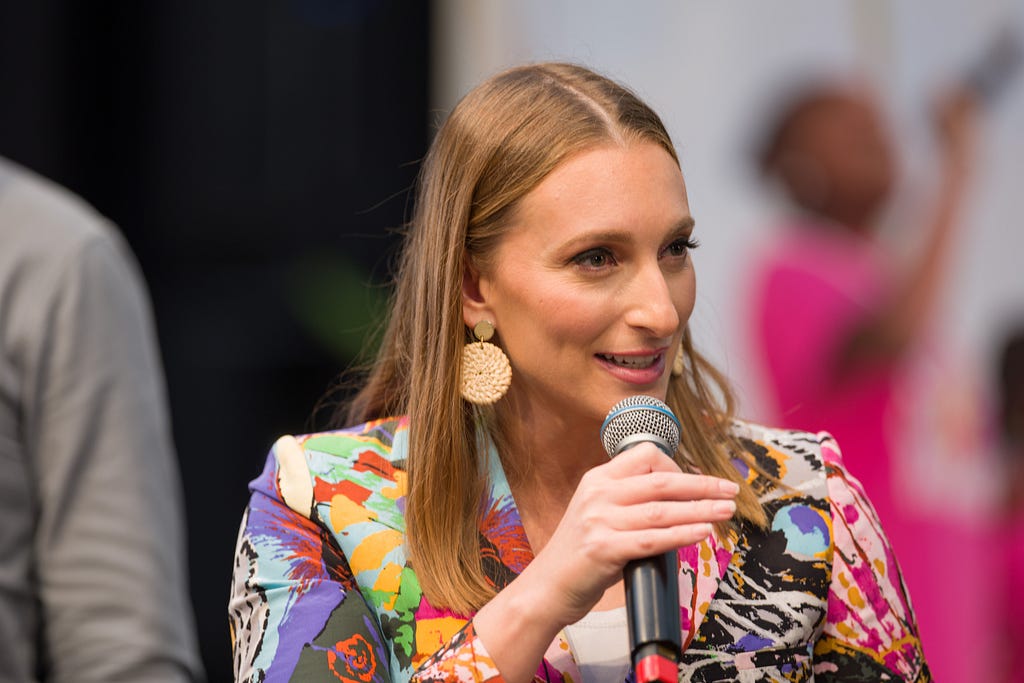
Rebecca Fishman Lipsey is President & CEO of The Miami Foundation, where she leads efforts to mobilize generosity and drive community impact across Greater Miami. Since 2020, she has grown the Foundation’s assets by over 50% while advancing equity and collective impact. A former education policymaker and founder of Radical Partners, she began her career as a public-school teacher and later served on the Florida Board of Education. Rebecca is deeply committed to Miami — and most proud of raising two kind, grounded sons alongside her husband.
Thank you so much for joining us in this interview series! Before we begin, can you please introduce yourself? Our readers would love to “get to know you” a bit better. Can you tell us a bit about your ‘backstory’ and how you got started?
I have the privilege of loving Miami for a living. I’ve spent the last 20 years building and supporting initiatives that make this community stronger — from public service on the Florida Board of Education and entrepreneurship as the founder and creator of Radical Partners to nonprofit leadership during my tenure at Teach for America — and now as the leader of the largest community foundation in Miami-Dade.
Each chapter has been rooted in the same belief: that Miami’s greatest strength is its people, and when we invest in them, we unlock what’s possible for our future. Leading this work has been one of the greatest opportunities in my life.
None of us are able to achieve success without some help along the way. Is there a particular person who you are grateful towards who helped get you to where you are? Can you share a story?
I’ve been shaped by a community of mentors and collaborators across generations — people I’ve learned from and built alongside, both younger and older. That ecosystem of relationships has been essential to who I am as a leader.
And on a more personal level, my husband has been my anchor and biggest supporter throughout my career. Being a mother of two, while leading in a role I care deeply about, would not be possible without a true partner. He supports me fully, challenges me, and believes in the work that I am doing. We don’t talk enough about how critical that kind of partnership is to leadership, particularly for female executives. Choosing my husband as my lifelong partner is one of the most important decisions I’ve ever made — it has impacted my professional success.
Ok, fantastic. Let’s now shift to the main focus of our interview. When you think about your company’s culture today, what’s one word you’d use to describe it and why? Please explain with stories or examples if you can.
Brave.
Our mandate is to take on the most pressing challenges facing our community, both today and for the future. That requires courage.
During COVID, for example, we worked alongside partners to ensure that every child in Miami-Dade County had access to the internet for learning when they could not attend school. Figuring out how to tackle this challenge took bravery — it required the building of unanticipated coalitions, taking risks, and moving quickly without a perfect roadmap. The outcome? Miami Connected.
At The Miami Foundation, we’ve built a culture where people are willing to say the hard things, try new approaches, and learn from what doesn’t work. That kind of bravery, paired with humility, is what allows us to do meaningful, systems-level work.
Many companies define values, but fewer truly live them. How do you personally hold yourself accountable to your organization’s values in day-to-day decisions, especially when it would be easier not to? Can you share an example?
A leader’s values are much more visible when it’s hard, than when things are easy.
When the Champlain Towers tragedy happened in South Florida, our community was grieving, yet there was an urgent need to respond. At the same time, there was confusion amid hundreds of competing GoFundMe fundraising efforts, many of them unaligned or unverified.
In that moment, leadership meant stepping forward with clarity, transparency, and collaboration, even when it would have been easier to step back. We worked with dozens of partners to centralize resources, bring in experts, communicate consistently, and make real-time decisions. Support Surfside was one of the toughest but also most rewarding projects of my career, where we lived out our values to the fullest.
Those are the moments where you must mean what you say. Leadership isn’t about comfort, it’s about showing up with integrity, especially when the stakes are high, and the path is uncertain.
Looking back, was there a specific moment, decision, or behavior that became a turning point for your company’s culture? Please share the story.
Unlocking the power of WE.
Our foundation houses hundreds of millions of charitable dollars on behalf of over 1,000 generous families, businesses, government entities and organizations.
There are so many people working every day to leverage those resources for the benefit of our community, but they often work in silos on their own mission or goals. The real power comes from bringing people together to accomplish things that are bigger and bolder than they could accomplish on their own.
During COVID, that became very real. We saw many people working on the same problems in parallel, but not in unity. It was a critical leadership moment, and we found ourselves bringing together tables full of partners with shared interests to solve major issues facing our community. That leadership moment unlocked so many opportunities and ultimately changed our institution forever.
Can you share a time when your company’s culture was tested, such as during a crisis, conflict, or major change, and how your leadership approach affected the outcome?
As mentioned earlier, during COVID, we led Miami Connected, a multi-partner effort to bring internet access to over 300,000 students who would otherwise have been unable to continue learning while at home. What people didn’t see is that the first strategy didn’t work, and neither did the second or third.
We had to lean into what we call “failure friendliness.”
When you’re operating in public, raising funds, and leading large-scale efforts, it’s incredibly hard to say, “This isn’t working, let’s try something else.” There’s pressure to have an answer. And eventually, we did have a successful approach.
But big challenges require persistence and an entrepreneurial spirit. It took seven different approaches before we landed on what worked. That experience reinforced a core belief for our team and partners: the bigger the problem, the more willing we have to be to adapt, pivot, and keep going to achieve our goals.
Here is the main question of our interview. Based on your experience and success, what are the “Five Things Leaders Can Do To Build and Shape Company Culture From The Top Down?” Please share a story or an example for each.
1. Build a teamwide appetite for bravery
No one ever regrets being brave. Build a teamwide appetite for bravery — which means comfort reaching, stretching, failing and learning on your feet, pivoting. Zoom out — ask yourself what would be transformational, take calculated bets on yourself and your team regularly.
A great example of this was the launch of the inaugural Give Miami 5K and Festival last year, another way for nonprofits to fundraise for Give Miami Day and bring their supporters out to spend a day with the community. It was our first time bringing this idea to life, and like any new venture, it came with uncertainty. But we leaned into our learners’ spirit and failure-friendliness, and the result was more than 3,000 people showing up across both events.
2. See the future
See the future. Get amazing at pattern recognition. Fast forward the movie. Understand that you can change the ending.
That mindset is what drove us to think about big, long-term investments in our community. We saw a pattern: incredible organizations and leaders doing meaningful work, but too often in silos, without a shared space to think, build, and solve together at scale, and other times without the resources to afford a physical space. So we asked ourselves: what would it look like to change that ending?
We’re in the process of building the Co-Lab as a true home base for Miami’s nonprofit, philanthropic, and civic leaders; a place designed for collaboration, innovation, and bold problem-solving. It will live in the historic Alfred I. duPont Building, and we’re excited to open our doors to the community in 2027.
3. Never lose your connection to the ground
Never lose your connection to the community. No matter how many layers exist within your organization, you have to keep your ear close to the ground — listening directly to the voices of the people and nonprofits you serve. That proximity is what keeps the work relevant, responsive, and rooted in real needs, not assumptions. Know the perspective of your community. Know the experience of your most junior staff member. They know what’s happening in a way you can’t from your corner office.
That means being intentional about how you stay connected. It’s making the time to hear directly from team members across the organization, especially those earlier in their careers, because they’re experiencing the work in real time and often see things others can’t. It’s building authentic relationships with nonprofit leaders, listening to what they’re navigating, what’s working, and where the gaps are.
It also means creating structured ways to bring people into the process. For major initiatives and events, we convene advisory groups that reflect the diversity of our community, ensuring that what we build is shaped with people, not just for them.
4. Joy is a choice
Teams are more powerful when they’re joyful — and joy isn’t about snacks and team parties and foosball tables. It’s about seeing the best in people. Feeling value in the way you spend your time. Seeing the glass as 100% full. It’s a choice, and it starts at the top.
For us, that shows up in how we treat each other — with respect, care, and intention. It’s reflected in the structures we put in place, like our annual sustainability week, when the entire office pauses so the team can truly recharge. And it’s in the small but meaningful moments…celebrating birthdays, recognizing anniversaries, and making sure people feel seen and valued.
Because joy, when it’s real, becomes part of the culture. And when that happens, it fuels not just how people feel at work, but the impact they’re able to make together.
5. Relationships are your most precious assets
Treat them accordingly. That belief shows up in the details of how we engage with people every single day. Before every event we host, we bring our team together for training, and one of the core principles we reinforce is simple but powerful: everyone is a VIP.
That means the experience should feel just as thoughtful and intentional for a major donor as it does for the leader or team member of a small nonprofit. Because in our work, every relationship matters, and every person is contributing to something bigger than themselves.
That consistency in how we show up is what builds trust over time. It’s how we establish real, lasting partnerships and why people continue to choose to build alongside us.
What advice would you give to leaders who want to build thriving cultures but aren’t sure where to start?
Culture is everything. It’s not what’s written on paper; it’s what’s lived every day and should feel like a fire in your gut!
For me, a lot of this comes from seeing what happens when culture is neglected: the realities of burnout, misalignment, and missed potential.
So, you have to be intentional. Talk about your values constantly. Tell stories about them. Celebrate them. Hold people accountable to them. It’s the only way to live them out. If it feels repetitive, you’re probably just starting to get it right. Culture should show up in how decisions are made, how people interact, and how success is defined.
How do you make sure your values and expectations are actually reflected by managers and team leaders throughout the organization? Please share examples if you can.
You have to operationalize them.
We’ve built clear frameworks that define what each value looks like at different levels of performance within the organization. We hold staff meetings to discuss them, conduct training related to our values with the leadership team, revisit them throughout the year, and integrate them into our performance reviews. This isn’t a once-a-year conversation — it’s ongoing, and it should feel familiar to all team members.
And most importantly, leadership must model it. If values aren’t embodied at the top, they won’t take hold anywhere else.
You are a person of great influence. If you could start a movement that would bring the most amount of good to the most amount of people, what would that be? You never know what your idea can trigger.
The movement, Give Miami Day, started 15 years ago (not by me), and is the largest single-city giving day in the nation. Last year, we raised a record $43.8 million from 120,000 donations for over 1,400 nonprofits in our community.
Through Give Miami Day, we’ve seen what’s possible when a community comes together: tens of thousands of people showing up in a single day to support the causes they care about. It’s powerful, and it’s proven that generosity is already part of Miami’s DNA.
But I believe we’re just getting started. The opportunity now is to bring even more people along and to expand what generosity looks like and who sees themselves in it.
Imagine if every person who calls Miami home saw themselves as an active participant in shaping this community — not just for one day, but year-round, in big and small ways. That’s how you build a culture of belonging and shared responsibility. And ultimately, that’s what transforms a place.
How can our readers further follow your work online?
Follow me on LinkedIn or visit The Miami Foundation website.
This was very inspiring. Thank you so much for the time you spent with this!
About The Interviewer: A dynamic and seasoned executive, Jim Hamel assumed leadership of Swanson Health Products, a global vitamin and supplement company in November 2021. As CEO, he has led the company to achieve double digit revenue growth internationally in his first fiscal year and has overseen expansion into 170+ international markets totaling over US $80M in revenue. Under Jim’s leadership, Swanson Health Products has continued its commitment to industry-leading service, quality and excellence with award-winning customer care and ongoing UL, NSF and Halal certification for achieving Good Manufacturing Practices and standards. Earlier in his executive career, Jim was the CFO with multi-national consumer products companies such as Diageo and Newell Rubbermaid and with other industry leading companies in ecommerce, agriculture, mining and explosives. Throughout his career he has been building his expertise in finance, international business, commercial operations, and risk management. Jim earned his Bachelor of Science in Accounting from North Dakota State University in 1989 and is a Certified Public Accountant (CPA). He also holds Six Sigma certifications and brings strong global finance acumen — with proficiency in Spanish — and board- and investor-level relationship building to every role he fulfills. Jim thrives on transformational leadership — with deep financial expertise, a global outlook, and a passion for wellness — to steer Swanson Health through its next phase of growth and innovation.
Building Company Culture From the Top Down: Rebecca Fishman Lipsey Of The Miami Foundation On How… was originally published in Authority Magazine on Medium, where people are continuing the conversation by highlighting and responding to this story.