

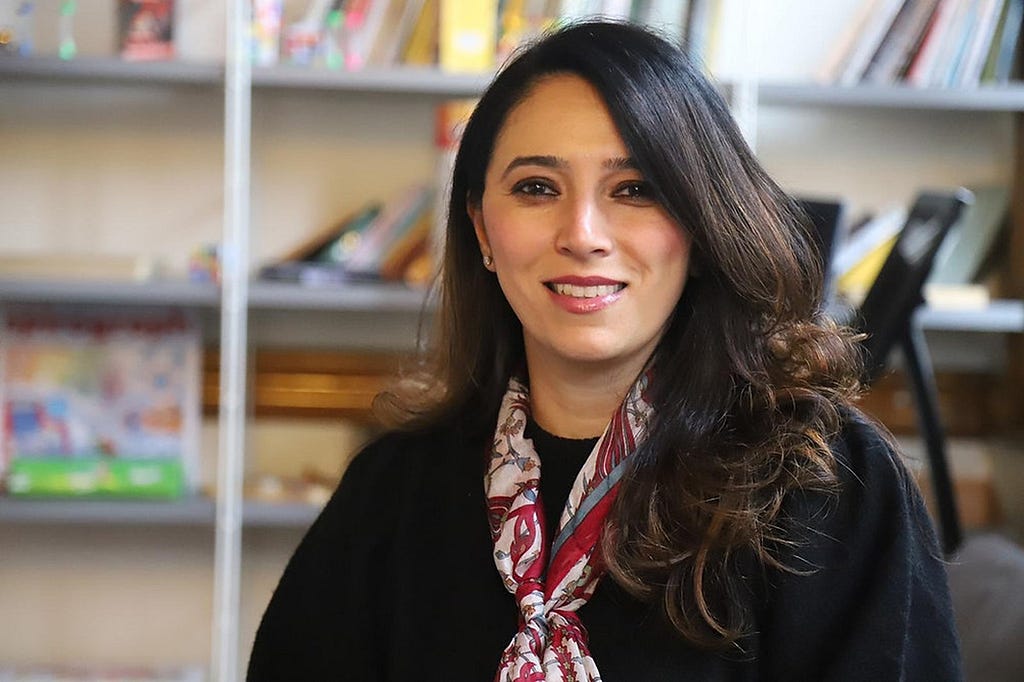
Social Impact Heroes Helping Our Planet: Why and How Lina Sergie Attar Of Karam Foundation Is Helping To Change Our World
A foundational moment for Karam’s identity as an organization that understands that people need more than the basics to live and thrive.
As part of our series on Social Impact Heroes, we have the pleasure of interviewing Lina Sergie Attar.
Lina Sergie Attar is a Syrian-American architect, writer, speaker, and humanitarian advocate born in Brooklyn and raised between the United States and Aleppo, Syria. Influenced by her upbringing in one of the world’s oldest cities, she studied architecture at the University of Aleppo before continuing her graduate studies at the Rhode Island School of Design and the Massachusetts Institute of Technology. For nearly two decades, Lina has worked to support Syrian refugee youth through innovative education, mentorship, and leadership development as the founder and CEO of Karam Foundation. Lina is also an internationally recognized writer and speaker whose work has appeared in The New York Times, The Atlantic, and Politico. She has spoken at conferences and universities including Harvard, MIT, Princeton, and has given a TED talk.
Thank you so much for joining us in this interview series! Can you tell us a story about what brought you to this specific advocacy path?
I’m Syrian American, born in Brooklyn, NY to immigrant parents who left Syria to pursue their medical training. When I was 12, my parents moved us back to Aleppo, Syria. It was a huge culture shock for me — life in Syria was at once brutal and nurturing. We lived with family close by in a beautiful, historic city that spanned thousands of years and under an authoritarian regime which we were taught to fear. I eventually moved back to America for graduate school but was truly Syrian by then. In 2011, when Syrians took to the streets to protest the Assad regime during the Arab Spring, my life changed. I never imagined we would witness an uprising in Syria and I was inspired by the revolution to dedicate my organization, Karam Foundation, to serve the Syrian people who deserved the freedom and dignity that they demanded. I never thought this would become my life’s mission.
Can you share the most interesting story that happened to you since you began leading your company or organization?
In December 2012, I visited the Atmeh Camp for the internally displaced in northern Syria which sheltered over 25,000 people in plastic tents. Over 12,000 children lived in the camp with little access to school or any semblance of normal life. It was cold, muddy, and miserable. I had $12,000 in donations with me to spend during my trip to help people in need. I asked the camp director, “What can I do with $12,000?” He thought for a bit and said, “You could feed the camp for a day or,” then he opened the cabinet behind him and showed me two beat-up soccer balls. “We only have these two balls for the entire camp. There’s nothing for the children to play with.” I thought hard about this choice between fulfilling a basic need for a fleeting moment and giving joy and play to thousands of kids for at least a few months. I chose investing in joy. A few days later, two trucks filled with soccer balls rolled into the camp and crowds of Syrian children cheered. This was a foundational moment for Karam’s identity as an organization that understands that people need more than the basics to live and thrive. We still make these kinds of choices today.
It has been said that our mistakes can be our greatest teachers. Can you share a story about the funniest mistake you made when you were first starting?
On one of our early missions in southern Turkey to work with a Syrian refugee school, we had a couple dozen volunteers from all over the world to work with the kids in arts, sports, storytelling, etc. When we put the program together we assigned the yoga teacher for the girls and the boxing group with the boys. After the first session, the boys and girls came to us in protest. The girls wanted to learn boxing and the boys wanted yoga! We switched them and everyone was happy the rest of the week.
Can you tell us what lesson you learned from that?
Making assumptions about what people want can cause mistakes. Even though we pride ourselves on always asking what people want first, there is always space to listen more deeply and ask more questions. In hindsight, it made a lot of sense. The girls wanted that sense of empowerment and strength that learning boxing can give. The boys wanted access to a sense of calm and focus that yoga provides. We came in with our assumptions about the community and were corrected quickly!
Can you describe how you or your organization is making a significant social impact?
At Karam, we believe in the power of deep, sustained impact on the life of a young person. Our programs often span years of service of refugee families and youth. We’ve built a “pathway to leadership” that takes displaced youth out of child labor and back to school, provides a world-class innovation program for refugee teens, and offers a higher education scholarship. This means that potentially we can have a young person with us for their entire childhood until early adulthood with many others coming along for a portion of the journey. This deep intervention that centers the importance of education and skills building, leads to nurturing young people ready to take care of themselves and their families in the future.
Can you tell us a story about a particular individual who was impacted or helped by your cause?
There are hundreds of stories of impact at Karam. One is Mohamad from Reyhanli. We met him in 2015 — he was a 14-year-old refugee working at a gas station and had dropped out of school to help provide for his family. We approached his mother who was taking care of her four children on her own and could not find work as a refugee. Three of the four children were out of school and working doing manual labor. We asked the mother, “If we give you what your children make monthly, would you send them back to school?” She exclaimed, “Yes!” And that’s what we did. It was the beginning of our Karam Families program that has since helped hundreds of Syrian refugee families in Turkey. Of course the program evolved to meet the needs of the people. But at its core was this question to the family and a partnership between us so we can all work towards the goal of the youth succeeding and reaching their potential through education. Today, Mohamad is a computer engineer. His sister, Iman, is a nutritionist. They and so many others make me proud of the work because I know they no longer need us. Not only that, they are able to help others. It’s a ripple effect of change. We all need to think about dignity when designing solutions for social problems.
Are there three things the community/society/politicians can do to help you address the root of the problem you are trying to solve?
- Look for the reasons why people are displaced or become refugees instead of only trying to help or create solutions after the displacement. No one wants to flee their homes to live in a camp — the circumstances just become too violent or dangerous for them to stay. Committing to stopping the root cause of displacement — wars, conflicts, lack of resources — would help alleviate the suffering of millions of people and build global stability.
- Understand that helping people after a crisis whether that’s a natural disaster, a mass displacement, or a conflict, is a long-term commitment. Emergency aid often comes in once at the beginning but then stops. People and communities need years of support to rebuild their lives after a disaster. Sustained support should be a priority for governments and development agencies if we want to create durable solutions.
- Let’s move away from the “band-aid” kind of support that gives a minimal amount of help — just enough food, education, training for a “refugee” — while expecting this will create real societal change. You can’t give refugee kids meager learning experiences and below basic vocational training and expect people to be able to thrive. They will stay in the cycle of need. We need to operate from a place of radical generosity. We give the maximum to people who have lost everything — the most education, the most nurturing possible if we want to build resilient, self-sustaining communities.
How do you define “Leadership”? Can you explain what you mean or give an example?
True leadership is not rooted in power, but in service, courage, and vision. It means making decisions that create opportunities not just for yourself, but for your broader community. For me, leadership is deeply tied to dignity — helping others realize their own agency and capacity to shape meaningful futures.
What are your “5 things I wish someone told me when I first started” and why. Please share a story or example for each.
1. Fundraising is all about building authentic relationships with people. At the heart of it, people give because they believe in you, trust your vision, and feel personally connected to the work. Building real relationships matters far more than simply making an ask.
2. Things (projects, ideas, interviews!) always take longer than you think. Big ideas, meaningful programs, and lasting impact rarely happen as quickly as you hope. Learning to be patient, adaptable, and steady through setbacks is incredibly important.
3. Listen more than you speak. And after you listen, listen again. Some of the best decisions come from truly listening to the people you’re trying to serve. Communities often know what they need — our role is to listen carefully enough to respond thoughtfully.
4. Define and uphold boundaries between your work and personal life because it’s easy to become consumed in this line of urgent work. When you care deeply, it’s easy for work to take over every part of your life. Creating boundaries protects your energy and helps ensure that you can keep showing up for the long haul.
5. Watch out for burnout in the team. The work is urgent, but no mission succeeds if the people behind it are exhausted. Taking care of your team is just as important as taking care of the mission itself.
Can you please give us your favorite “Life Lesson Quote”?
I have two: “You wanna fly? You gotta let go of the shit that’s weighing you down.” Toni Morrison. “Start by doing what’s necessary, then, do what’s possible. Suddenly you’re doing the impossible.” St. Francis of Assisi
Can you share how that was relevant to you in your life?
I believe that life is all about learning and relearning how to let go. We are born with clutched fists, grasping at everything, and we die with open palms, in complete surrender. Learning how to surrender in the hard moments is the key to access a sense of peace. It is so hard to actually do, I know! Meditation and yoga helps cultivate this. Starting by responding to what’s in front of you, no matter how small, is how I built the Karam Foundation. You take action and the path forward appears. If you zoom out and see the entire crisis, millions of refugees, millions of kids in need, then you are paralyzed. You can’t do anything. But look around you, at the neighbor who needs a hand, the local community center that can use your skills, an organization that needs a donation. You can take a generous step and the one after and slowly, you are making a real difference.
Is there a person in the world, or in the US with whom you would like to have a private breakfast or lunch with, and why?
I’m always intrigued and inspired by people who push the boundaries of pursuing excellence, mastering their craft, and creating beauty in the world. The list of who I’d like to have lunch with evolves but right now that would include Taylor Swift, fashion designer Daniel Roseberry, restaurateur and writer Will Guidara, ceramicist and writer Edmund De Waal and of course, always, Oprah. These people function at the highest levels of their fields with so much innovation and grace. There’s so much to learn from them.
You are a person of enormous influence. If you could inspire a movement that would bring the most amount of good to the most amount of people, what would that be?
I would encourage everyone to give generously — if we all did, we could truly live in a better world. I also believe deeply in the power of truly knowing one another. If people made genuine efforts to understand those around them, across cultures and borders, we would create more peace, humanity, and shared prosperity.
How can our readers further follow your work online?
Our website: www.karamfoundation.org On Instagram: @linasergie, @karam_foundation
Thank you so much for the time you spent on this. We wish you continued success with your work!
Social Impact Heroes Helping Our Planet: Why and How Lina Sergie Attar Of Karam Foundation Is… was originally published in Authority Magazine on Medium, where people are continuing the conversation by highlighting and responding to this story.