

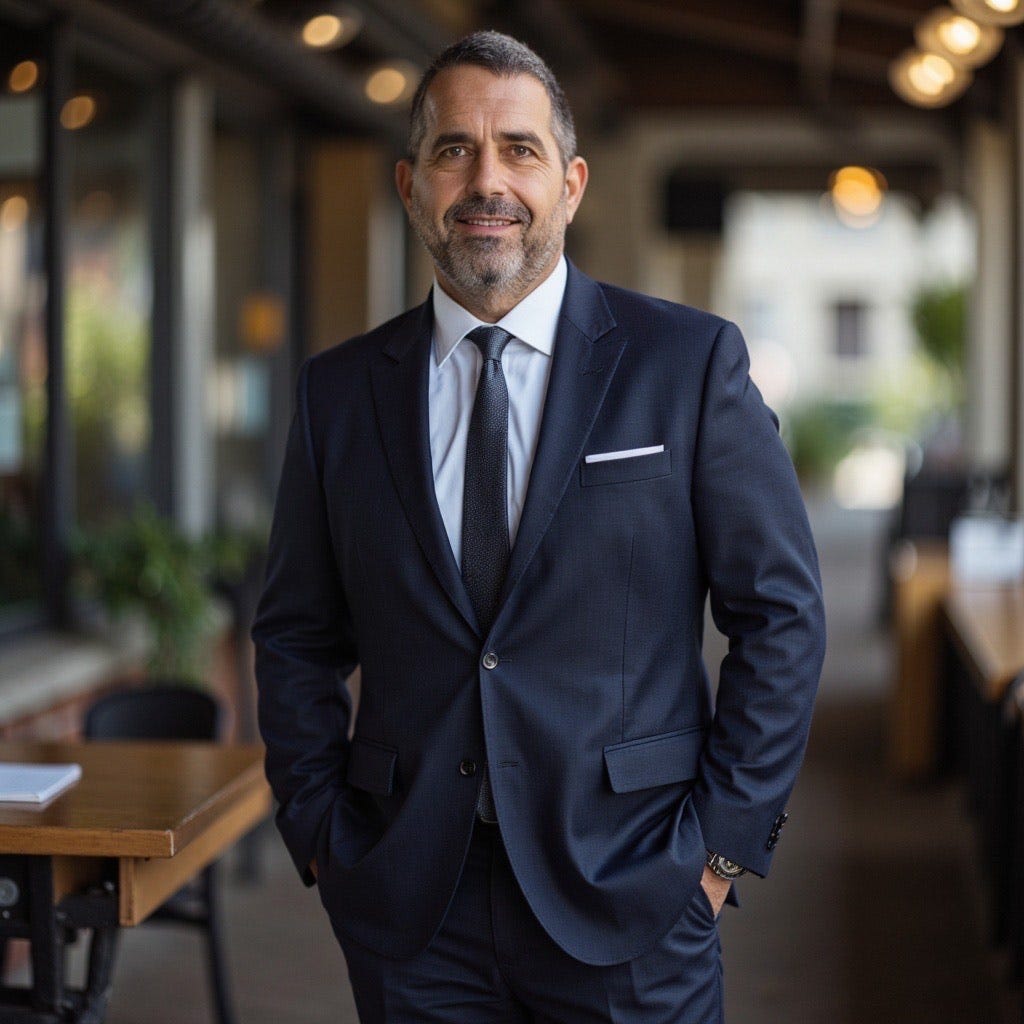

Building Company Culture From the Top Down: Steven Spiro of Tracer and TilePix On How the Personal Example of Exceptional Leaders Shapes Companies That Thrive
An Interview With Jim Hamel
“In a moment where we could have hoarded our resources to survive, we chose to spend them to serve.”
As a part of this series, we had the pleasure to interview Steven Spiro.
With over 30 years of leadership in the technology and consumer product sectors, CEO Steven Spiro is a prolific innovator and the driving force behind Tracer and its wall decor brand TilePix. Since founding the company in 2002, Steven has utilized his expertise in sales, marketing, and product development to scale Tracer to more than $200 million in lifetime sales. A master of both the laboratory and the boardroom, Steven holds 72 issued US utility patents. His career is defined by his ability to bridge complex engineering with commercial viability, a skill he honed through several key milestones. The first is his strategic innovation. He spent four years developing video technology for a computer-assisted learning venture, collaborating directly with Eastman Kodak to advance video graphics in photographic lenticular technology. The second is from a healthcare technology lens. Steven spent seven years at Marquette Medical Systems (now GE), leading sales and product development for computer-based medical diagnostic systems. The third is in market leadership. He built and trained elite sales forces to bring diverse hardware, software, and consumer products to the global marketplace. Steven’s success is rooted in his unique ability to translate high-level technical concepts into market-ready solutions through exceptional communication and one-to-one relationship building.
None of us are able to achieve success without some help along the way. Is there a particular person who you are grateful towards who helped get you to where you are? Can you share a story?
Yes, my father was very instrumental in teaching me about entrepreneurship and more importantly, about morals and doing the right thing. At eighteen, my entire future was refrigerated. I had spent a sweltering summer pouring every cent into an ice cream truck, building an inventory meant to fund my way to college. Then came the storm. The power flickered and died. Overnight, the compressors fell silent, and the summer heat did the rest. When I opened the truck doors the next morning, I didn’t find inventory; I found a sticky, colorful graveyard of everything I had worked for. My profits had literally liquified. Defeated, I watched my father climb into the driver’s seat. He offered to drive the empty truck back to the depot to end the lease. I sat in the house, mourning the summer and the education I thought I’d lost. Hours later, a sound cut through the silence: the bells. I ran to the window. There was the truck, pulling into the driveway. But it wasn’t empty. My father — a man with almost nothing to his name — had spent his last dollars to fill those freezers higher than I ever could. He didn’t just replace the ice cream; he restored my hope. That day, I learned that while we may work alone, we only survive because of each other.
Let’s now shift to the main focus of our interview. When you think about your company’s culture today, what’s one word you’d use to describe it and why? Please explain with stories or examples if you can.
Over our 22-year history, Tracer has navigated many challenges through a combination of hard work and persistence. A clear example of this occurred during the launch of our wall decor brand, TilePix, at the height of the COVID-19 pandemic. After shipping our initial products to Walgreens, we discovered a technical issue: the magnetic adhesive was failing, causing tiles to fall in our testing environment. Despite the significant financial impact, I made the decision to issue a voluntary recall of approximately 500,000 units. It was the necessary step to maintain our commitment to the customer. What followed was a concentrated effort in both design and labor: Engineering: Our R&D team worked for 45 days to develop and test a completely new adhesive formulation. Operations: Our staff at the Louisville facility manually opened every recalled box, replaced the faulty wallpads, and repacked the units for distribution. This experience defines what we mean by tenacity. When we encounter an obstacle, we don’t walk away; we do the work required to go through it or around it.
Many companies define values, but fewer truly live them. How do you personally hold yourself accountable to your organization’s values in day-to-day decisions, especially when it would be easier not to? Can you share an example?
At the start of the pandemic, our business, like many others, was staring into an uncertain void. But while we were worried about our future, we saw a more immediate crisis: a desperate shortage of PPE. We realized we had the raw materials (clear polyester) and the engineering talent to help. We didn’t wait for a contract or a grant. We simply moved: Engineering: We designed a functional face shield in days. Production: We spun up a custom mold and sourced components like rubber bands. Distribution: We didn’t sell them; we gave them away. What started as a local effort for the NYPD and New York care facilities grew into a nationwide donation of nearly 100,000 shields. True values aren’t about what you do when things are going well — they are the decisions you make when you have every excuse to look the other way.
Many companies define values, but fewer truly live them. How do you personally hold yourself accountable to your organization’s values in day-to-day decisions, especially when it would be easier not to? Can you share an example?
Our turning point came in 2014 when we made a conscious decision to pivot. We were deeply entrenched in the specialized business of lenticular printing. While we were arguably the best in the world, it was a tiny market that yielded a stagnant $4 million in annual revenue with no repeat business. We were constantly seeking a new crop of customers. We adopted the slogan “Innovate or Die.” Our team collectively decided we needed new products that met three criteria: A) they had to provide repetitive revenue, B) we had to be able to protect them with a patent, and C) they had to be very sellable. That led us to create inventive, novel products for the wall decor market. The cultural turning point was to constantly create and innovate together. Coming up with new innovations is now part of our DNA and the driving force behind our growth.
Can you share a time when your company’s culture was tested, such as during a crisis, conflict, or major change, and how your leadership approach affected the outcome?
Culture is tested most during explosive growth. In 2016, our pivot to wall decor quadrupled our revenue in a single year, demanding double the output from our staff almost overnight. To manage this shift, I moved my “office” to the production floor. I spent that year building automation, setting up conveyor belts, and training alongside the team. I’ve always preferred the carrot to the stick; we prioritized praise and financial incentives, eventually ensuring every employee had equity in the company. Today, that hands-on approach has built a lean, elite workforce. We average $1.2 million in revenue per employee — a metric that proves when you give a team a stake in the outcome, they don’t just work for you; they build with you.
Here is the main question of our interview. Based on your experience and success, what are the “Five Things Leaders Can Do To Build and Shape Company Culture From The Top Down?” Please share a story or an example for each.
To shape a culture from the top down, you have to move beyond slogans and into action. Here are the five pillars we use to lead at Tracer:
1. Visible Presence (Not Micromanagement)
Leadership requires proximity. I make it a point to be involved in everything from technical processes to small social gatherings. The goal isn’t to control every move, but to be accessible. I’ve found that the more time I spend in the trenches with my staff, the more cohesive and effective we become as a unit.
2. Systems-First Scalability
Systems run the company; people run the systems. We rely on Standard Operating Procedures (SOPs) for almost everything we do. By codifying what works into a repeatable system, we allow our team to hit their marks consistently. Once you “nail it,” the system ensures you can do it a thousand times over.
3. Radical Kindness
Kindness is the glue of our culture. Treating every individual with dignity isn’t just a “soft” value, it’s a motivator. When a workplace feels like a family, people don’t just show up for a paycheck; they show up to support one another. That bond is what carries us through high-pressure seasons.
4. Bold Conviction
Being bold means having the courage to pivot on a dime. As a smaller company, we “dive in” to challenge massive conglomerates by trusting our inventions and our gut. It requires having the conviction to make a hard decision and the grit to see it through, even when the path forward isn’t perfectly clear.
5. Applied Invention
We don’t innovate for the sake of novelty; we innovate to solve problems. This mindset has led to over 75 U.S. utility patents. For example… “The Snap Moment.” When our “Snap to Canvas” replaced a competitor’s adhesive system that had a high failure rate, I found inspiration while repairing my son’s screen door. I redesigned the product to “snap” together mechanically, similar to how a screen snaps into a door frame. That pivot led to a rollout in 8,500 stores and grew our revenue from $4 million to $14 million in a single year.
What advice would you give to leaders who want to build thriving cultures but aren’t sure where to start?
It’s really important to lead by example, and a major component of that is making sure the workplace is fun. Having fun isn’t always quantifiable, but it’s essential. We have a culture of joking, cooking, and camaraderie. We make it concrete with specific examples: we’ve had big bowling parties, yoga, and meditation sessions at the office where the whole company sits outside. This shows our team that it’s not all about deadlines and spreadsheets. When you bring that element of fun in, people want to be there and they enjoy being with their coworkers. That’s what truly helps build a thriving culture.
How do you make sure your values and expectations are actually reflected by managers and team leaders throughout the organization? Please share examples if you can.
We ensure our values are reflected by managers by keeping our organization as flat as possible. While an organization chart exists, there is no one in the company who wouldn’t feel comfortable coming to any manager, including myself, with a problem. It is important to keep that open line of communication. The culture of care is personal and extends beyond work tasks. For example, in one of our management meetings, the focus shifted to an older employee who was limping due to back problems. Everyone was concerned, and we ended up getting him a good ergonomic chair. Seeing my managers focus on the well-being of our staff, not just me, makes me feel that our values are being passed through and reflected on a daily basis.
You are a person of great influence. If you could start a movement that would bring the most amount of good to the most amount of people, what would that be? You never know what your idea can trigger. 🙂
Living in New York City, it breaks my heart to see the number of homeless people. I believe we need a different approach to how we treat the underserved members of our community. I would start a movement to encourage a greater commitment to community involvement and outreach. My call to action would be for all of us to dedicate a set percentage of our time, whether you’re successful or just starting out, to helping others. This could be anything from volunteering at a soup kitchen to being a Big Brother or Big Sister. These touchpoints can really make a difference in someone’s life, and a dedicated commitment of time would bring the most good to the most amount of people.
Thank you for sharing these insights!
About The Interviewer: A dynamic and seasoned executive, Jim Hamel assumed leadership of Swanson Health Products, a global vitamin and supplement company in November 2021. As CEO, he has led the company to achieve double digit revenue growth internationally in his first fiscal year and has overseen expansion into 170+ international markets totaling over US $80M in revenue. Under Jim’s leadership, Swanson Health Products has continued its commitment to industry-leading service, quality and excellence with award-winning customer care and ongoing UL, NSF and Halal certification for achieving Good Manufacturing Practices and standards. Earlier in his executive career, Jim was the CFO with multi-national consumer products companies such as Diageo and Newell Rubbermaid and with other industry leading companies in ecommerce, agriculture, mining and explosives. Throughout his career he has been building his expertise in finance, international business, commercial operations, and risk management. Jim earned his Bachelor of Science in Accounting from North Dakota State University in 1989 and is a Certified Public Accountant (CPA). He also holds Six Sigma certifications and brings strong global finance acumen — with proficiency in Spanish — and board- and investor-level relationship building to every role he fulfills. Jim thrives on transformational leadership — with deep financial expertise, a global outlook, and a passion for wellness — to steer Swanson Health through its next phase of growth and innovation.
Building Company Culture From the Top Down: Steven Spiro of Tracer and TilePix On How the Personal… was originally published in Authority Magazine on Medium, where people are continuing the conversation by highlighting and responding to this story.