

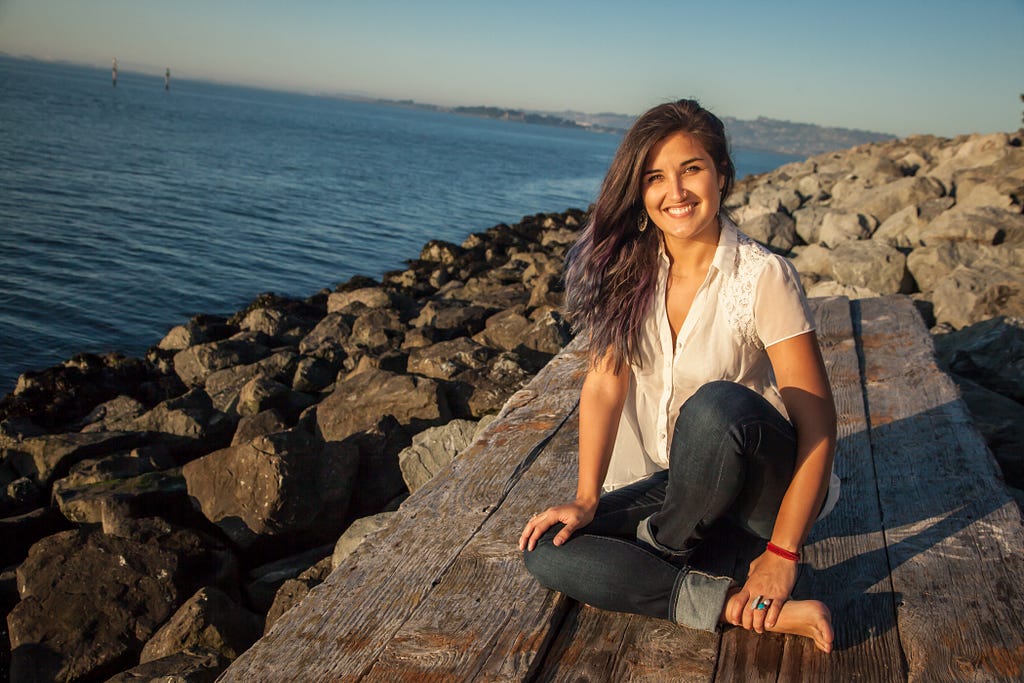
Celebrating Diversity: Eri Guajardo Johnson-Oak Of Ven Johnson Law On How To Build Inclusive Communities
Success is measured when folks of marginalized identities hold positions of power. A major indication of success will be when inclusion is no longer framed as an act of kindness, but as the standard.
As a part of this series, we had the pleasure to interview Eri Guajardo Johnson-Oak.
Eri Guajardo Johnson (she,they) is a queer, bi-racial birth worker who specializes in supporting survivors of sexual violence and teaching care providers within the intersections of healing & reproductive care. For over 17 years, Eri has been dedicated to supporting survivors of sexual assault & marginalized populations. She has studied indigenous Mexican and Indian healing modalities to learn about mind, body, spirit, communal wellness, herbalism, and food as medicine. They’ve taught and organized countless classes and community events centered around the healing and empowerment of those most marginalized in our society. They are the founder of Birth Bruja- an online educational platform devoted to decolonial approaches to healing and reproductive care- where they teach and host other guest facilitators. Outside of Birth Bruja, you can find Eri teaching & speaking on panels via local community organizations, non-profits, academia & more.
Thank you so much for joining us in this interview series. Before we dive into our discussion about celebrating diversity, our readers would love to “get to know you” a bit better. Can you share with us the backstory about what brought you to your specific career path?
Since I was a young child, I’ve felt a deep pull to be in service to my community. Growing up with parents who worked within the legal system, I was surrounded by conversations about accountability, advocacy and the power systems hold to either protect or cause harm.
That foundation led me into the rape crisis and reproductive justice movements, where I engaged in activism, community organizing and public education. It was then that I began to understand the intersection between healing and justice in a much deeper way. I came to see that justice is not only about legal outcomes, but about whether the humanity of survivors and victims is truly recognized and honored, both in our communities and within our systems.
That understanding continues to shape my role today as Director of Community Engagement and Strategic Initiatives at Ven Johnson Law. My work is centered on building relationships with legal and nonprofit organizations that support some of the most marginalized members of our society, while also helping to ensure that our work remains grounded in the real and evolving needs of the communities we serve.
Can you share an interesting or hopeful story where spending time with someone who did not look like you or who was different from you taught you something that has been useful to you?
In my early twenties, I experienced, for the first time, what it felt like to exist in a space that was not centered around whiteness or heterocentric norms, even as a queer, mixed-race Latinx person. I was working at a rape crisis center that was predominantly staffed by queer and lesbian women of color.
That experience shifted something in me. It was the first time I understood what it meant to move through the world outside of the Eurocentric male gaze. I began to choose beauty and comfort in ways that felt freeing rather than performative. My understanding of beauty expanded, but more importantly, so did my understanding of belonging, embodiment and liberation.
It changed how I saw myself and how I understood the environments we create for one another.
You are a successful leader. Which three character traits do you think were most instrumental to your success? Can you please share a story or example for each?
Integrity, humility, and accountability continue to guide how I move through both my work and my relationships.
Integrity, for me, is about doing what is right, even when it is difficult or unseen.
Humility is the willingness to recognize both our strengths and our limitations, and to remain open to learning and shifting.
Accountability is the practice of owning our actions and their impact, without deflection, and committing to growth when we fall short.
These are not static traits, but ongoing practices.
Ok, thank you for that. Let’s now jump to the primary focus of our interview. Can you share a personal story that highlights the impact of diversity and inclusivity in your life or career?
Before becoming a parent, I facilitated a support group for survivors with disabilities at a community-based rape crisis center that prioritized accessibility. Over the course of eight weeks, participants shared how their experiences of violence were shaped not only by what happened to them, but by the barriers they faced in systems that were not built with them in mind.
That experience stayed with me.
Now, as a parent of a child with a disability, those lessons have become deeply personal. I’ve come to see in very real ways how profoundly ableist our world can be, from the absence of accessible changing spaces, to public health practices that overlook medically vulnerable people, to the limited pathways for adults with disabilities to find meaningful work and community.
At the same time, inclusivity has been the thing that grounds me. It has shaped how I show up in my work, how I move through the world and how I parent. Inclusive spaces have given me language, connection and a sense of purpose. They have transformed what could feel like isolation into something rooted in community and care.
Inclusivity has not only informed my work, but it has also made it possible for me to remain in it with clarity and commitment.
How do you approach and manage the challenges that arise when working towards creating more inclusive communities?
I try to be intentional about where I invest my time, energy and resources. I choose to be in relationship with people and spaces that are already embodying the values I believe in.
That shared foundation allows for honesty when challenges arise. It creates room to move through discomfort or conflict with intention, rather than avoidance, and to grow through those moments rather than fracture.
Over time, that process builds trust and strengthens our ability to show up with integrity, humility, and accountability.
What innovative strategies or initiatives have you implemented or observed that effectively promote the importance of diversity and inclusivity?
A practice of inclusivity is a practice of uplifting marginalized individuals and communities. The beauty is that by doing so, we automatically uplift all.
Whenever possible, I choose venues that are wheelchair accessible, provide diaper-changing stations, and are owned by women, people of color, or members of the LGBTQ+ community.
When curating a menu, I select dishes and beverages that are accessible to those with common allergies and religious dietary restrictions.
When inviting facilitators to lead a space, I prioritize individuals from marginalized backgrounds, recognizing that lived experience brings valuable nuance and depth to their ability to cultivate mindful and inclusive environments.
In creating media, such as invitations, social media graphics or presentation slides, I use fonts and color palettes that are accessible for people with visual impairments, and universal imagery that allows participants the uninterrupted space to see themselves and their own lived experiences reflected in the work.
In your opinion, what are the key elements that make a community truly inclusive, and how can these be fostered on a larger scale?
Physical spaces that are wheelchair accessible, bathrooms with diaper changing stations, educational material that are understandable and accessible to a large swath of people.
Communities that center the most vulnerable are those that enable all intersections of identity and life experience to exist within the space.

Here is the main question of our interview. Based on your experience and research, can you please share “5 Ways We Can Build Inclusive Communities”? If you can, please share a story or an example for each.
1. Start with the welcome
Notice who is being included and excluded by the language you use and the images you feature on website, promotional materials, etc. Notice who is being included and excluded through the channels of promotion.
2. Focus on the logistics of accessibility
Logistics of the venue, the medium that is used for sharing information. ASL interpretation or accessibility limitations of videos without closed captions. When considering who to invite into positions of leadership, facilitation and/or as a featured guest, consider their physical and cultural embodiment. For example, someone who grew up and works in a religious community will have a different cultural embodiment than someone who grew up and works in a diverse environment.
3. Be intentional on how you’re spending your resources and money
Uplifting diversity and inclusivity are nothing without an investment of resources. Be intentional on how you spend your money. The most well-known people and venues are those who are most connected to privilege. Do the leg work to connect to the countless brilliant and skillful folks of marginalized identities who provide services and own event spaces.
4. Be Aware of What & Who You Consume
Pay attention to who and what you consume through media. Whose culture and lived experiences are being centered through your social media, audio books, news outlets, etc? Who do you center as “experts” when you seek to invest time and resources for information? Who do you automatically disregard as irrelevant and amateur?
5. Seek to connect with others who are doing the work
Building inclusive and diverse spaces is transformational work. It can be exhausting! It is crucial to connect with others who embody similar values to maintain inspiration, motivation, and resourcefulness. Shifting societal cultural is not about “checking boxes” or being perfect. It is about embodying these values as best as we are able.
How do you measure the impact and success of diversity and inclusion efforts, and what changes have you seen as a result of these initiatives?
Success is measured when folks of marginalized identities hold positions of power. A major indication of success will be when inclusion is no longer framed as an act of kindness, but as the standard.
You are a person of great influence. If you could start a movement that would bring the most amount of good to the most amount of people, what would that be? You never know what your idea can trigger.
The reproductive justice movement already offers a powerful framework. By centering women of color, particularly Black women, it creates a model of care that is rooted in bodily autonomy, community, and collective well-being.
It reminds us that healing and justice must be interconnected.
How can our readers further follow you online?
Outside of my work at Ven Johnson Law, I am the founder of Birth Bruja, an online educational platform devoted to intersectional and decolonial approaches to reproductive care.
While much of my work happens offline, Birth Bruja is a space where I share and collaborate with others engaged in this work. Folks can follow along on Instagram and Facebook at @BirthBruja.
Thank you for sharing these insights!
Celebrating Diversity: Eri Guajardo Johnson-Oak Of Ven Johnson Law On How To Build Inclusive… was originally published in Authority Magazine on Medium, where people are continuing the conversation by highlighting and responding to this story.