



Edit, edit, edit. Retired author Lynn Gardner shared that little piece of advice when I was a few books in, and I quickly realized how important that single sentiment truly is. Every book deserves to shine, and it’s worth the effort with every project to put in the effort to make it the best you possibly can.
Books have the power to shape, influence, and change our lives. Why is that so? What goes into a book that can shape lives? To address this we are interviewing people who can share a story about a book that changed their life, and why. As a part of our series, I had the pleasure of interviewing Traci Hunter Abramson.
Traci Hunter Abramson, a former Central Intelligence Agency officer, worked for the CIA for six years before leaving to raise her family and credits the agency with providing her with a wealth of ideas for her thriller novels (and the skills needed to navigate her children’s teenage years.)
Traci has written more than 45 bestselling novels and has received multiple awards, including the 2025 Silver Falchion Judges’ Top Pick — Thriller, the 2024 Whitney Award — Outstanding Achievement Winner, 2022 Rone award finalist, 2021 Swoony Award for Best Mystery/Suspense Romance, and is a ten-time Whitney Award winner, including Best Novel of the Year in 2017 and 2019.
Recently retired from coaching high school swimming for twenty-six years, she enjoys traveling and spending her time as a popular writing instructor, keynote speaker, panelist, and attendee at conferences, including Bouchercon, Killer Nashville, Thrillerfest, and ALA.
Thank you so much for doing this with us! Before we dig in, our readers would like to get to know you a bit more. Can you tell us a bit about your “backstory” and how you grew up?
I grew up in Arizona where my dad was a banker and my mom was a model/television host. Summers were spent at the pool, mostly at swim team practice and exploring the woods near the summer cabin my father built. My grandparents lived on a small farm, where I learned to ride horses and work in the orchards and the gardens. My parents stretched their budget to give me and my sister the chance to belong to the country club until they ultimately divorced when I was a young teenager.
During those early years, I took lessons in everything from ice skating to gymnastics, and during the summer before my senior year in high school, I traveled to Caracas, Venezuela as an exchange student.
And while at times it felt like I was living a life of privilege in our middle-class existence, I’ve also spent my college years as the poor student who struggled to have enough to buy groceries while working to pay for books, rent, and tuition. Yet, I look back on the ups and downs of my childhood, and I’m grateful for each one. Every victory and every challenge helped lay the foundation for me to create stories and characters that have filled my fictional worlds.
Let’s talk about what you are doing now, and how you achieved the success that you currently enjoy. Can you tell our readers a bit about the work you are doing?
I’ve been a full-time novelist for well over a decade now and published for twice that. I think a lot of my successes have come from keeping a regular schedule to write and surrounding myself with great people. My editor, the graphic designers, the marketing teams, and the vast number of people who work behind the scenes in the publishing industry contribute so much to getting each book into the world. I know that their efforts are every bit as important to my successes as to whatever story I create on the page.
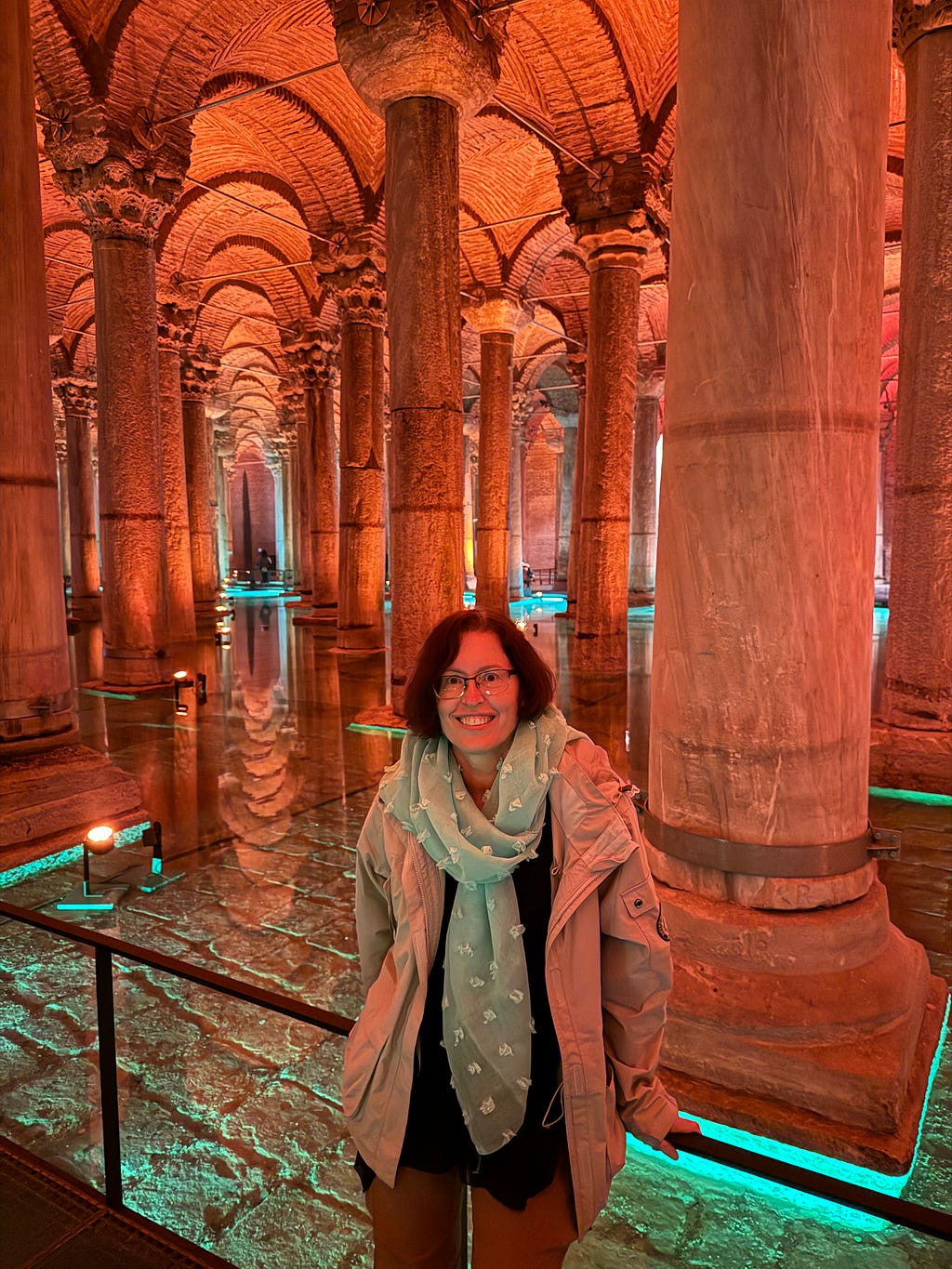
I also love to use my life experiences as background for my novels. One of the settings in Victim #8 is Istanbul, which is a city I fell in love with when I visited in 2024. I was even lucky enough to get a great photo in the Basilica Cistern, which became the cover photo for the book.
You are a successful leader. Which three character traits do you think were most instrumental to your success? Can you please share a story or example for each?
Persistence, creativity, and gratitude.
Persistence: My first book took seven years to write. It would have been so easy to give up and turn to different hobbies and interests, but the drive to write remained with me. So many people hope to write a novel one day. Only those who persist will succeed. And when it comes to leadership, it’s natural to want to emulate those who strive to work hard themselves and overcome obstacles.
Creativity: Obviously, to write fiction, a certain level of creativity is needed. For me, I blame my dad for helping me develop this particular trait. My sister and I had the ridiculously early bedtime of 7pm throughout elementary school, but we knew better than to disobey our dad. So what else could I do but entertain myself by creating fictional stories in my head? These early exercises taught me to think outside the box, not only in my writing but in solving all manner of problems.
Gratitude: Everyone wants to feel appreciated. When we recognize those who help us in the many aspects of our lives, the support of those friends, family, and supporters grows stronger. I recently had several opportunities to chat on the phone with some aspiring authors. All of them were so appreciative of me taking time to help them, but for me, it feels like paying forward the kindness others have bestowed upon me. From Bookstagrammers who post about my books to fellow authors who sacrifice their time to write endorsements to my editor and the others at my publishing houses, everyone who helps me along my journey deserves to be recognized.
What’s the WHY behind the work that you do? Please share a story about this if you can.
I’ve always been a storyteller and an avid reader, but what really started me down the path to publication was when I was working with some young teenagers in my church youth group. They were looking for books to read that had storylines that went beyond what was then available in the YA market, but they didn’t want any of the on-page intimacy or graphic violence or language that is more prevalent in adult fiction. When I realized that a large gap existed in the market, I decided to pursue publication in the hope of filling it.
None of us are able to achieve success without some help along the way. Is there a particular person who you are grateful towards who helped get you to where you are? Can you share a story about that?
When I first started writing, I was a complete closet writer. I didn’t tell anyone that I spent my precious free time creating fictional worlds. When I finished writing my first novel, I shared it with my sister-in-law, Rebecca. Over the next many years, she helped me learn the craft of writing fiction. She selflessly shared her time and editing talents to help me become the writer I am today.
Awesome! Let’s now jump to the primary focus of our interview. I’m an author and I believe that books have the power to change lives. Can you please tell our readers about “The Book That Changed Your Life”? Can you share a story about how it impacted you?
There are so many books that have influenced me, especially when I was growing up, but the one that always comes to mind is Up from Slavery by Booker T. Washington. Throughout the pages of his autobiography, Washington exhibits his strong commitment to the importance of education. He also advocates for everyone to make themselves valuable, contributing members of society. And in so doing, he recognizes that people at all levels of society truly matter and should be treated with respect.
What was the moment or series of events that made you decide that you wanted to take a specific course of action based on the inspiration from the book? Can you share a story about that?
Books have a tendency of becoming part of us, even without us always recognizing it. The one book that I have been largely inspired by is Standing for Something by Gordon B. Hinckley. Within the pages, he describes various virtues that are often forgotten, one of which he calls the “gospel of work.” He advocates for a strong work ethic and the importance of keeping focus on balancing that with other virtues, such as marriage, family, optimism, and civility. These hidden or what Hinckley would call neglected virtues inspire me in my day-to-day life to work hard while also striving for balance.
Can you articulate why you think books in particular have the power to create movements, revolutions, and true change?
Well-written books have the ability to make us connect with characters while also seeing our reflection in them. They can inspire us to be the hero, to avoid the behaviors that are less than admirable, and also allow us to find empathy for others. Understanding what motivates a character can translate into us seeking for why people act the way they do. This gives us the ability to effectively create change, whether it is through a revolution or learning to give grace when faced with misunderstandings.
A book has many aspects, of course. For example, you have the writing style, the narrative tense, the topic, the genre, the design, the cover, the size, etc. In your opinion, what are the main, essential ingredients needed to create a book that can change lives?
We always want a compelling plot, but the aspect that can really change lives is when readers really connect with the characters. In order to care about the plot, we have to care about the people. And if we care about the people, we are willing to make changes, even when they might be uncomfortable.
What are your “5 Things I Wish Someone Told Me Before I Started My Career” and why?
- Edit, edit, edit. Retired author Lynn Gardner shared that little piece of advice when I was a few books in, and I quickly realized how important that single sentiment truly is. Every book deserves to shine, and it’s worth the effort with every project to put in the effort to make it the best you possibly can.
- Trust your instincts. Often I seek advice on how to improve my writing during the early draft stage, but more than once, I’ve questioned the wisdom of following that advice. What I have come to learn is that each author has a unique voice, and sometimes, we have to trust our voice rather than make changes that others suggest. Many times a problem does exist that needs to be addressed, but authors need to find the solution that works for them so they can remain true to themselves.
- Don’t compare. Whether it’s a bestseller list or an awards program, authors will have many situations that pit them up against other writers. The first time I attended an awards gala in which I was a finalist, I took my cousin as my plus one. When my category’s winner was being announced, I twisted in my chair to look at the table next to me where several other finalists were seated. I was certain one of them was about to win. I was right. Stephanie Black won best mystery/suspense that night. It wasn’t until after the gala ended that my cousin pulled me aside laughing. She noted that I clearly had no awareness that I too had the potential to win. My shoes were kicked off under the table, I didn’t experience any nerves about possibly being the winner, and I certainly hadn’t prepared an acceptance speech. But I was ready to be happy for whoever won that night. I have since won that same award several times, but I always try to go into every situation such as that first one prepared to be happy for whoever wins and to never compare myself to the talented friends I’ve come to admire.
- Write the story you want to read. A lot of authors will chase trends when trying to decide what to write next, but the stories we’re excited about are the ones that really touch our readers’ hearts. One example comes from the days following the Virginia Tech shooting. I remember hearing an account of one of the survivors, and to deal with the trauma of having such a tragedy so close to home, I started writing. What had been intended to be simply an escape turned into a full novel that featured someone who was willing to fight to overcome a past trauma and push to create her best life.
- Finally, enjoy the journey. Writers begin books because they have a story to tell, but the best part of writing is the people you meet along the way. So many of my closest friends are other authors, influences, and even readers who have supported me on my journey.
The world, of course, needs progress in many areas. What movement do you hope someone (or you!) starts next? Can you explain why that is so important?
I do have a lot of areas I’d love to see positive change. Sadly, the list is long for this, but I have seen some amazing efforts to try to make the world a better place like Jason Wright’s Kindness Cards movement (giving gift cards to the homeless.) For me, I’d love to see progress on helping people remember what freedom and tolerance really mean. Sometimes we forget that freedom isn’t making others believe as we do, but rather having respect for all even when we don’t see eye to eye.
How can our readers further follow your work online?
I can be found through my website at traciabramson.com. I’m also on Instagram and Threads (@traciabramson) and Facebook (@tracihabramson and the Facebook group Traci’s Friends.)
Thank you so much for taking the time to share with us and our readers. We know that it will make a tremendous difference and impact thousands of lives. We are excited to connect further and we wish you so much joy in your next success.
Thank you so much!
Former CIA Officer Traci Hunter Abramson On The Book That Changed Her Life was originally published in Authority Magazine on Medium, where people are continuing the conversation by highlighting and responding to this story.