

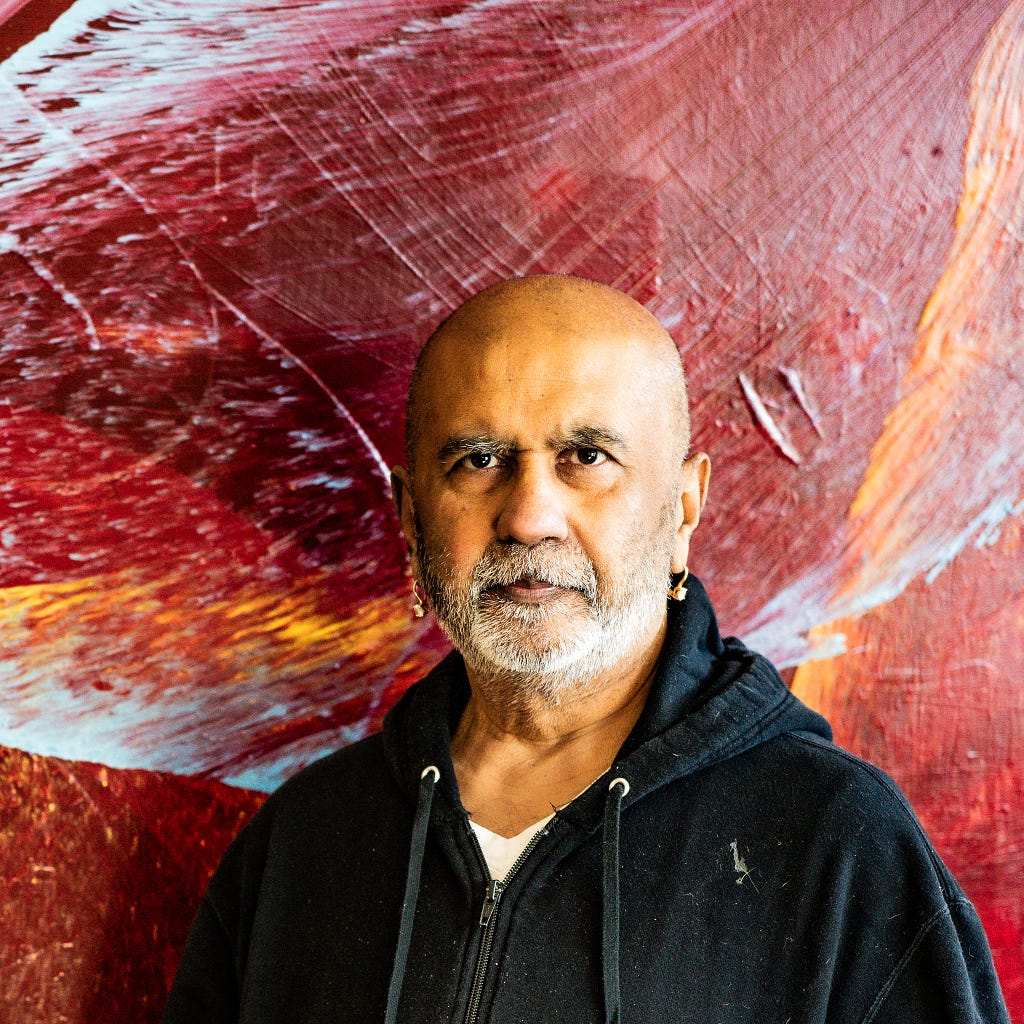
Mathematics, building companies and painting are three ways into the same question: what is abstraction, and why does it move us?
As a part of this series, we had the pleasure to interview Ritu Raj.
Ritu Raj is an abstract painter, author and entrepreneur based in Phoenix, Arizona, where his signature technique, Organic Movement, lets thread take the place of the brush and makes gravity a collaborator. He is the creator of ArtGraph, a language for abstract art, and the author of The Shape of Seeing and The Unalgorithmic Self. His companies include Avasta, SideCar, Wag Hotels and Diamond Foundry, and his paintings are represented by Jarrow & Goodman in Los Angeles.
Thank you so much for joining us in this interview series! Can you tell us a story about what brought you to this specific career path?
I grew up inside art without ever studying it. My father, K.B. Goel, was an art critic in New Delhi, and the painters he wrote about, Souza, Raza, Husain and Swaminathan, came to our home and talked for hours about form and spirit. My mother, a professor of English literature, lived by the rhythm of language. If my father taught me how to see, she taught me how to listen.
I studied mathematics, and for three decades I built companies, among them Avasta, SideCar, Wag Hotels and Diamond Foundry. Each began with a problem of my own I refused to accept. In the 2020 lockdown, a photographer friend suggested I paint. I ordered four-by-four-foot canvases and acrylics and taught myself by experimenting. I have painted almost every day since.
I don’t think of it as a change of path. Mathematics, building companies and painting are three ways into the same question: what is abstraction, and why does it move us?
Can you share the most interesting story that happened to you since you began leading your company or organization?
It began with a piece of cotton string from the kitchen drawer. In 2020, I meant only to pull a straight line across a canvas. As I tensioned it, the string slipped from my hand and fell onto the canvas. When I lifted it away, it left behind a trace that was organic, unplanned, alive.
That small accident became my Organic Movement paintings, where thread takes the place of the brush and gravity becomes a collaborator. The string trembles, twists and resists prediction. I can guide it, but I cannot command it. It taught me that control is not mastery, but conversation. That idea now runs through everything I make, including two books.
It has been said that our mistakes can be our greatest teachers. Can you share a story about the funniest mistake you made when you were first starting? Can you tell us what lesson you learned from that?
When Medium launched, I joined and posted my first articles. I wrote the way I spoke, in an English that grew up in Delhi, and I didn’t proofread much. My first few pieces came back edited by Ev Williams himself, the founder of Medium and co-founder of Twitter, quietly fixing my spelling and grammar.
I laughed, then I was mortified, then grateful. The lesson stayed with me: let good editors in. Your ideas are yours, but a second pair of eyes is a gift, not a judgment. I still work with editors on every book.
Can you describe how you or your organization is making a significant social impact?
I grew up watching what art can do for a country. In 1947, months after independence, a group of young painters in Bombay, F.N. Souza, S.H. Raza, M.F. Husain and others, formed the Progressive Artists’ Group. After nearly two centuries of British rule, they threw out the academic realism of the Raj and claimed the freedom to paint “with absolute freedom for content and technique.” My father, the critic K.B. Goel, spent his life writing about them and the artists who followed, and many of them sat at our table. They taught me that a new way of seeing can be a form of social change. I believe abstraction can do that again now, in an age ruled not by an empire but by algorithms.
The Unalgorithmic Self began with a feeling I could not shake: we are becoming a function of algorithms. They are everywhere. The series we binge, the games our children play and we play, the feeds we scroll before we sleep. Each one is designed to carry us through highs and lows, and to know what we will want before we want it. The algorithms are pulling the strings.
With AI we have reached another level. It is no longer only choosing what we see. It is beginning to think for us. And in doing so it quietly takes something we hardly notice we are losing: the chance to work things out for ourselves, to make mistakes, and to learn from them, or not.
I believe the answer to an algorithmic world is abstraction. An algorithm hands you a finished meaning. An abstract painting refuses to. You cannot scroll past it and understand it. It asks you to stand still, look, and complete it yourself, and no two people complete it the same way. That is exactly the muscle the algorithms let waste away.
The trouble is that most people are averse to abstraction. They feel they don’t get it, so they walk away. My work is to turn that aversion into an encounter, and to make abstraction a mainstay of everyday life rather than something for experts. ArtGraph, the language I am building for abstract art, gives anyone words for what a painting does to them: six dimensions read the painting, and three read the encounter between the painting and the person looking at it. The marks it produces are free to share under Creative Commons, because a language only works if it travels. My two books do the same work in prose. The Shape of Seeing teaches slow looking from inside the studio. The Unalgorithmic Self makes the case for why it matters now.
There is an irony in this I enjoy. Algorithms pull our strings. In my studio, I let one go. In 2020 a piece of string slipped from my hand onto a canvas and left a line I could never have planned. That accident is the opposite of an algorithm, and it is where all of this began.
Can you tell us a story about a particular individual who was impacted or helped by your cause?
The person who changed my work most is a painter, not a pupil. Beth Ames Swartz has been making abstract work in Arizona for more than sixty years. She founded the Arizona Artists Breakfast Club and has championed modern art in Phoenix for as long as anyone can remember.
In June 2024 she wrote to me, “Welcome to Arizona,” and offered to help. Jody and I had dinner with her, saw her studio, and a few days later she came to see mine. She was curious about the glow on my paintings and wanted to try it on her own new work. Then she sent me a long email of advice, the kind only a painter with six decades behind her can give. Show your work in series. Ask what you want to say about life. Look back at everything you have made before making more, because something good may already be hiding there. Find your own natural style instead of echoing the great artists you admire. And don’t let a technique become a crutch.
It stopped me. For weeks I hardly painted. I travelled to Spain and stood in front of Picasso, Miró and Gaudí, and saw how much their work says to the world. I came back with a different question: not what to paint next, but what my paintings are saying.
She also told me something I think about every day: take care of your health, so you can paint for a long time. That is what a community of artists does. Beth didn’t just encourage me. She told me the truth, and it made the work better. ArtGraph and the books are, in a way, my answer to her second question.
Are there three things the community/society/politicians can do to help you address the root of the problem you are trying to solve?
- Teach looking, not only art history. Ten quiet minutes with one painting, and the words to describe it, would do more for a child than memorising names and dates. Schools and museums can make slow looking a skill we practise.
- Make human-made work visible. When an image, a song or a piece of writing is generated by a machine, say so. People deserve to know when they are meeting another mind, so they can choose.
- Keep the places where encounters happen alive: local galleries, independent bookstores, studios open to the public. That is where a person first stands in front of a painting and feels something. Support them, and buy from them.
How do you define “Leadership”? Can you explain what you mean or give an example?
Leadership is refusing to accept a problem you can’t stop seeing, and then building the answer in the open so others can join you.
I did not run kennels before Wag Hotels; I had a dog and would not leave him in one. I was not a taxi driver before SideCar; I lived in a city of empty cars circling for parking. And I am not a historian of abstraction. I am a painter who could not find words for what his own paintings do to people, and would not settle for the words that existed. ArtGraph is the result. In each case, leading meant going first, without permission, and making the path visible for the next person.
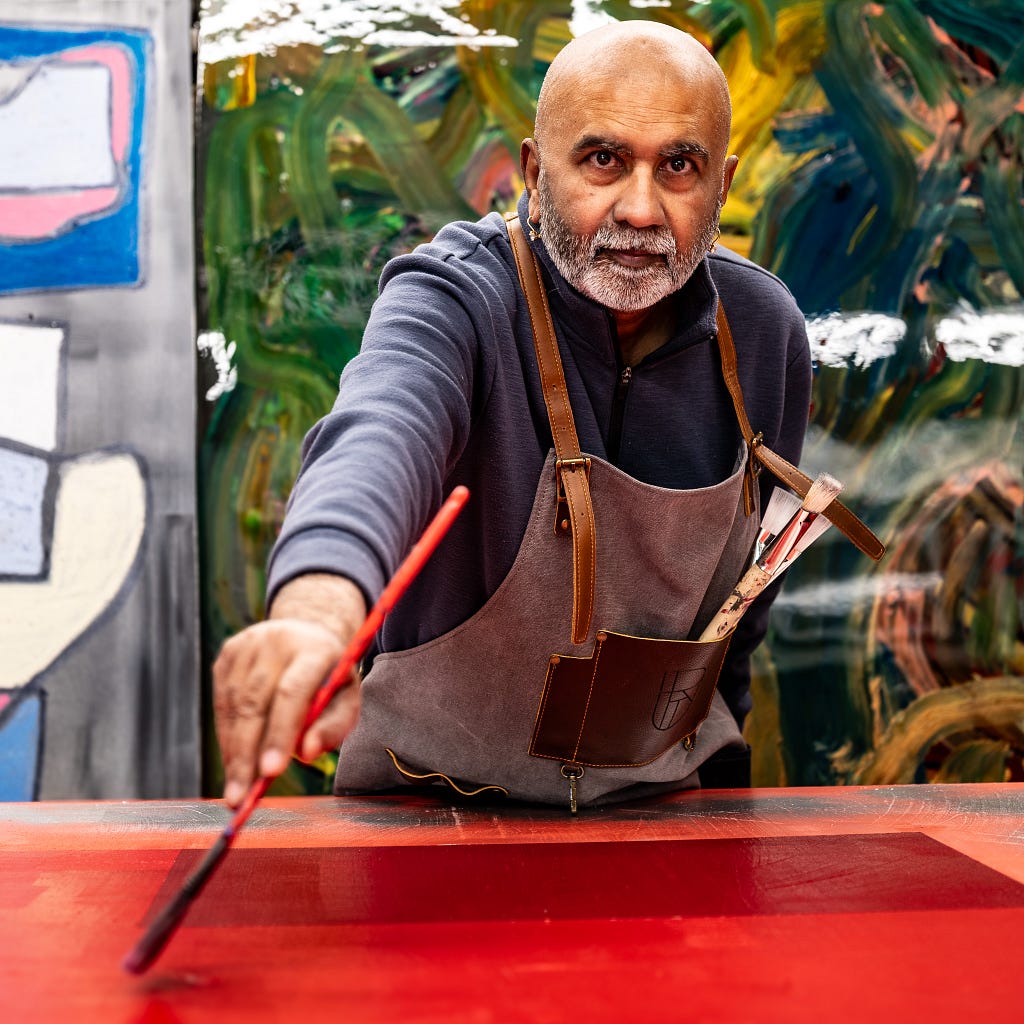
What are your “5 things I wish someone told me when I first started” and why. Please share a story or example for each.
1. Control is not mastery, but conversation. The string taught me this. I spent years in business believing I could plan an outcome. The string slipped from my hand, and left a line I could never have planned. Now I guide, listen and respond, in the studio and with people.
2. You don’t need permission, or a degree. I have no degree in art. I grew up inside it instead. Every company I started was in a field I had never worked in. What you need is a problem you care about enough to stay with.
3. Use the hours away from the work. An abstract painter can’t paint from eight to five; the paint needs time to dry and the eye needs time to rest. In those hours I began writing about abstraction, and two books came out of them.
4. The viewer completes the work. When someone stands before a painting, their gaze completes it. I used to think the painting was finished when I put down the string. Now I know it is finished each time someone looks. That is why ArtGraph reads the encounter as well as the canvas.
5. Every tool needs an author. I wrote The Unalgorithmic Self openly in conversation with an AI model, and I say so in the preface. The tool clarified and challenged. The ideas and the values had to be mine. Use the tools, but remain the author of your own life.
Can you please give us your favorite “Life Lesson Quote”? Can you share how that was relevant to you in your life?
“Every great painting begins where language ends.” My father used to say this.
As a boy I took it as a statement about painting. Now I hear it as a challenge. ArtGraph and both of my books live in that gap between image and word. I am not trying to replace the silence a painting creates. I am trying to give people enough language to stay in it a little longer.
Is there a person in the world, or in the US with whom you would like to have a private breakfast or lunch with, and why? He or she might just see this, especially if we tag them. 🙂
Two people, for very different reasons.
The first is my hero, Jerry Saltz (@jerrysaltz). He won the Pulitzer Prize for Criticism, and as New York magazine’s senior art critic he has spent years arguing, loudly and generously, that art belongs to everyone, not only to insiders. He left art school and found his own way into the art world, which gives me hope. I would want him to know that I am committed to a world where abstract art is part and parcel of contemporary art, not a corner of it that people feel shut out of, and that I will keep working on it. And I would ask him the question I ask myself every day: what would it take for people to stop being afraid of abstraction?
The second is Sam Altman (@sama). No one has done more to bring AI into everyday life, and I am not against that. I would simply love for him to read my book The Unalgorithmic Self: Art, AI, and the Future of Human Thinking, and then talk over breakfast about what should never be automated, even when it can be. The people building these tools are also the people best placed to protect what makes us human.
You are a person of enormous influence. If you could inspire a movement that would bring the most amount of good to the most amount of people, what would that be? You never know what your idea can trigger. 🙂
A movement for slow looking. Once a week, stand in front of one work of art, a painting, a tree, a face, for ten minutes, and then put into words what it did to you. No phone, no captions, no hurry.
We spend our days being predicted by machines. Ten minutes of real attention is how we remember that our lives have an inside. I call my studio practice “Art that listens.” This would be people who listen back.
How can our readers further follow your work online?
Paintings and writing: rituart.com
ArtGraph, the language for abstract art: artgraph.co
Books: The Shape of Seeing and The Unalgorithmic Self, on Amazon at amazon.com/author/ritu.raj
Instagram: @ritu.us · X: @ritu · Medium: Ritu Raj
This was very meaningful, thank you so much. We wish you only continued success in your great work!
Social Impact Heroes: How Ritu Raj Of ArtGraph Is Helping To Change Our World was originally published in Authority Magazine on Medium, where people are continuing the conversation by highlighting and responding to this story.