


The impact I would actually claim isn’t a readership number. It’s that a founder somewhere designs mission protection into her cap table at the first term sheet, rather than discovering at the moment of acquisition that her values had no legal standing. That is the whole game.
As a part of this series, we had the pleasure to interview Laurie Lane-Zucker.
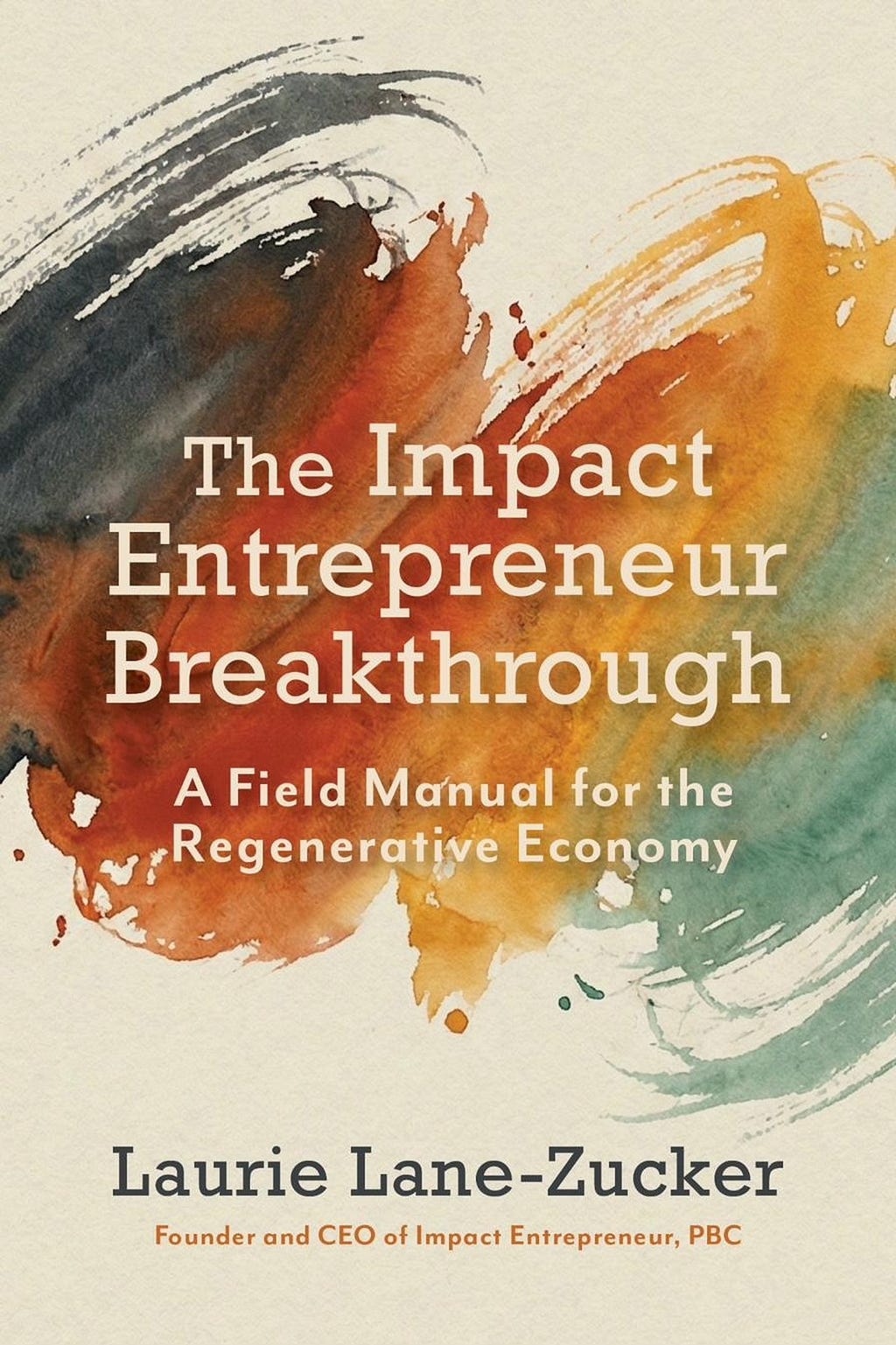
Laurie Lane-Zucker is the founder and CEO of Impact Entrepreneur, PBC, a global multimedia publishing platform serving members in more than two hundred countries, and the author of The Impact Entrepreneur Breakthrough: A Field Manual for the Regenerative Economy (Berrett-Koehler, September 2026). He coined the term “impact entrepreneur” in 2011, cofounded the concept of place-based education, and led The Orion Society for twelve years, collaborating with Wendell Berry, Barry Lopez, and Terry Tempest Williams. He founded one of the earliest Certified B Corps, publishes Impact Entrepreneur Magazine, and lives in Sheffield, Massachusetts.
Thank you so much for joining us in this interview series! Can you tell us a story about what brought you to this specific career path?
I came to economics through literature and journalism, which is a stranger route than it sounds. In the early nineties I became the founding executive director of The Orion Society and Orion Magazine, and for twelve years I had the privilege of editing and publishing writers such as Wendell Berry, Terry Tempest Williams, Barry Lopez, and David James Duncan, who were describing, with more precision and beauty than anyone alive, what industrial extraction was doing to land and to community. We took those writers out of the literary world and into small towns and schools through a program we called The Forgotten Language Tour. Around the same time, we developed and named place-based education, rooting learning in local community and ecology rather than in the abstractions of a textbook.
What I learned in those years is that the diagnosis was never the bottleneck. We were not short of clear description. We were short of structures. You could move a reader to tears about a river on Sunday, and on Monday that same reader would go to work inside an enterprise whose balance sheet treated the river as a free disposal site. The story and the structure were running in opposite directions, and the structure was winning.
So I moved toward the machinery, and built one of the earliest Certified B Corps. That company didn’t survive, and its failure turned out to be the most useful thing I ever built, because it taught me the reverse of the lesson I’d learned at Orion. Structure alone doesn’t hold either. I had built the mechanism and assumed the culture would follow it. It doesn’t. The two have to be built together, each making the other inhabitable. That’s what Impact Entrepreneur was designed to be from the start, and in 2011 I put a name to the identity at the center of it: the impact entrepreneur, someone who doesn’t treat regeneration as a program bolted onto an extractive core but as the logic the enterprise actually runs on. Everything since has been a variation on one question: what has to be built so that the good outcome no longer depends on anyone continuing to feel strongly about it?
Can you share the most interesting story that happened to you since you began leading your company or organization?
The most instructive thing that has happened to me is watching language get away from me. Twice.
When John Elder and I named place-based education in the mid-nineties, we were describing a pedagogy, and a marginal one. Two decades later I began seeing the phrase turn up in finance: place-based investing, used fluently by people who had no idea the term had come out of a conversation about how children learn. The same thing happened with impact entrepreneur, which I coined to describe a particular stance toward the economy. It was aspirational then. By 2018 it was operational, not because the world had changed all that much but because enough people were acting as though it were true, and in doing so were making it so.
I’ve come to treat that as the most reliable evidence that cultural infrastructure is real. A term you still own is a term that hasn’t traveled. The measure of a frame is whether it becomes useful to people who owe you nothing. It’s also a durable lesson in humility about authorship: the ideas that matter are the ones that stop being yours.
Can you share a story about the funniest mistake you made when you were first starting? What lesson did you learn?
I’ll admit up front that my answer isn’t a pratfall, which may itself be the confession.
The mistake I made early on was taking absolutely everything seriously. Every meeting was consequential. Every setback was structural. I carried each of them home. I was working on questions that genuinely are serious: extraction, ecological loss, the machinery of an economy that treats living systems as inputs. And I concluded, wrongly, that seriousness of subject required seriousness of manner at all times.
What that cost me was not productivity. It was relationship. I couldn’t see the lightness other people were bringing into the room, and I certainly couldn’t value it. I read it as insufficient commitment. It took me an embarrassingly long time to understand that lightness is not the opposite of seriousness. It’s often the thing that makes serious work survivable, and it’s almost always how people actually build trust with one another. The colleagues who could make a joke in a hard meeting weren’t less committed. They were better at the part I was worst at.
Kundera called it the unbearable lightness of being, and there is something genuinely unbearable about it when you’re young and certain. You want the weight. The weight feels like proof you care. But a career is a long accumulation of mistakes, and you need somewhere to put them down. Lightness is where you put them down.
So the lesson is one I’d now offer to anyone starting out in this work: the gravity of your subject does not entitle you to humorlessness. It probably obligates you to the opposite. You’ll last longer, and people will want to build things with you.
Can you describe how you or your organization is making a significant social impact?
Impact Entrepreneur is a publishing platform and a network: Impact Entrepreneur Magazine, two webinar and one author’s conversation series, conferences, and a community that now reaches members in more than two hundred countries, supported by forty editorial correspondents around the world. But describing us as media undersells what the work is for.
The impact economy suffers from no shortage of good intentions and a serious shortage of shared language, verified examples, and structural literacy. Founders reinvent the same governance mistakes because nobody told them how the previous generation’s mission protections actually failed. Investors say patient capital and mean a five-year fund. Nearly everyone says impact, and very few can say what would have to be true for the claim to hold.
So what we build is connective tissue. We make the field legible to itself. We publish the practitioners who are actually restructuring ownership and capital rather than decorating extraction; we hold the line between reducing harm and actively healing, which are not the same thing; and we give people the vocabulary and the worked examples to distinguish impact integrity from impact-washing.
The impact I would actually claim isn’t a readership number. It’s that a founder somewhere designs mission protection into her cap table at the first term sheet, rather than discovering at the moment of acquisition that her values had no legal standing. That is the whole game.
Can you tell us a story about a particular individual who was impacted or helped by your cause?
I want to answer this honestly, which means answering it slightly sideways: I usually don’t know who they are.
Here’s what happens instead. I’ll be scrolling through LinkedIn, that strange digital commons where professional identity gets performed and reperformed endlessly, and I’ll stop on a profile. Not because I know the person. Usually I don’t. But because of what’s written in that small piece of prime real estate next to their name, where people announce to the world who they are.
Not their company. Not “Founder” or “CEO” or any of the usual markers. Just: Impact Entrepreneur.
As if it were a profession. A calling. Not what they do. Who they are.
I created that term in 2011, deliberately, with the explicit hope that it might become not just terminology but identity: a way for systems-minded changemakers to recognize themselves and each other, to claim a different stance toward economy and enterprise, to inhabit a role that didn’t yet have a name. Watching it claim its own life still moves me, every time.
So the particular individual is a stranger whose name I’ll never learn, in a country I may never visit, who found language for something they already were and decided to stand behind it publicly. There are tens of thousands of them now, across more than two hundred countries. And the reason I’d rather tell it this way than hand you a tidy success story is that the anonymity is the result. If I could name them all, it would mean the identity had never escaped my network, and an identity that hasn’t escaped its author isn’t an identity. It’s a brand.
Are there three things the community, society, or politicians can do to help you address the root of the problem you are trying to solve?
Three, and they compound.
First, fund prevention and make its return visible. We have built an entire security and social apparatus that pays lavishly for reaction and almost nothing for the conditions that would have prevented the emergency. The economics are not close. Peer-reviewed work puts disaster preparedness at roughly four to seven dollars saved per dollar invested, ecosystem restoration at seven to thirty, and pandemic preparedness, the most striking figure in the literature, at over eleven hundred dollars of economic value per dollar spent. I call this the Prevention Dividend™. The reason it doesn’t drive budgets is not that the evidence is weak. It’s that prevention produces no photograph. No politician cuts a ribbon in front of the pandemic that didn’t happen. Requiring that ratio to appear as a line in any major spending decision would change more than most legislation does.
Second, make mission-protecting structures ordinary rather than exotic. Benefit corporation statutes, purpose trusts, steward ownership, golden shares: these exist, they work, and most founders learn about them years too late to use them. States can standardize them. Procurement officers can prefer them. Law and business schools can stop treating them as a seminar elective and start teaching them as the default question you ask when you incorporate.
Third, make the costs visible on the balance sheet. Carbon pricing, extended producer responsibility, true-cost accounting: whatever the instrument, the principle is the same. An economy that lets you impose costs on people who never agreed to bear them is not suffering a market failure to be tinkered with at the margins. It is a design, working as intended, and designs can be changed.
How do you define “Leadership”?
Leadership is the willingness to build something that will hold after you have stopped paying attention to it.
The version of leadership our culture rewards is charismatic and personal: the founder whose conviction carries the enterprise. I have watched that model fail repeatedly, and it fails in a specific way. The founder’s values turn out to be the only thing holding the mission in place, and a change of ownership is precisely the moment they stop holding.
So I define leadership structurally. It is the discipline of asking, at every decision point, what happens to this commitment when I am gone: when the market turns, when the board changes, when someone offers a number large enough to make everyone in the room reasonable. A leader who cannot answer that question has built a personality, not an institution.
The practical test is unglamorous. It rarely looks like a speech. It looks like a governance document nobody will read for thirty years, drafted by someone who understood that the whole point is to constrain their own successors, themselves included.
What are your “5 things I wish someone told me when I first started”?
1. Naming a thing is doing a thing, and then you have to let it go. I spent years assuming the real work was institutional and the language was decoration. It’s the reverse more often than not. When John Elder and I named place-based education, we changed what teachers could ask their principals for. When I coined impact entrepreneur, I gave a scattered set of people a way to recognize one another. The corollary took me much longer to accept: once a name is working, it stops being yours, and the people carrying it furthest will have no idea where it came from. That is the success condition, not a theft.
2. The diagnosis is not the bottleneck. I believed for years that if people simply understood clearly enough, behavior would follow. It doesn’t. Understanding is necessary and nowhere near sufficient, and I published enough of the finest environmental writing of the era at Orion to have learned that sooner. I wish someone had told me to spend less time perfecting the argument and more time on the incentives and legal structures that determine what people can actually do on Monday morning.
3. Values are not load-bearing. Structures are. This is the most expensive lesson in the field, and almost everyone learns it by watching someone else pay for it. The Body Shop held B Corp certification and it did not save the company. Ben & Jerry’s had a contractual mission agreement and ended up litigating against its own parent. Patagonia, by contrast, placed its purpose into a trust in 2022 and made the mission structurally unavailable to future owners. Same kind of company, same sincerity, radically different durability, and the variable is not conviction. It’s governance design.
4. Prevention has no constituency, so you have to build one. Every serious analysis says the same thing: it is far cheaper to prevent than to respond. And prevention still loses nearly every budget fight. I wish I had understood earlier that this is a narrative problem before it is an economic one. The numbers were never going to win on their own. They needed a name, a frame, and someone willing to repeat them until they became a normal thing to say in a budget meeting.
5. Build the culture alongside the structure, or neither holds. I learned half of this at Orion and the other half when the B Corp I founded failed with its legal form, its certification, and its governance all intact. Neither half works alone. The proof is everywhere once you look: platform cooperatives like Stocksy United, which returns fifty to seventy-five percent to its photographers, or the Drivers Cooperative, which delivers meaningfully higher per-trip earnings to its drivers, are not thought experiments. They work. Most people have never heard of them. Technical innovation without narrative infrastructure stays a curiosity.
Can you please give us your favorite “Life Lesson Quote”?
Norman Maclean: “Eventually, all things merge into one, and a river runs through it.”
I love that famous line, and not for the reason people assume. It isn’t consolation. It’s a description of how systems actually behave.
We are trained to see the world as separable: the economy here, the ecology there, public health somewhere else, security in a category of its own with its own budget line. Nearly every serious failure of the past decade has come from that habit of mind. A watershed doesn’t recognize the boundary between the farm and the town downstream. A pandemic doesn’t respect the line between health policy and economic policy. Maclean is describing a watershed, and a watershed is the right mental model for almost everything that matters: many tributaries, one system, and whatever you did upstream arriving eventually at somebody else’s door.
I’ve spent my working life on the economic version of that sentence, trying to get people to see that the extraction, the inequality, the ecological damage, and the erosion of public trust are not four problems. They are one river.
Is there a person with whom you would like to have a private breakfast or lunch?
Yvon Chouinard.
The obvious reason is the one everybody cites: the 2022 trust that put Patagonia’s purpose beyond the reach of any future owner, including himself. I’ve written about it, I teach it, and it remains the clearest example I know of leadership that outlasts the leader.
But that’s not what I’d want to talk about, because that part is public. What I’d want to ask him is the question that comes after: what does the structure cost, and what happens when the people currently holding it are gone?
Every mission-lock mechanism, whether purpose trust, steward ownership, or golden share, eventually confronts the same problem. You can put purpose beyond the reach of owners, but you cannot put it beyond the reach of interpretation. Trustees change. Language written in one decade gets read in another by people with different instincts. The structure buys you enormous protection and it does not buy you permanence, and I’d want to know whether he sees that, and what he thinks the answer is.
That’s the frontier question for everyone building in this space right now, and there are very few people on earth who have had to think it through with real money and a real company on the line.
If you could inspire a movement that would bring the most good to the most people, what would it be?
I would redefine security.
We spend staggering sums defending against a narrow band of threats while the conditions that actually determine whether people are safe go chronically underfunded. Ask what has genuinely destabilized communities over the past decade and the answers are ecological breakdown, a pandemic, economic precarity, democratic erosion, and the fraying of social trust. Almost none of that is addressable by force, and almost all of it is addressable by investment.
So the movement I’d want is one that treats security as infrastructure rather than as armament, built on five interdependent pillars: ecological stability, public health capacity, economic equity, democratic infrastructure, and community cohesion. Weaken any one and the others become brittle. That isn’t primarily a moral claim; it’s an engineering observation, and the case for it is arithmetic as much as ethical. Prevention outperforms reaction by margins that would be considered scandalous in any other domain of public spending.
I’ve given the operational version of this a name, Defense as a Service™, because a critique without a delivery model is just a complaint. The point isn’t to shame the security establishment. It’s to offer a better answer to the question it claims to be answering.
How can our readers further follow your work online?
The book, The Impact Entrepreneur Breakthrough: A Field Manual for the Regenerative Economy, is out from Berrett-Koehler on September 1, 2026, with a companion resource hub at impactentrepreneur.com/breakthrough.
Our platform and magazine are at impactentrepreneur.com. I’m on LinkedIn at linkedin.com/in/laurielanezucker, and our video work, including the Luminarias series and Deep Dive conversations, is at youtube.com/@ImpactEntrepreneurTV. We’re also on Instagram at @impactentrepreneurglobal.
Thank you so much for the time you spent on this. We wish you continued success with your mission.
Social Impact Heroes: How Laurie Lane-Zucker of Impact Entrepreneur Is Helping To Change Our World was originally published in Authority Magazine on Medium, where people are continuing the conversation by highlighting and responding to this story.