


My entire speaking career came out of picking up garbage.
As a part of this series, we had the pleasure to interview Sam Demma.
Sam is a Toronto-based best selling author and one of the most in-demand keynote speakers today. As the youngest Certified Speaking Professional (CSP) in history at only 26-years-old, he has delivered over 800 speaking performances across Canada, the United States, Vietnam and Kenya. Sam’s forthcoming and third book, Return on Goodwill, arrives this fall on September 11th, and to celebrate the new release, he will embark on a companion cross-Canada speaking tour, which hits Toronto, Calgary, and more.
Thank you so much for joining us in this interview series! Can you tell us a story about what brought you to this specific career path?
Growing up, I only wanted one thing: to play professional soccer. I moved to Italy when I was thirteen to chase that dream. By seventeen, I was playing on one of the most competitive teams in the country; I had a scholarship offer from the University of Memphis, and I was about to play in the Disney Cup, one of the biggest recruiting tournaments in North America.
Then my body quit on me. Three major knee injuries. Two surgeries. A torn labrum in my right hip. All of it inside two and a half years.
I stopped playing and pretty much stopped doing anything. When your entire identity is wrapped up in one thing, and that thing disappears, you genuinely don’t know who you are anymore. I spent a lot of time in my basement, staring at a black laptop screen and feeling sorry for myself.
The shift came from a teacher named Mr. Loudfoot. He wrote a phrase on the chalkboard about small consistent actions and asked the room what ours were going to be. For whatever reason, that question stuck to me like glue.
So I started small by picking up trash on my walks home from high school. My buddy Dillon saw me one afternoon and pulled over to ask why I was picking up trash. After explaining what Mr. Loudfoot shared, he suggested we join forces and get more people involved. That turned into a project called PickWaste — every Saturday morning, for one hour, picking up litter in our community. We did that for five and a half years. We collected thousands of bags, thousands of volunteer hours, and eventually, it led to national news coverage.
We needed volunteers, so I started walking into schools to recruit them. After one of those talks, a principal pulled me aside and told me I had a gift and that I should keep doing this. I went home that night, Googled how to become a keynote speaker, and called every single person listed on the first five pages of results. Most people never picked up. Seven people did. That was eight and a half years and 800 keynotes ago.
My entire speaking career came out of picking up garbage.
Can you share the most interesting story that happened to you since you began leading your company or organization?
Getting invited to speak in Kenya! About halfway through a six-week speaking tour with my friend Ziyaan, one of our stops was Cheptenye High School. It’s located in a small town and the former school of one of the young people travelling with us. We pulled into the gravel parking lot and immediately noticed two full fields of kids playing soccer and students packed around the sidelines cheering. I could hear the ball coming off their feet. Most of them had no shoes.
The principal stood there, ready to give us a tour. He took one look at my face and suggested I go play instead.
That’s all I needed. Shoes, socks, and shirt went in a pile on the sideline, and I ran out barefoot. The kids chirped at me immediately, which was fair. Then I scored, and the skepticism died down a bit.
The crowd cheered every time I touched the ball, almost entirely because I was the only foreigner out there. We played for about 90 minutes. I was soaked and completely happy.
Then I laced up my grey New Balances and walked toward the car, and a student named Peter was waiting for me in the parking lot.
He said, “Soccer means everything to me, but I can’t afford the proper shoes. Please, can you buy me a pair?”
He told me he’d won a pile of awards, all of them for soccer. He wanted to keep playing. He just had nothing on his feet.
I wrote down his shoe size and promised him we’d sort it out, but driving away, I couldn’t let it go, because Peter wasn’t the exception. Almost nobody on that field had shoes. I turned to Ziyaan and said we could definitely get Peter a pair, but maybe there was something bigger here.
Back at the hotel that night, we filmed a video and launched a GoFundMe. The goal was $3,000, enough to get the whole team cleats and balls. We bought a poster board, taped it to the hotel wall, and started tracking donations by hand like a telethon.
We hit $2,000 in the first hour. Then we hit the goal. Our audience told us to aim higher, so we bumped it to $10,000. We did a three-hour Instagram Live doing twenty-five push-ups for every fifty dollars donated, which was a mathematically terrible decision. By 3:54am local time, we were at almost $7,000. Then Canadian entrepreneur Dan Martell dropped $5,000 in one shot.
By morning we had raised $13,000.
The team got their cleats and balls. The extra went to I am Heshima, a charity that pays school fees for students, and we helped Habimana, our volunteer cameraman, buy proper equipment. The rest we gave away to people we met as we kept travelling.
It has been said that our mistakes can be our greatest teachers. Can you share a story about the funniest mistake you made when you were first starting? Can you tell us what lesson you learned from that?
I missed one of the first paid speaking engagements of my career. Three hundred people were sitting in an auditorium waiting for me. I was sitting on a dock at my family’s cottage in a bathing suit, ninety minutes away, with absolutely no idea anything was wrong.
I wish the reason was interesting, but the truth is I forgot to put it in my calendar. Nineteen-year-old me was just running the entire operation out of his head and assuming nothing would go wrong.
My phone rings. It’s the woman who hired me. She says, “Are you close? The event starts in about fifteen minutes.”
I went into full physical shock. Face on fire, sweating through my palms, standing on this dock in silence for so long that it probably felt like a decade on her end. In that pause, one question showed up: do I tell her the truth, or do I make something up?
I told her the truth. “I’m so sorry. I completely forgot to put the event in my calendar.”
There was a long pause on her end too.
The truth didn’t fix anything. Three hundred people were still sitting in a room waiting for a speaker who was not coming, but it gave us somewhere to start. We talked about what happened, what we could do next, and how to make it right.
That conversation would have been impossible if I’d opened with a lie, because then I’d have been managing a story instead of solving a problem.
Two lessons came out of it.
Talent means nothing without systems and support. I now run my entire life and business out of a calendar, with a team of amazing people who support the impact we are creating in the world.
Honesty costs you comfort in the moment and buys you trust that lasts. Trust takes forever to build and vanishes instantly, and the fastest way to protect it is to say the embarrassing thing out loud before someone finds out on their own.
Can you describe how you or your organization is making a significant social impact?
Our mission statement is to make people better, and we live it out daily.
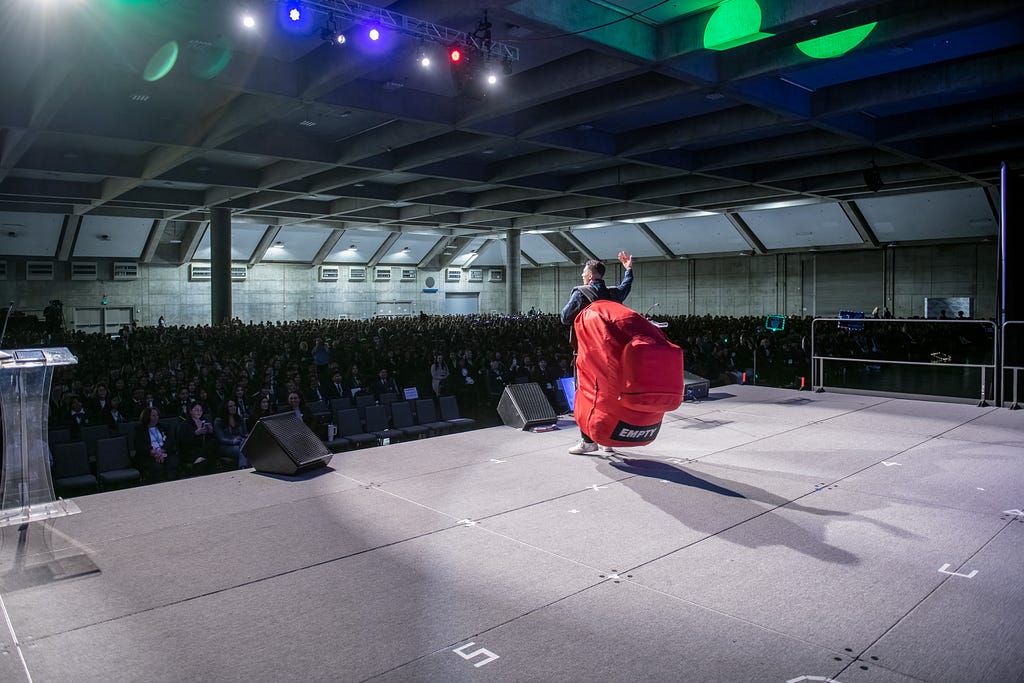
I deliver 100 to 150 keynotes a year to organizations, educational institutions, and conferences — over 800 events across four continents so far. We publish two videos a day across every platform, which reach roughly 2.2 million people and garner hundreds of millions of views. We also write and publish helpful books: Empty Your Backpack for mindset, Be Someone’s Taco for kids, and Return on Goodwill, arriving September 11th.
However, what we measure most as a company is what we call “moments of significance.”
A moment of significance is one you intentionally create for another person because you think it will land as meaningful for them. It’s about exceeding an expectation or surprising somebody who wasn’t expecting anything.
I was on a flight to Sacramento when a flight attendant named Josh noticed a passenger struggling to hold his phone up to watch a show. Josh grabbed a paper cup, tore the rim into three flaps, folded two back inside for stability, bent the third forward as a ledge, and handed the man a phone stand. Then he did it for two more passengers. I asked if the airline trained him to do that. He laughed and said no, he just enjoys helping.
A few weeks later I told that story on stage in Idaho and got it filmed. We posted the clip, and it went off. Flight attendants from all over the world showed up in the comments. It’s now been viewed over two million times, and within a few weeks Josh found it himself.
When the video took off, Josh’s mom was in surgery. Hundreds of strangers who had never met either of them started leaving prayers and messages under the video about a paper cup.
Today, Josh is known for his paper cup phone stands and for releasing tutorials consistently. Watch one of the first ones for yourself.
It warms my heart every time I talk about it. This story perfectly captures the social impact we make through our organization. We hunt for these opportunities to create moments of significance for others.
Can you tell us a story about a particular individual who was impacted or helped by your cause?
His name is Andrew, and this story is why I have a children’s book.
During the COVID-19 pandemic, I called him to check in. He picked up, and the first thing he said was, “Yo Sam, I’m still in bed.” I looked at my watch. It was 2 pm.
If your friend is still in bed at 2 pm, they are probably not doing great.
I hung up and wanted to do something. So I dug through his social media for anything he liked, and I found a post that said his vote for dinner was tacos. You can probably guess where this goes. I went on Uber Eats, found a taco dinner for two, punched in his home address, and left a note for the driver. “These are from your friend Sam. He hopes you feel better.”
Then I sat there watching the little car icon crawl through the streets like it was Pac-Man.
The tacos got delivered. Less than sixty seconds later, my phone rang. It was Andrew on FaceTime, sitting on a bar stool at his kitchen counter, his wife Emily beside him, an open box of tacos behind them, both of them absolutely bawling.
I said something like, “Guys. It’s a cardboard box with tacos in it. Please calm down.”
Andrew said it had nothing to do with the food. He told me things I didn’t know. That he and Emily had shut down their businesses. That they’d had to lay off someone they couldn’t afford to pay anymore. That they had no idea how the next few months would work out.
Then he said, “Maybe for you it’s just tacos. For us, it’s a moment of hope.”
That year, on my birthday, he sent me a logo. A bright yellow smiling taco with the words “Be Someone’s Taco” above it.
The idea is to be whatever someone needs you to be. It changed the direction of my career because it taught me that everyone is carrying something we may not know about, which is why sometimes the smallest things can make the biggest difference.
Are there three things the community/society/politicians can do to help you address the root of the problem you are trying to solve?
Fund the adults, not just the assemblies. I get flown in to speak to a school or organization for an hour, and I love that hour, but the counsellor who follows up with the crying kid in the hallway on Tuesday is doing the real work. Right now she has 400 students on her caseload. One assembly a year is a bandage. Properly staffed coaches and health support inside schools are the actual answer, and it’s a budget decision.
Build service into education instead of bolting it on. Every teenager I meet who’s found some sense of purpose found it by helping somebody else. Volunteer hours are usually treated like a box to check before graduation. If schools built genuine, ongoing service into how kids learn, we’d fix a lot of the loneliness problem sideways without ever calling it a mental health initiative.
Stop treating kindness like a soft skill. In workplaces, kindness gets filed under culture and morale, which is the polite way of saying it’s optional when things get busy. Every organization I work with that treats goodwill as a real operating principle outperforms the ones that don’t. Leaders need to name it, model it, and reward it out loud.
How do you define “Leadership”? Can you explain what you mean or give an example?
Leadership is modelling the behaviour you want to see in others and making decisions that help the collective reach mutually agreed-upon goals. It is also behaving the same way in every room, especially the ones where there’s nothing in it for you.
There’s a question I return to constantly. I stole the idea from Warren Buffett, and I call it the Janitor/Chairperson Test.
Ask yourself: would the janitor describe me the same way the chairperson would? Meaning, are you treating everyone with the same level of dignity and respect, or are you selective with your humanity?
It’s about how you show up when nobody with authority is watching. It’s easy to be warm with people who can open doors for you. It’s natural to engage when someone’s approval matters. The real test happens when there’s nothing at stake, and nobody would ever know how you treated them.
Most of us fail this test regularly. We’re busy thinking about the next thing instead of the person standing in front of us. Failing it doesn’t make you a bad person. It makes you a human with a calendar.
The person who taught me this best is a man named Ron MacDougall. I met him at a bar in Bradford, Ontario, the night before a big speech. We were sitting next to each other and started talking because the Maple Leafs missed a shot that should have been an easy goal. That turned into a three-hour conversation and a friendship.
At some point, I asked him a question that got him talking about his father, who used to tell him this. Some people make more money than others. Some people have nicer things. Some people are more talented. Some people are better looking, but no one is better than anyone else.
Ron actually lives it. We talk now and then, and he has never once ended a phone call without telling me how much he valued the conversation. His behaviour does not change based on the room he’s in, because to him that invisible line between important people and everyone else doesn’t exist.
That’s my definition. Leadership is modelling the behaviour you want to see in others, making decisions for the collective good, and staying consistent in character when there’s no audience and no upside.
What are your “5 things I wish someone told me when I first started,” and why? Please share a story or example for each.
1. Never let your identity be one thing. When soccer ended, I didn’t just lose a sport. I lost the answer to “who are you?” I had built a single-story identity, and when that story got taken away, I had nothing left to stand on. Now I hold every role I have a little more loosely. They’re things I do. They’re not the whole of who I am. If somebody had told me that at seventeen, those two years of transition would have looked very different.
2. Nobody is coming to discover you. After that principal told me I had a gift, I didn’t get a phone call with an entire career promised to me. I sat down and cold-called every person on the first five pages of results, asking how the speaking business worked. Almost nobody answered. A few did, and those few conversations built my entire career. The waiting version of me would still be waiting.
3. Rejection is usually a challenge to be more creative. My first ever job interview was at Starbucks. They did not hire me. Nineteen-year-old me took that personally for an embarrassingly long time. Since then I have been told no thousands of times, and I’ve learnt that a no almost never means “you’re not good enough.” It usually means “not this, or not now.” Every no gets you closer to a yes, or provides the information you need to improve and try again.
4. The message is the almond. The story is the chocolate. My mentor Chris told me that speaking is like a chocolate-covered almond. The almond is the message, but if you don’t wrap it in chocolate, nobody wants to eat it. I told him I love raw almonds and that he was a liar, haha. The chocolate is the humour, relatability, authenticity, and storytelling. I call my speeches performances now instead of presentations for exactly that reason.
5. Do good and throw away the scoreboard. My Noona Frances has a paper calendar where she writes every family birthday by hand. She’s given away so much money to charity that the government once audited her over it. She has never once mentioned it to get anything back. Watching her taught me that the moment you start tracking what you’re owed for your kindness, it stops being kindness and turns into a transaction. Almost everything good that has happened in my career came from things I did with zero expectation attached.
Can you please give us your favorite “Life Lesson Quote”? Can you share how that was relevant to you in your life?
“I have no special talents. I am only passionately curious.” Einstein wrote that late in his life, and I think about it constantly.
It became one of my favourites because of a conversation with a mentor of mine, Dan Martell. Dan had done something generous for me and told me to reach out if he could ever be helpful. I wanted badly to return the favour, and I couldn’t figure out how. This is a man who has achieved success at the highest level in basically every area of his life. What do you offer someone who needs nothing?
So I said it out loud, half laughing. “Dan, I don’t really have anything to offer you. But if you ever think I could be of service, I’d love to help.”
He stopped me. “Sam, don’t ever say you don’t have anything to offer. You always have your curiosity. Be curious about something someone else is doing that you don’t know much about. Ask thoughtful questions. Your curiosity is a great tool, and it makes people feel special.”
That reframed my entire career.
When I was nineteen, with no success and no reason for anyone to take my call, curiosity was my only asset. I Googled how to become a keynote speaker and called every person on the first five pages. They gave me their time because I asked questions from a place of genuine not-knowing.
When you ask someone a real question, the unspoken message is that you think what they know is important. It shows them that you care about their perspective. People feel that immediately.
Is there a person in the world, or in the US with whom you would like to have a private breakfast or lunch with, and why? He or she might just see this, especially if we tag them. 🙂
Hands down, Simon Sinek.
I’d ask him how he stays sensitive and emotionally connected to his work and people, even after millions of similar interactions and compliments.
I’d also be curious how he structures his time and the decision-making rules he puts in place to keep his health and well-being optimal.
You are a person of enormous influence. If you could inspire a movement that would bring the most amount of good to the most amount of people, what would that be? You never know what your idea can trigger. 🙂
Be someone’s taco!!
I want a world where people stop waiting for a big moment to be generous and present. How cool would it be to look around an airport and instead of seeing everyone glued to their phones, they are talking to each other, looking for opportunities to help, and making connections.
How can our readers further follow your work online?
People can follow along on my website or their favourite social platform.
I post two videos a day on Instagram, TikTok, YouTube, and Facebook. That’s where most of the day-to-day stuff shows up.
If your readers want to read our books, they can visit our shop: https://shop.samdemma.com/
My new book, Return on Goodwill, comes out September 11th, 2026. It’s about eight everyday practices for living with genuine kindness and what tends to happen when you do.
This was very inspiring. Thank you so much for the time you spent on this. We wish you only continued success.
Social Impact Heroes: How Sam Demma Is Helping To Change Our World was originally published in Authority Magazine on Medium, where people are continuing the conversation by highlighting and responding to this story.