


My passion to help women intensified while volunteering in Cambodia and then when I was CEO with homelessness charity, Orange Sky. As a single mother who had suffered workplace bullying, discrimination and assault, I was silenced by toxic relationships. Like me, women suffer violence or coercive control in silence, due to fear, embarrassment or shame.
As a part of this series, we had the pleasure to interview Jo Westh.
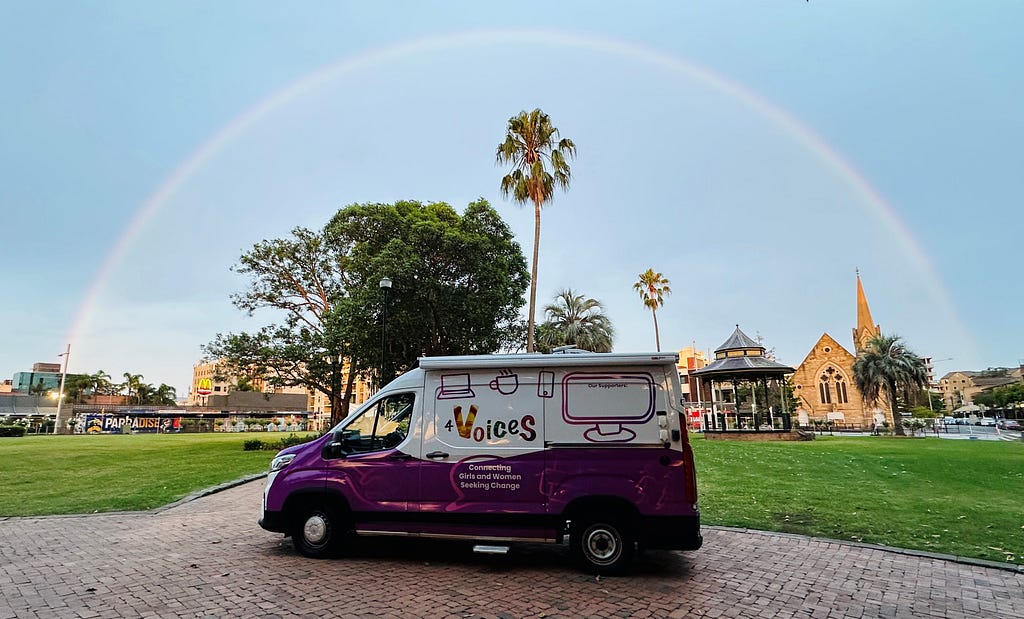
Jo Westh is the Founder and Chief Executive Officer of 4 Voices, an Australian not-for-profit delivering immediate, barrier-free support for women at risk of homelessness, domestic violence, and isolation. Taking out a second mortgage on her home to launch her first solar-powered mobile connection hub van, Jo has grown 4 Voices into a network of 600 volunteers operating six customised vans and Australia’s first outbound telephone support service, supporting over 15,500 women annually.
Thank you so much for joining us in this interview series! Can you tell us a story about what brought you to this specific career path?
My passion to help women intensified while volunteering in Cambodia and then when I was CEO with homelessness charity, Orange Sky. Mobile laundry vans wash and dry the clothes of people experiencing homelessness. But, I noticed that most of the users of this service were men. I kept asking myself: where are all the women going? As a single mother who had suffered workplace bullying, discrimination and assault, I was silenced by toxic relationships. Like me, women suffer violence or coercive control in silence, due to fear, embarrassment or shame. As a result, an estimated 80% of all domestic violence incidents in Australia are never reported. So, at age 60, I wanted to do something about this. I wanted to build a service specifically for women to intercept hardship before it turns into an acute crisis.
Can you share the most interesting story that happened to you since you began leading your company or organization?
We launched in King George Square in March 2020 with purple balloons, cupcakes, and 50 eager volunteers. Exactly two weeks later, COVID-19 lockdowns hit Brisbane. It was devastating. I had to completely reinvent our service delivery model on day 14. Realizing connection doesn’t strictly require being physical face-to-face, we created Australia’s first outbound telephone support service. Today, our volunteers proactively call over 200 isolated women every week to provide practical and immediate support to help them avoid crisis.
It has been said that our mistakes can be our greatest teachers. Can you share a story about the funniest mistake you made when you were first starting? Can you tell us what lesson you learned from that?
When running our outreach van outside a Centrelink office (an Australian social security support program), a woman used to come every week, order a white coffee with no sugar, and sit quietly at our table for the full three hours without speaking a word. I privately thought, “She’s just occupying a chair that could help someone else.”
Months later, a passerby asked our van, “What do you guys do here?” and this quiet woman turned around and replied, “They do everything.” I realised then that I didn’t even know her name despite her sitting with us for six months. That was my biggest mistake and greatest lesson. Since then, I always take the time to ask about people and I never forget a name, a coffee preference, or a personal story. Remembering someone makes them feel human again.
Can you describe how you or your organization is making a significant social impact?
Australia spends $26 billion annually on domestic violence, yet an estimated 90% of those funds are spent on crisis response, often after severe harm has occurred. In 2026 alone, our 600 volunteers logged 30,384 hours, served 33,965 warm drinks, and made 28,096 connections — bringing our total impact to 15,500 women supported in that one year. By taking solar-powered vans equipped with Wi-Fi, laptops, phones and free coffee in public places, we act as a low-barrier “community connection service”. We address immediate basic needs first, food, clothing, shelter — just like on Maslow’s hierarchy. This offer of what is a basic human right helps to build a relationship of trust so women feel safe revealing other issues, such as coercive control, domestic violence, housing or financial stress, unemployment or digital isolation.
Can you tell us a story about a particular individual who was impacted or helped by your cause?
We met Kit in a park after she had fled severe domestic violence while pregnant. Traumatised and homeless, her newborn daughter, Aurora, was placed into child safety custody. Kit began visiting our mobile van weekly. Step by step, our volunteers provided a safe space without judgment. We helped replace her lost ID, secured crisis accommodation, applied for social housing, connected her with the NDIS, and secured mental health support. Today, Kit has stable housing and is progressing through a formal child reunification plan with regular visits with her daughter.
Are there three things the community/society/politicians can do to help you address the root of the problem you are trying to solve?
- Invest in early intervention infrastructure. By shifting funding upstream to preventative connection rather than investing predominantly in late-stage crisis response, our governments could avoid so much waste — of money and lives impacted by trauma.
- Dismantle bureaucratic hurdles and stop forcing traumatised women to jump through rigid eligibility hoops or endure intrusive interrogations that cause them to resign themselves to violent situations.
- Address social isolation proactively and recognise that social disconnection is a primary precursor to crisis. If they build spaces that encourage early help-seeking, fewer women would become “just another statistic”.
How do you define “Leadership”? Can you explain what you mean or give an example?
Leadership isn’t management of people — it’s doing the right thing, demonstrating genuine empathy, and making sure the people around you feel heard, appreciated, and cared for. It’s seeing something that can be done to improve someone else’s life, and taking action.
What are your “5 things I wish someone told me when I first started” and why. Please share a story or example for each.
1. How hard charity registration and compliance really is. I hate detail, and I had to write a constitution, secure a board of directors, get lawyers involved, and handle a lot of compliance and paperwork. Passion is the driver but you need to be driven to push through the red tape and paperwork. You need to manage ongoing compliance (or get someone who can!) This requires determination to build a stable, and sustainable organisation.
2. How all-consuming the commitment will be. Starting a social impact movement isn’t a part-time interest; it becomes a 24/7 commitment that demands everything you have. I didn’t realise how complex it would be to start, or how much of myself I’d have to put into it.
3. The heavy toll on your personal health, wellbeing and relationships. You cannot pour from an empty cup. Maintaining physical fitness and mental agility is essential to surviving founder burnout. Fortunately, I have a supportive family and partner, but it’s so important to look after yourself. Do what I say, not what I do!
4. Surround yourself with the right people and right skills. You’ll need a good volunteer base, but even then you can’t expect your volunteers to be as driven as you are as a founder. Non-profit organisations and charities can’t pay for expert resources, so you need to learn how to identify the gaps and become great at asking for help. Figure out how to package volunteering opportunities in a way that’s sustainable and supportive. We now offer bite-sized, 3-hour weekly shifts to over 600 volunteers which allow them to give their best without burning out.
5. Start with solid financial and governance foundations. Taking out a personal loan for our first van during a global pandemic was tough, and I learned we needed to build credibility and visibility too. And you need a great board — not just mates or relatives, but those with skills and connections. Creating a highly skilled, professional board has been a game-changer for our sustainable growth.
Can you please give us your favorite “Life Lesson Quote”? Can you share how that was relevant to you in your life?
Maya Angelou said, “People will forget what you said, people will forget what you did, but people will never forget how you made them feel.” Alongside Gloria Steinem’s reminder, “We are linked, not ranked.” At 4 Voices, we believe that everyone’s story is unique and should be respected and listened to; and instead of a hierarchical organisation structure we have a collaboration chain where everyone’s voice holds equal value.
Is there a person in the world, or in the US with whom you would like to have a private breakfast or lunch with, and why? He or she might just see this, especially if we tag them.
Gloria Steinem. I deeply admire her dignity, self-effacing curiosity, and lifelong commitment to learning. She proved that a woman’s skill set and vision can change lives, and don’t atrophy with age.
You are a person of enormous influence. If you could inspire a movement that would bring the most amount of good to the most amount of people, what would that be?
“Connection before crisis.” A movement where we slow down, pull up a chair, and listen to a person’s unique human story without judgment. If we all stopped long enough to truly listen to one another, we could change and save lives.
How can our readers further follow your work online?
https://www.4voices.org.au/
https://www.linkedin.com/in/jo-westh-105a1012/
Thank you so much for the time you spent with us. We wish you continued success!
Social Impact Heroes: How Jo Westh Of 4 Voices Is Helping To Change Our World was originally published in Authority Magazine on Medium, where people are continuing the conversation by highlighting and responding to this story.