

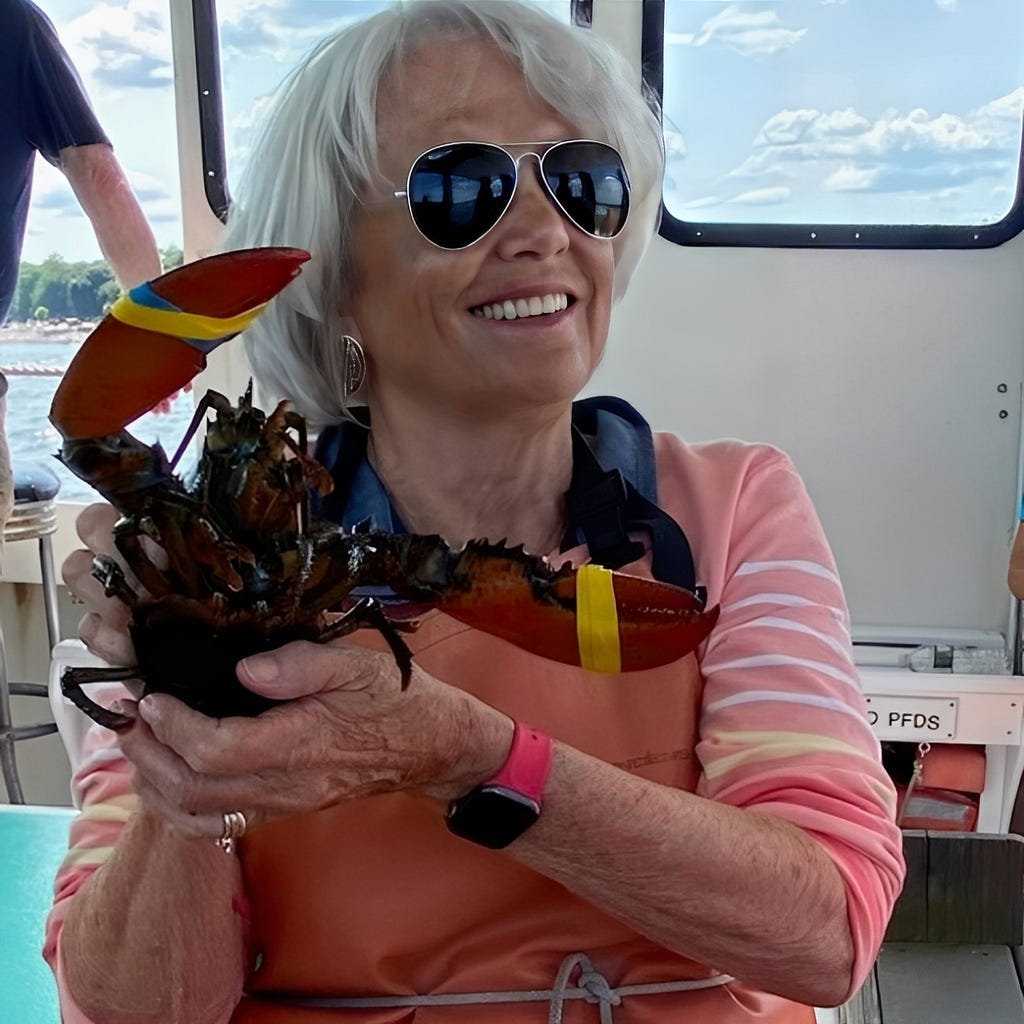

I’m clearly a word person, and I came of age hearing leaders who were inspirational speakers — a quality I think is critical to leadership. Martin Luther King’s “I Have a Dream” speech and President John F. Kennedy’s call to “Ask not what your country can do for you — ask what you can do for your country” both played a significant part in my understanding of leadership as being rooted in a vision of a world built from each of us doing the hard work of living as our best selves. By best, I mean our most moral and ethical selves, not our highest achieving or highest earning selves. The best leaders have done this work themselves and know how to support and empower others to do it.
As part of my series about “authors who are making an important social impact”, I had the pleasure of interviewing Kate Woodworth.
Kate Woodworth wrote her first novel when she was twelve and published Racing Into the Dark (EP Dutton) in 1989. She continued writing novels and publishing short stories for the next thirty-six years while raising three children and working as a copywriter in publishing, advertising, and healthcare. In 2015, she became a climate novelist after recognizing that climate fiction was the best way for her to inspire others to take action to save the planet. After a decade of research about lobsters, climate change, islands, grief, sustainable agriculture, and a lot of drafts, Little Great Island — a story about the power of love and community in the face of climate change — was published by Sibylline Press in May, 2025, along with the simultaneous launch of the Be the Butterfly climate change initiative.
Thank you so much for joining us in this interview series! Before we dive into the main focus of our interview, our readers would love to “get to know you” a bit better. Can you tell us a bit about your childhood backstory?
I’m one of four children born to my parents between 1950 and 1955. As a survival mechanism for our parents, we children were encouraged to go play outdoors (“shooed out of the house”). Outside play might involve building a village in the sandbox and peopling it with imaginary characters, poking around the shoreline of the neighbor’s pond in search of frog eggs and watching them transform into tadpoles, or rescuing orphaned baby birds or rabbits, which I then raised until they were old enough to return to the wild. At night, our father read to us, and then, after we’d been sent to bed, our parents played opera at top volume to drown out our upstairs shenanigans.
In the summer, as my siblings and I got older, we went first to the beach and then to an island off the coast of Maine. Once again, we spent most of the daylight hours outdoors — swimming, collecting shells and sea glass, running around barefoot (the goal was to toughen your feet to where you could walk on hot asphalt with no problem), and just being in the natural world. Through opera, I absorbed the musicality of language, while being outside gave me an appreciation of nature.
Of course, there was school. My parents were both college educated and they believed strongly that their children needed a good education. I was fortunate to be in schools in which my love of reading and writing was nurtured from early elementary school all the way through my MFA program.
For as long as I can remember, I was thought of as a storyteller (not always a compliment). In fifth grade, when assigned an essay on the human digestive tract, I wrote it from the point of view of the pea. In sixth grade, my composition teacher stopped by my desk to look at something I was working on and told me, “This is the way real writers punctuate dialogue.” I thought: I need to learn this, because I am a real writer.
When you were younger, was there a book that you read that inspired you to take action or changed your life? Can you share a story about that?
When I was very young, I was transformed by books like The Wind in the Willows; Carbonel: The King of the Cats; and The Lion, the Witch and the Wardrobe, which brought to life hidden worlds that existed just beyond notice in our daily lives. Those books affirmed my belief that there are things outside our immediate perception that needed to be treated with care and exposed me to the tremendous power of the imagination.
In sixth grade, I was inspired by Scout, the narrator of To Kill a Mockingbird. I can’t say that I fully understood the racial messages of the book at that age, but I wanted to be Scout. I wanted to be a tomboy, to have the courage and the compassion to understand that someone who was different wasn’t frightening, and to be brave enough to yell an insult at a boy who was trying to scare me.
In high school, the most inspirational book I read was Helen Keller’s The Story of My Life. Thanks, in part, to a classroom assignment to act out the parts of both Keller and her teacher Annie Sullivan, I was able to define, in my own mind, the ways in which the written word can bring readers to a new understanding of ourselves, of others, and of our multi-faceted world. That, I realized, was what I wanted to do: create worlds and characters and invite readers to expand their understanding of what it means to be human by stepping into my stories.
It has been said that our mistakes can be our greatest teachers. Can you share a story about the funniest mistake you made when you were first starting? Can you tell us what lesson you learned from that?
Perhaps I’m not wired to find my mistakes funny, even when they occurred long ago. I tried to come up with a mistake other than the one that kept returning to consciousness before recognizing it’s a story about a mistake that needs to be told:
The biggest mistakes (plural…I seem to be a slow learner) I made throughout my career involved allowing myself to be alone in a room with a male colleague.
The first time it happened, I was newly graduated from college and working for a reputable New York City magazine publisher in advertising sales promotion — a department of three women. My job was to provide the advertising sales team (all male) with any materials they needed to keep their clients happy, and so when a much older man from the sales department asked me to have coffee with him after work, I assumed it was to talk about client needs. We went to a coffee shop located at street level in the building where we worked. When I headed for a table near the window, he said we should go to the back of the restaurant where we couldn’t be seen. His comment seemed weird to me, but the man was forty years my senior and married, so I figured I’d misunderstood. I knew I had a plum job, and I didn’t want to mess up. I did as I was told.
But as we drank our coffee, the man put his hand on my arm and told me he’d set me up in an apartment. All I had to do was “be nice.” I thought that, at any moment, my workmates would pop out from behind a pillar, laughing and saying it was all a joke. Some form of initiation rite.
That’s the end of the funny part.
When no laughing coworkers appeared, I mumbled something about how I had a signed lease and a commitment to my roommates. But that’s not the end of the story.
A few days later, the same man cornered me in a female coworker’s office. This time, I knew it was no joke. As he closed in on me, I contemplated climbing over the desk (in a skirt and heels) and making a dash for the door. I was quite sure I wouldn’t make it. Happily, my coworker returned to her office. She was an inch or so over five feet tall and a few years older than me. He was over six feet and not her boss, but I don’t think that mattered to her. She ripped him a new one. He never bothered me again.
Can you describe how you aim to make a significant social impact with your book?
Many of the popular early climate fiction books were post-apocalyptic or science fiction, but I’m concerned that those genres leave readers with the idea that climate change is something that might happen in some distant future. I wanted, in Little Great Island, to be clear that it’s happening now…and not just in a country we’re unlikely to visit, but in a place that most readers know of even if they’ve never visited. Unlike post-apocalyptic stories, there’s no huge, devastating event in Little Great Island. Rather, the cumulative effects of sea level rise and ocean warming have crippled the fishing industry to the point where my characters need to find and agree on a new social and economic structure…and fast. My hope is that my novel inspires all of us to incorporate habits that will help mitigate climate change into our daily lives now.
However, I recognized that the initial hope that climate fiction would lead to climate action wasn’t proving to be the case. In 2020, Matthew Schneider-Mayerson, an Associate Professor of English at Colby College, conducted a study to determine why readers weren’t more motivated after reading fictional stories about climate change. He found that there was an immediate, small increase in concern about the environment, but that it didn’t last long.
I saw, in Scheider-Mayerson’s study, a window of opportunity for a call to action, which my publisher agreed to include at the end of my book. This call to action — called Be the Butterfly in reference to the butterfly effect — invites readers to do one small thing to save the planet. My hope is that readers…and anyone who accepts the Be the Butterfly invitation…will feel the hope that comes from action and that, over time, enough butterflies will be flapping our wings that our government leaders and corporate executives will be swayed by the breeze.
A dozen climate writers — including Bill McKibben, Barbara Kingsolver, Peter Heller and Lydia Millet from this country and authors from the UK, Norway, and Thailand — are participating by having named environmental nonprofits readers can support if they choose. The names of those authors and their nonprofits are also listed in the back of Little Great Island. Finally, I am including academics, climate writers, and representatives from nonprofits as co-speakers on my book tour to address local environmental concerns and to amplify the message we all share: The time to act is now.
Can you share with us the most interesting story that you shared in your book?
One of the book’s main characters is a woman, Mari McGavin, who is knowledgeable about and passionate about sustainable agriculture. I knew very little about the topic, so I began interviewing farmers to get a better sense of my character. One farmer I talked with — I’ll called her Annie — had grown up in a small, rural town in Maine. Annie hadn’t traveled much, got married young and, when she and her husband went to eastern Colorado for a year for his work, she was tremendously lonely and homesick.
One day, some very nice women knocked on her door. They were very friendly, and so when they invited Annie to go with them to church, she agreed. Annie hadn’t been exposed to much in the way of religion, and she was excited to learn that God loved her and that prayer could help her with her trials. When she returned to her community in Maine, Annie could not wait to tell her friends and family about God and Jesus and the power of prayer. After a month, she was told that if she didn’t knock it off, everyone would quit speaking to her.
Although I’m not religious, I was touched by this story of a woman excited to share what she’d learned with people she loved, and I knew it was, somehow, key to Mari’s character. But while Mari is also from a small, isolated Maine community and has little understanding of religion or religiosity, I felt it was disrespectful to insert Annie’s story into my book. Instead, I made my character a woman who leaves her South Carolina master’s program in sustainable agriculture to work on a farm called God’s Bounty. Thrilled to be employing the knowledge she’s acquired and in love with another farmer, she pays little attention to the religious aspects of God’s Bounty until the farm’s yield and income are compromised by climate change. Mari’s sustainable practices are blamed. She is both shamed and punished but forgives and justifies the behavior of her friends and husband until suddenly she realizes that both she and her son are in danger, and they are forced to flee.
Like Annie, Mari wanders innocently into a situation that seems ideal, but that turns out to have deeper implications than she realized. Also like Annie, Mari is subjected to ridicule and discrimination when she returns home, but there the two stories split.
What was the “aha moment” or series of events that made you decide to bring your message to the greater world? Can you share a story about that?
I was corresponding with an 11-year-old girl in Las Vegas, Nevada, about her feelings about climate change when she told me that Baby Boomers were responsible for much of the climate crisis and yet that generation (my generation) was doing little to ameliorate the problem. This was no ordinary girl: At the time, she was in her third year of study at the University of Nevada, Las Vegas. I had invited her to be on a conference panel with me and, as I imagined responding to her criticism of Baby Boomers in front of several hundred people, the only comment I could imagine making was “Guilty as charged.” Out of that interaction, I recognized that I not only want my children and grandchildren to inherit a sustainable world, I believe I have a responsibility to do what I can to ensure everyone’s children and grandchildren inherit a livable planet.
Without sharing specific names, can you tell us a story about a particular individual who was impacted or helped by your cause?
Be the Butterfly is designed to help individuals overcome fear, denial and/or inertia by inviting them to act. At my book events, I provide “commitment cards” on which people can state their intended act. Less than two weeks after the publication of Little Great Island, I had collected a stack of 80 commitment cards from individuals who were inspired to take action, including one from a professor named Bill in Cheney, Washington, who pledges to teach more about the importance of scientific information about climate change; one from Shashi-Kalea from Bangalore, Karnataka, who promises to conserve water; and a fifth-grader named Joanna from Westwood, Massachusetts, who promises to air dry her clothes this summer rather than using the dryer.
The arm of Be the Butterfly that involves other climate writers is designed to boost existing nonprofits. Those nonprofits, in turn, will help the individuals and communities they serve. I will likely never hear the stories of Be the Butterfly impacting individual lives, but I recently received a thank you from Trees for the Future, an organization in sub-Sahara Africa that teaches and provides materials for sustainable land use so that impoverished farmers can revitalize soil and benefit from more bountiful crops. I would never have known of the existence of this organization if it hadn’t been for one of my “author butterflies”, Jane Ekstam, PhD, professor emerita of English literature at Østfold University College in Norway, who suggested it as her nonprofit.
Are there three things the community/society/politicians can do to help you address the root of the problem you are trying to solve?
Finding a resolution for the challenges facing the characters in Little Great Island required a lot of thought because I hoped my book would contain a message about what we, as a global society, could do to address the climate crisis we are facing. Some very smart scientists are working on promising solutions, but I looked to how we could make changes in how we interact with the nature world and with one another. What I hope my readers will do is 1) honor our ability, as humans, to feel empathy for people already impacted by changes in the climate and to feel empathy for all the living things that make up the web of life we depend on for our existence; 2) challenge ourselves daily to be a little bit better stewards of the earth. Maybe that means upcycling an article of clothing. Maybe it means turning off the water while brushing your teeth. Maybe it means voting for a candidate focused on environmental issues. The specific action is up to the person performing it. 3) Use our capacity for complex thought. Binary thinking — red vs. blue, liberal vs. conservative, winner vs. loser — is far too simplistic for the challenges we face.
How do you define “Leadership”? Can you explain what you mean or give an example?
I’m clearly a word person, and I came of age hearing leaders who were inspirational speakers — a quality I think is critical to leadership. Martin Luther King’s “I Have a Dream” speech and President John F. Kennedy’s call to “Ask not what your country can do for you — ask what you can do for your country” both played a significant part in my understanding of leadership as being rooted in a vision of a world built from each of us doing the hard work of living as our best selves. By best, I mean our most moral and ethical selves, not our highest achieving or highest earning selves. The best leaders have done this work themselves and know how to support and empower others to do it.
What are your “5 things I wish someone told me when I first started” and why? Please share a story or example for each.
As a girl growing up in the 1950s and 1960s, I was socialized to believe that men were smarter than women and that women should defer to men as a matter of both etiquette and practicality. Those who knew me then would argue that I definitely did not internalize the message, but I did, and I struggled with it for years. So what I wish someone told me:
- Many women are much, much smarter than men. Sometimes it’s a different kind of intelligence, such as emotional intelligence, and sometimes women just flat out have a higher IQ. Please avoid falling into the binary thinking trap here. I’m not saying that all women are smarter than all men or that all men are emotional cripples (or that women don’t have their emotional challenges). The point is that we are better when we work together as equals. My husband is an engineer who started his MIT education at the age of sixteen. When we decided to convert from fossil fuels to geothermal energy, he understood and oversaw the project from start to finish. My role was to point out that just because a solution worked logistically didn’t mean it worked for our lives. When it comes to understanding interpersonal relationships, I’m the one with the knowledge and insight…but I’m guilty of overthinking, and his more practical view of relationships often hauls me out of a hole I’ve dug.
- Women’s perspectives are critical to all areas of society across the globe, including corporate and government leadership. When Michelle Obama spoke, women listened…and were inspired.
- I have a voice worth listening to. I’m not talking about my singing voice, which is definitely not worth listening to. I’m talking about the wisdom I’ve acquired over a lifetime. When I was writing Little Great Island, a loud voice in my head demanded to know what made me think I knew enough about environmental instability or grief or the kind of denial that leads to a woman putting her son in danger to write about those topics. Now, as I appear in front of audiences, I see that I don’t need to be an expert; I only need to create the opportunity for discussion on those topics.
- The earth’s resources are finite, and they are not ours to squander. Creatures that inhabited the waters off the coast of Maine when I was child — mussels, sea stars, sea urchins — are gone now.
- Perfection is unattainable, and striving for can hurt you and the people you love. As a writer with three children, a too-big house and yard, and a demanding full-time job, I believed my family, my home, and my career all occupied the top priority position. I couldn’t imagine doing less than my best in any of those arenas. My health suffered. Worse, my children’s emotional health suffered, particularly in their teenage years. Happily, they are all healthy adults now, but I will always carry that guilt.
Can you please give us your favorite “Life Lesson Quote”? Can you share how that was relevant to you in your life?
The life lesson quote I keep close to my heart is “The urge to create is all we can know of god.” Words associated with religion tend to ignite instant prejudices — both positive and negative — which is why I don’t repeat my quote in public. However, as an English major and a child of an alcoholic, I noticed that lower case “g” and gave myself permission to interpret god in whatever way works for me. The interpretation I chose is probably closer to what most people call imagination or inspiration. As a result, I view writing as more of a spiritual practice than a commercial one.
Is there a person in the world, or in the US with whom you would like to have a private breakfast or lunch with, and why? He or she might just see this, especially if we tag them. 🙂
Bill McKibben, environmentalist, author, journalist, moral visionary, and founder of ThirdAct — a community of Americans over sixty determined to safeguard the climate and democracy. McKibben is everywhere at once, fighting for the vision of the United States as a country that is morally and ethically great as well as a leader in other sectors. Somehow, he has also generously found the time to support me — a total stranger who shares his vision that we can be better humans than we are currently being — and Be the Butterfly.
How can our readers further follow your work online?
I write a monthly Substack, Food in the Time of Climate Change, about what farmers and fishermen are seeing right now about how changes in weather are affecting the food we eat. Katewoodworth.substack.com
Be the Butterfly updates are available on my social media channels: Instagram: kate.woodworth.92 and Facebook
https://www.facebook.com/kate.woodworth.92
This was very meaningful, thank you so much. We wish you only continued success on your great work!
Social Impact Authors: How & Why Author Kate Woodworth Is Helping To Change Our World was originally published in Authority Magazine on Medium, where people are continuing the conversation by highlighting and responding to this story.