


Impactful Communication: Mark Steffe Of First Command Financial Services Inc On 5 Essential Techniques for Becoming an Effective Communicator
An Interview With Athalia Monae
Build understanding before action. Start with the “Why.” I try to be very clear, very transparent with folks about why we’re doing certain things and then the “what” behind it and the “how” behind it.
In an age dominated by digital communication, the power of articulate and effective verbal communication cannot be understated. Whether it’s delivering a keynote address, leading a team meeting, or engaging in a one-on-one conversation, impactful speaking can open doors, inspire change, and create lasting impressions. But what truly sets apart an effective communicator? What techniques and nuances elevate a speech from mundane to memorable? As part of this series, we had the pleasure of interviewing Mark Steffe, president and CEO of First Command Financial Services, Inc.
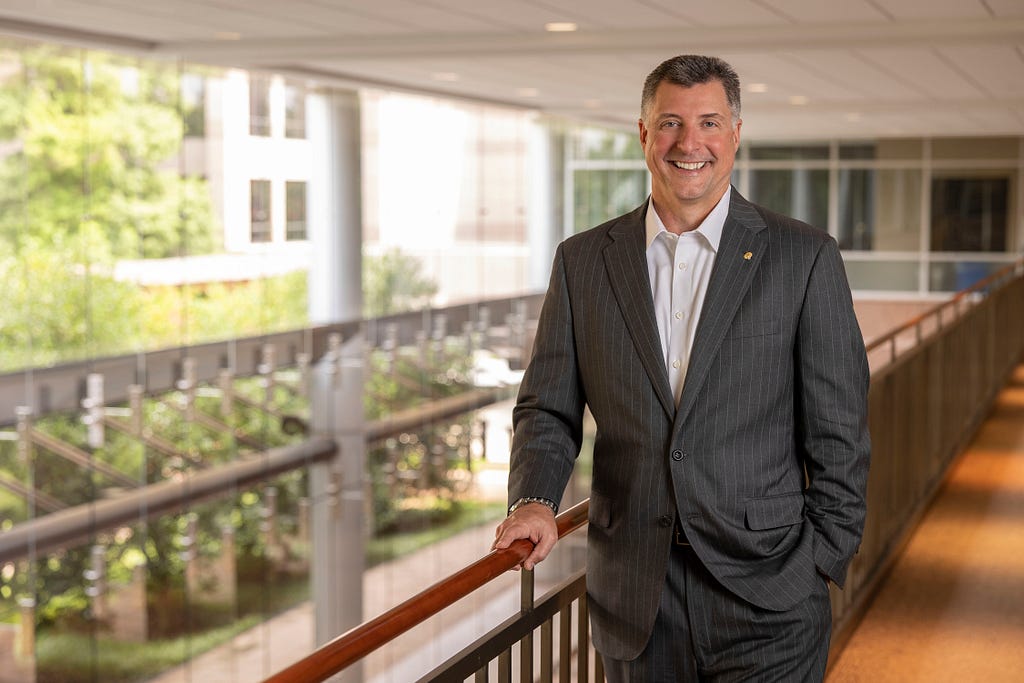
President and CEO Mark Steffe brings more than three decades of experience in the financial services industry and a leadership style grounded in authenticity, clarity and service to First Command.
Mark joined the company as a senior vice president and chief of staff of advisor operations in 2010. In his subsequent roles as senior vice president, director of advisor operations for the Midwest Division and executive vice president, national director of advisor operations, Mark helped build strong, collaborative relationships between Advisors, company leaders and key support teams. His accomplishments and proven leadership led to his promotion to president in 2017 and expanded COO responsibilities in 2018.
In early 2020, he was appointed CEO and led the company through the COVID-19 pandemic with poise, transparency, and care, prioritizing workforce stability and client continuity. Since then, Mark has ushered First Command through strategic transformation, reinforcing its mission while evolving its structure. He is proud of the organization’s growth, inclusive culture, and cross-functional collaboration.
Mark began his career in financial services in 1991, advancing through leadership roles in sales, strategy, operations, and advisor development. Raised in a working-class family, he carries deep respect for the values held by hard-working Americans, which fuels his devotion to supporting military families through financial empowerment.
Leading with integrity, Mark is a builder driven to set the tone for what’s possible. Under his leadership, First Command, through its subsidiaries, maintains more than $45.5 billion in managed accounts and mutual funds, with more than $70 billion in life insurance coverage in force. Additionally, First Command Bank holds more than $1 billion in total assets. He currently serves on the First Command Financial Services board, the First Command Bank board, and the board of the Financial Services Institute.
Mark graduated with high honors from the University of Illinois, earning a Bachelor of Science in Finance. He holds Series 7, 8, 23, 63 and 65 securities registrations and completed the Harvard University Advanced Management Program in 2015.
He lives in Texas with his wife and is the proud father of five children, cherishing every opportunity to make memories with them.
Thank you so much for joining us in this interview series. Before we dive into our discussion about communication, our readers would love to “get to know you” a bit better. Can you share with us the backstory about what brought you to your specific career path?
For 18 years I was living what many would consider the dream in wealth management — working with ultra-high-net-worth families, dealing with eight and nine-figure portfolios. It was a lot of fun and very interesting helping wealthy families get wealthier. Don’t get me wrong — there’s nothing wrong with that, but I wasn’t changing anyone’s life trajectory. These families were going to be fine with or without me.
When I joined First Command, I really came to understand not only the challenges military families face, but also the massive sacrifices they make for us. Did you know that they typically have a permanent change of station, which means they move for the job, every 2–3 years? As a result, military spouses have experienced high underemployment. According to First Command’s Financial Behaviors Index — a quarterly survey tracking financial behaviors and attitudes among U.S. consumers with household incomes of at least $50,000 — two out of three military spouses say, “My spouses’ military service causes me to be underemployed (working at jobs below my experience level, education or both).”
Now, instead of helping the wealthy get wealthier, I lead First Command as we help military families pursue a path to financial security and stay on that path. This easily is the most rewarding work I’ve ever done in my 30+ years in financial services.
Can you share the most interesting story that happened to you since you started your career?
The most interesting moment came just 69 days into my role as CEO when COVID hit. The executive leadership team and I had to simultaneously navigate a global crisis while ensuring our clients, employees, and advisors felt supported — all while positioning the company not just to survive, but to emerge stronger than before.
You are a successful business leader. Which three character traits do you think were most instrumental to your success? Can you please share a story or example for each?
Transparency: Be clear and honest about any given situation, good or bad.
Integrity: Do what you say you’re going to do. Period.
Flexibility: Recognize that life doesn’t always go according to plan and some of the best outcomes were not part of the original plan.
Ok, thank you for that. Let’s now jump to the primary focus of our interview. Let’s begin with a basic definition so that we are all on the same page. How would you define an “Effective Communicator?” What are the characteristics of an effective communicator?
An effective communicator does three things really well: First, they make the complex simple. Second, they listen more than they talk — and I mean really listen, not just wait for their turn to speak. And third, they tell you not just what they’re thinking, but why they’re thinking it. This means being transparent about the reasons behind our actions — the “why” — as well as the “what” and “how.”
I strive to be approachable so that others feel comfortable engaging with me, knowing their input is valued. By creating these open channels of communication, I’m able to identify issues early and seize opportunities more quickly, ultimately driving better outcomes for everyone involved.
How can one tailor their communication style to different audiences or situations?
First, it’s important to know your audiences and their pain points. What keeps them up at night? What would make their job easier? If you can answer those questions, you can tailor your message in a way that resonates.
When I speak to an audience, I try to envision not only the people I’m talking to, but myself 30 years ago sitting in that audience and saying, “What do I want to hear from the CEO?” If I’m speaking with newer financial advisors or team members, I’m more detailed in how I explain things. If I’m meeting with more seasoned FAs or longtime employees, I can relate to them slightly differently because they are more familiar with the industry and how First Command operates. I frame my communications in a way that will speak to each of them. Most importantly, I follow up on what I say I’m going to do. This builds trust, which is critical in leadership communication.
This took me years to learn, but when speaking to large groups, my job is to make the room feel as small as possible. I’m not speaking AT people — I’m speaking WITH them, having a conversation.
Can you provide an example of a time when you had to adapt your communication style to reach a particular audience successfully?
The most significant example has been leading First Command’s transformation — what we call “First Command of the Future.” When I became CEO, I could have simply announced the changes we needed to make, but that approach would have created massive resistance and ultimately failed.
Instead, I recognized that transformational change requires deliberate, sequential, and repetitive communication. I had to be incredibly thoughtful about how I introduced new concepts, taking time to help people understand not just what we were changing, but why it mattered for our clients, our advisors, our employees, and our company’s future.
This meant communicating the same core messages consistently but tailoring them for different audiences — speaking to field advisors about how changes would help them better serve military families, talking with home office teams about operational improvements, and helping our board understand the strategic vision. Each conversation built on the previous ones, creating momentum rather than confusion.
The key was patience and persistence. Rather than rushing through change announcements, I invested time in dialogue, listened to concerns, and adjusted our approach based on feedback. This slower, more thoughtful communication style allowed us to win hearts and minds across the organization.
Today, we have genuine buy-in from our field force, home office employees, and board members because they were part of the journey, not just recipients of directives. The transformation’s success came from adapting my communication to focus on building understanding and commitment rather than simply announcing decisions.
How do you handle difficult or sensitive conversations while maintaining open and effective communication?
I’ll be honest — this might be the hardest part of leadership, and I still get it wrong sometimes. I’m very focused on transparency at First Command. While it’s not always easy to have those difficult and sensitive conversations, I can’t bury my head in the sand, because that makes the situation even worse.
Of course not all details can be shared with the full group, but the facts that are most relevant should be shared — along with our action plan for addressing them. Every difficult conversation provides an opportunity to be a stronger leader and create confidence with your team. Most people don’t want me to sugar-coat the facts. They want to hear the truth and just as importantly, they want to know what we’re going to do next. As a leader, that’s my focus.
In your experience, how does storytelling play a role in impactful speaking? Why do you think stories are effective in communication?
Stories bring to life any point I’m trying to make, and also help me relate to my team/audience better. There’s nothing worse than someone who sits at the head of the table or stands up on stage and reads a dry PowerPoint deck. Instead, I find ways to relate the information I’m presenting to the audience I’m sharing it with. Storytelling makes anyone seem more human and interesting. Stories make the intangible tangible, understandable and relatable. Stories connect and inspire.
What are your “5 Essential Techniques for Becoming an Effective Communicator”?
1. Build understanding before action. Start with the “Why.” I try to be very clear, very transparent with folks about why we’re doing certain things and then the “what” behind it and the “how” behind it.
2. Create open channels of communication. It’s important to be incredibly approachable so people feel that they can interact with me. If I can open up those channels of communication, we can identify issues faster. We can jump on opportunities faster.
3. Connect the dots to show the big picture. One of the things I focus on is connecting the dots to paint the big picture. If you consider each individual presentation as a puzzle piece, what I try to do is give them the picture on the top of the box and to show them how all those pieces fit together.
4. Ask yourself: What would make them lean forward? Focus on the specific challenges, opportunities, or insights that will genuinely capture their attention and feel immediately relevant to their situation.
5. Focus on understanding, not just agreement. My job is to make the best business decisions possible. My goal is for people to understand and respect the decision, even if they don’t personally benefit from it. When someone can say, “I don’t love this decision, but I understand why they made it and it makes business sense,” that’s success.
How do you integrate non-verbal cues into your communication? Can you provide an example of its importance?
With so many distractions, like cell phones, non-verbal cues are critically important today. When I tell my team that their voice truly matters and I want them to understand the “why” of what we’re doing, I need to be laser-focused on their thoughts and questions. So when I’m in meetings — whether they’re 1:1 or town halls with hundreds, I try to give my audience my undivided attention. That means they have eye contact, head nods and the general understanding that I truly care what they have to say and am listening. Body language speaks louder than words.
I am committed to fostering an environment of psychological safety that helps ensure employees feel encouraged and able to contribute. Employees who feel heard are more engaged and productive. First Command creates structured opportunities for employees to share concerns through regular Town Hall meetings, CEO breakfasts, quarterly home office meetings, CEO forums, etc. These periodic interactions are some of my favorite parts of the job.
How has digital communication changed the way you convey your messages? Are there any specific challenges or advantages you’ve encountered?
Digital communication has been both a blessing and a curse. The blessing is obvious — I can reach our entire organization instantly, share updates in real-time, and create consistent messaging across all our channels.
But here’s the curse: it’s made us lazy about real conversation. I caught myself last year sending emails to people who sit 20 feet from my office. When did that become normal?
I’m a firm believer that frequent, redundant and consistent messaging is critical to solid communications. Digital communication has supported these efforts tremendously. Whether it’s email communications, e-newsletters, videos or social media, we’re able to identify the key messages we want to communicate and repeat those messages often. It’s not just what you say, it’s how you say it. So aligning messaging across different digital channels helps employees understand and remember. The biggest advantage is that we can repeat these messages in different ways digitally. The challenge is to know if the messages are truly resonating with audiences. The best way to do that is through face-to-face, two-way communications.
Public speaking is a common fear. What techniques or strategies do you recommend to manage and overcome stage fright?
I speak in front of audiences every day, but there’s never a time when I don’t get nervous about it. When I stop being nervous about presenting in front of an audience is maybe the time I should hang it up because it will mean that I don’t care as much as I should. That said, I try to have fun with public speaking. Sharing our mission and what we’re doing to serve our military families inspires me and I enjoy talking with others about First Command’s important work.
I remember why I’m there. I’m not performing for my own ego — I’m sharing information that could help military families pursue financial security. When the purpose is bigger than your fear, the fear becomes manageable.
What additional resources do you recommend for individuals looking to improve communication skills?
There are all sorts of books, podcasts and executive coaching programs available. From Dale Carnegie’s book, How to Win Friends and Influence People, to Simon Sinek’s TED Talk about How Great Leaders Inspire Action, there is no shortage of resources. I also completed the Harvard University Advanced Management Program and found it tremendously helpful to hear how my peers communicate. Perhaps most helpful is to identify a mentor who effectively communicates and adapts the best parts of their style to yours.
You are a person of great influence. If you could start a movement that would bring the most amount of good to the most amount of people, what would that be? You never know what your idea can trigger. 🙂
If I could start a movement to bring the most good to the most people, it would be a global initiative focused on helping individuals and organizations discover and act on their “why.” That is, their core purpose and the deeper reason behind what they do.
I’ve learned that when leaders and their teams are crystal clear about their purpose, they are more motivated, collaborative, and resilient, which leads to stronger communities and more meaningful impact.
If individuals, families, companies, and even governments were all guided by a clear sense of purpose that did not include profit or convenience, we could unlock untapped potential, drive positive change, and build lasting connections.
How can our readers further follow you online?
I’m active on LinkedIn: https://www.linkedin.com/in/mark-steffe/
I share insights about leadership, communication, and our work with military families. I’m also always interested in connecting with other leaders who are passionate about purpose-driven business.
Thank you for the time you spent sharing these fantastic insights. We wish you only continued success in your great work!
Impactful Communication: Mark Steffe Of First Command Financial Services Inc On 5 Essential… was originally published in Authority Magazine on Medium, where people are continuing the conversation by highlighting and responding to this story.