

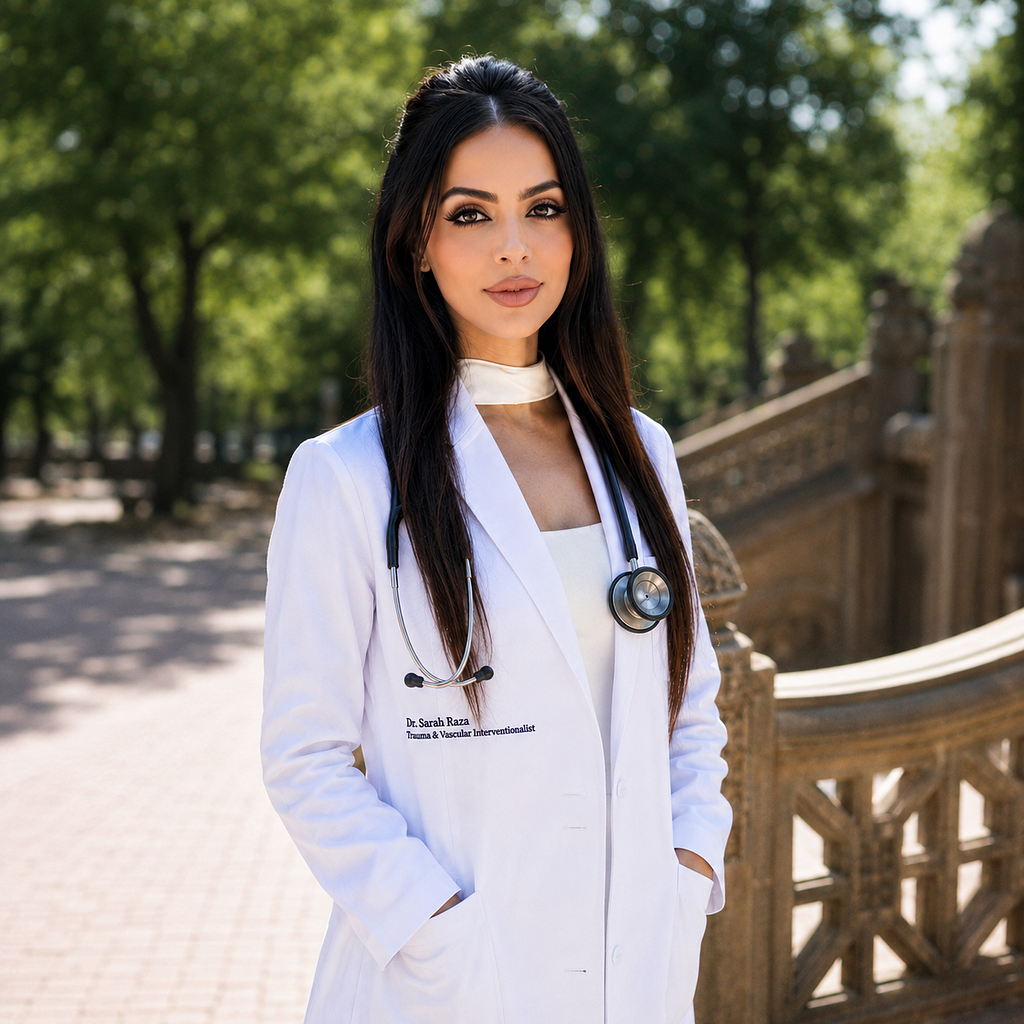
Social Impact Heroes: How Dr Sarah Raza Of Physicians For Human Rights And MAHSA Medical Is Helping To Change Our World
My career has become a way to unite the two values that have guided me since childhood: saving lives through medicine and standing with people whose safety, dignity and voices are at risk.
As part of my series about “individuals and organizations making an important social impact”, I had the pleasure of interviewing Sarah Raza.
Dr. Sarah Raza, DO, MS, is a double board-certified vascular and interventional radiologist who performs lifesaving, minimally invasive endovascular surgical procedures for critically ill adults and children with severe traumatic injuries, uncontrolled hemorrhage, vascular disease and cancer. As one of the approximately 15% of physicians in her male-dominated specialty who are women, she has built a career at the intersection of high-acuity trauma care and advanced image-guided medicine. Her international humanitarian work includes conducting forensic evaluations of survivors of torture, persecution, sexual violence and physical abuse through the Physicians for Human Rights Asylum Network and providing pro bono life-saving medical care to severely injured protesters in Iran through her work with MAHSA medical.
Thank you so much for joining us in this interview series! Can you tell us a story about what brought you to this specific career path?
My path began long before medical school. I am the daughter of Iranian and Indian immigrants who came to New York City as refugees seeking safety and security. I grew up in an inner-city neighborhood alongside families from Afghanistan, Uzbekistan, Russia, Sierra Leone and many other parts of the world. Many had fled war, political repression, domestic violence and other forms of persecution. Although New York was a city of opportunity, my own family lived in poverty. We depended on public housing and government assistance, and there were times when I did not know where my next meal would come from. Those experiences taught me resilience, perseverance and grit, but they also made me acutely aware of how profoundly a person’s future can be shaped by circumstances beyond their control.
Two of my closest childhood friends were Afghan girls whose families had escaped Taliban violence. While we were still in middle school, they were forced into marriages and later confided in me about the abuse and domestic violence they experienced. I also became aware at an early age of the dangers confronting women and girls in different communities, including forced marriage, sexual violence and female genital mutilation. Hearing these experiences from people I loved made such issues deeply personal. My mother had received only a middle-school education, and as the only daughter in my family, I became determined to be independent, capable and successful — even in spaces where women had historically been excluded.
I was drawn to medicine because of its intellectual rigor and its extraordinary capacity to save a human life. That ultimately led me to vascular and interventional radiology, a field of minimally invasive, image-guided endovascular surgery in which I specialize in trauma care. In a life-threatening emergency, I can locate the source of internal bleeding and perform a procedure to stop it within minutes. Women have historically represented fewer than 10% of interventional radiologists, making it one of medicine’s most male-dominated specialties. I became the first woman to serve as chief resident in my training program and later the first female interventional radiologist practicing across the six Los Angeles hospitals I cover. These milestones carried special meaning for me because they reflected the independence and strength I had been determined to build since childhood.
My humanitarian work grew from the same foundation. The stories I encountered as a child never left me; they eventually motivated me to use my medical training on behalf of survivors of torture, abuse, persecution and displacement. Through the Physicians for Human Rights Asylum Network and my international medical work with NGO’s such as MAHSA medical, I now serve people whose experiences echo those I witnessed growing up. My career has become a way to unite the two values that have guided me since childhood: saving lives through medicine and standing with people whose safety, dignity and voices are at risk.
Can you share the most interesting story that happened to you since you began leading your company or organization?
One of the most meaningful moments in my humanitarian work brought me back to an experience I had decades earlier. As a high-school student in New York City, I participated in Model United Nations and visited United Nations headquarters. At a young age, I heard people describe violence, oppression and injustice affecting communities around the world. Their stories stayed with me and helped catalyze my commitment to humanitarian service.
Years later, through the Physicians for Human Rights Asylum Network, I evaluated an asylum seeker who had survived sexual violence, physical abuse and torture. A forensic evaluation requires clinical objectivity, but it also requires patience, cultural sensitivity and a trauma-informed approach. Over the course of our interview, she gradually felt safe enough to share experiences that were extraordinarily painful and difficult to recount.
Afterward, she asked whether I would attend her asylum hearing and sit beside her for support. She told me that, among all the people expected to be in the courtroom, I was the person with whom she felt safest and whom she trusted most. That request was one of the most touching moments of my career. It made me appreciate that careful listening and treating someone with dignity can be as consequential as the medical findings we document.
In that moment, I thought about the women whose stories I had heard at the United Nations as a teenager. What had once seemed like a distant global crisis was now embodied in a woman sitting across from me — and I had developed the skills to help her seek safety. It felt like a profound full-circle moment and reaffirmed why I continue this work: medicine can document the consequences of violence, but compassionate human connection can also help a survivor feel seen, believed and less alone.
It has been said that our mistakes can be our greatest teachers. Can you share a story about the funniest mistake you made when you were first starting? Can you tell us what lesson you learned from that?
On my third day of residency, before I had consumed enough coffee to function — and with barely one eye open — my senior resident showed me how the hospital’s pager system worked. Without my morning coffee, I confess that I was barely listening.
Later that day, I found the pager on my desk and assumed it was only for practice. I have always loved fidgeting with gadgets, so I mindlessly began pressing buttons. To my horror, I had somehow signed myself in as the interventional radiology physician on call. Suddenly, I was receiving emergency pages about a gastrointestinal hemorrhage and a patient with postpartum bleeding. With barely three days of experience, I was convinced the hospital had mistakenly placed its survival in my completely unprepared hands.
I immediately found my senior resident, who brought me to the actual attending on call so the pages could be redirected without delaying anyone’s care. Unfortunately for my rapidly increasing heart rate, that attending was the department chair, Dr. Lobko — a stoic Eastern European physician who already intimidated me. I stood in front of him sweating through a long, panic-stricken explanation of how I had accidentally taken over the emergency pager. He did not even look at me. He turned to my senior resident, said, “Fix it,” and closed his door.
I walked away thinking, “I hope I never have to work with that man.”
Three years later, I entered the procedure room for my first major case — and there was Dr. Lobko. I mentally prepared myself to be grilled for two hours. Instead, he was patient, encouraging and remarkably kind. He eventually became my closest mentor, my favorite teacher and the physician whose example I now try to follow. We later laughed about how intimidating he appeared to people who did not know that beneath his stern exterior was an extraordinarily compassionate and funny person.
The practical lesson was simple: pay attention during every hospital orientation — preferably after coffee — and never experiment with an unfamiliar pager. The deeper lesson was not to judge someone by one interaction. The person I initially hoped never to work with became my greatest mentor, proving that some of life’s most meaningful relationships can begin with its most awkward moments.
Can you describe how you or your organization is making a significant social impact?
Through the Physicians for Human Rights Asylum Network, I have had the profound honor of evaluating Iranian asylum seekers who report surviving torture, physical abuse and psychological trauma inflicted by the Islamic Revolutionary Guard Corps and other state authorities. I have also worked with people experiencing severe post-traumatic stress after escaping war, persecution and other devastating circumstances. Many arrive feeling frightened, isolated and uncertain that anyone will believe what happened to them. By listening without judgment, conducting a careful trauma-informed evaluation and documenting both physical injuries and psychological consequences, I can become a trusted medical resource during an extraordinarily vulnerable period in their lives. My medicolegal affidavits provide courts with independent medical evidence that can help them understand how an applicant’s findings relate to the reported trauma. It is an extraordinary privilege to use my training to help survivors feel seen and heard while contributing meaningful clinical evidence to their cases.
Through MAHSA Medical, I was directly involved in providing confidential, pro bono telehealth medical care to numerous Iranian civilians injured during the government’s violent response to the January 2026 protests. They included children and other vulnerable civilians with severe wounds who feared that seeking treatment at a hospital could expose them to identification, arrest or retaliation. One person I assisted reportedly had approximately 100 shotgun pellets lodged throughout the chest and torso, creating concern for serious internal injury and long-term complications. In situations like this, we provided urgent assessment, triage and treatment planning while helping people recognize complications that required immediate intervention. This work offers an essential — and, in some circumstances, potentially lifesaving — path to medical care for injured civilians who might otherwise have nowhere safe to turn.
Can you tell us a story about a particular individual who was impacted or helped by your cause?
One story that has stayed with me involved a 16-year-old boy injured during the January protests in Iran. According to his family, security forces began firing into the crowd and attacking civilians with bladed weapons. As he tried to help his mother reach safety, a guard grabbed him and stabbed him multiple times, including in his hand and thigh. He escaped and made it home, but seeking hospital care could have exposed him and his family to identification or arrest.
His case reached me through one of the smaller Iranian medical NGO networks with which I provided telehealth care, alongside my work with MAHSA Medical. Because of my vascular and trauma expertise, I worked with his family and physicians on the ground to assess the injuries remotely and develop a practical plan for cleaning, closing, dressing and monitoring the wounds. Our goal was to prevent bleeding, infection, permanent disfigurement and loss of function under circumstances in which conventional medical care was not safely accessible.
I remained connected to his case, and months later I received a follow-up image showing that his hand had healed remarkably well. His family reported that he had regained nearly complete function.
His recovery demonstrated what coordinated humanitarian telehealth can accomplish. Physicians in Los Angeles and Iran came together across borders to provide urgently needed care to a wounded child who otherwise had nowhere safe to turn. In a setting where seeking treatment could itself place someone in danger, that network helped protect not only his health, but potentially the future function of his hand.
Are there three things the community/society/politicians can do to help you address the root of the problem you are trying to solve?
First, I hope great care and consideration will be given to Iranian asylum seekers, particularly amid the war affecting Iran and the sharp increase in executions. People reporting torture, persecution or trauma should have access to appropriate medical evaluations and care so their physical and psychological injuries can be properly understood.
Second, communities and healthcare institutions can support organizations such as Physicians for Human Rights by volunteering expertise and expanding access to forensic evaluations, legal assistance and trauma-informed mental healthcare.
Third, the international community should protect healthcare workers and safe access to treatment. Hospitals must remain places of care rather than surveillance or arrest, and secure telehealth and humanitarian medical networks should be supported so injured civilians can seek help without endangering their freedom or lives.
How do you define “Leadership”? Can you explain what you mean or give an example?
I define leadership as using one’s abilities in service of the common good, especially when doing so is difficult or carries personal risk. Paraphrasing Marcus Aurelius, we should spend less time debating what a good person should be and simply become one. A leader does not rely on a title; a leader acts with integrity, remains steady under pressure and helps others contribute their strengths toward a shared purpose.
I have seen this exemplified by Dr. Kamiar Alaei, one of the founders of MAHSA Medical. He brought together physicians from multiple specialties to provide pro bono telehealth care to civilians injured during the protests in Iran. He listens openly, assigns cases according to each physician’s expertise and coordinates a large, diverse group with remarkable efficiency. At the same time, he leads with compassion, humility and resolve.
His commitment to marginalized communities began long before this work. He and his brother pioneered community-based HIV prevention and treatment in Iran and helped establish the country’s first “Triangular Clinic,” which served people affected by HIV, sexually transmitted infections and substance-use disorders. He continued serving these stigmatized populations despite considerable personal risk and was later imprisoned following proceedings that international human-rights organizations condemned.
To me, Dr. Kamiar Alaei demonstrates that leadership means more than directing people. It means creating trust, transforming individual expertise into collective action and remaining committed to vulnerable people even when that commitment comes at a personal cost.

What are your “5 things I wish someone told me when I first started” and why.
1. Anger can become constructive energy.
I once believed that anger had no place in medical work. I now understand that anger is a natural response to torture, abuse and injustice. The challenge is to prevent it from compromising clinical judgment and instead channel it into disciplined action — providing care, documenting harm and continuing to advocate for the dignity and safety of survivors.
2. Humanitarian medicine can affect you more deeply than you expect.
Providing telehealth care during conflict exposed me to an emotional intensity for which clinical training could not fully prepare me. Witnessing families and young children suffer violence in real time brought grief, helplessness and moral distress alongside the responsibility to remain calm enough to help.
3. Humanitarian crises cannot be understood without understanding their political context.
Medical care should remain impartial, but clinicians must understand the environment in which patients live. In Iran, hospital surveillance, internet restrictions and the threat of arrest directly affected whether injured civilians could seek care, communicate with us or safely follow a treatment plan.
4. In war-time, it’s nearly impossible to follow Western medical standards of care.
We could not recreate a Los Angeles trauma center inside someone’s home in Iran. We had to adapt — developing practical splints and dressings, guiding wound care and coordinating decisions about retained pellets and shrapnel. I learned that resource limitations should never become an excuse for unsafe care, but neither should the absence of ideal conditions prevent us from offering responsible help.
5. You must learn to live with uncertainty.
Some consultations lasted only minutes, but the people stayed with me for months. Internet shutdowns could abruptly end communication, leaving me wondering whether an injured person had recovered, been arrested or was even alive. Humanitarian work sometimes means caring deeply without ever receiving closure.
Can you please give us your favorite “Life Lesson Quote”? Can you share how that was relevant to you in your life?
My favorite life lesson comes from Kahlil Gibran’s The Prophet: “Work is love made visible.”
That line captures what medicine and humanitarian service mean to me. In a trauma procedure, love is not sentimental; it becomes preparation, precision and the willingness to remain composed while another person’s life depends on what I do next. In my work with asylum seekers, it becomes listening patiently to experiences of torture and abuse, documenting injuries carefully and treating survivors with dignity. During the protests in Iran, it meant answering calls across borders and finding practical ways to help injured civilians who had nowhere safe to seek care.
Gibran’s words remind me that love is most meaningful when translated into action. Whether I am stopping a life-threatening hemorrhage or helping a survivor’s story be understood, I want the quality of my work to make that commitment visible.
Is there a person in the world, or in the US with whom you would like to have a private breakfast or lunch with, and why? He or she might just see this, especially if we tag them. 🙂
I would choose Angelina Jolie. As a teenage goth girl myself, I initially admired her because she seemed fearless, unconventional and completely unapologetic about being herself. As I grew older, I came to respect her even more for turning that same intensity into a decades-long commitment to humanitarian work.
She has supported displaced and vulnerable people across countries, cultures and backgrounds without treating humanitarianism as a temporary interest. I admire the way she combines strength with emotional honesty, compassion and grace. I would love to ask her how she has remained open to other people’s suffering for so many years without losing either her resolve or her own humanity.
You are a person of enormous influence. If you could inspire a movement that would bring the most amount of good to the most amount of people, what would that be? You never know what your idea can trigger. 🙂
I would create a movement to guarantee every asylum seeker who reports torture, sexual violence or serious physical or psychological trauma access to an independent, trauma-informed medical evaluation before a final decision is made in their case. These evaluations can document scars, chronic injuries, PTSD and other consequences of abuse while explaining how closely the clinical findings correspond with the person’s account. This is especially important for Iranian asylum seekers who may face return to the same authorities or forces they identify as their persecutors. A trained physician can provide courts with essential medical context about what the individual endured and the severity of the lasting harm. My goal would be to build a nationwide network of volunteer clinicians so that no survivor’s case is decided without first offering them the opportunity to have the medical evidence of their trauma properly documented and understood.
How can our readers further follow your work online?
Readers can follow me on Instagram at @doctor_zarasahara where I share my work with MAHSA Medical, the Physicians for Human Rights Asylum Network and other humanitarian organizations. I also highlight medical and human-rights issues that deserve greater attention, compassion and action.
This was very meaningful, thank you so much. We wish you only continued success in your great work!
Social Impact Heroes: How Dr Sarah Raza Of Physicians For Human Rights And MAHSA Medical Is Helping… was originally published in Authority Magazine on Medium, where people are continuing the conversation by highlighting and responding to this story.