


Social Impact Heroes Helping Our Planet: Why and How Ekaterina Sky Of Our Life Force Is Helping To Change Our World
An Interview With Martita Mestey
“Art can take something painful and turn it into something that brings people together.”
As a part of this series, we had the pleasure to interview Ekaterina Sky.
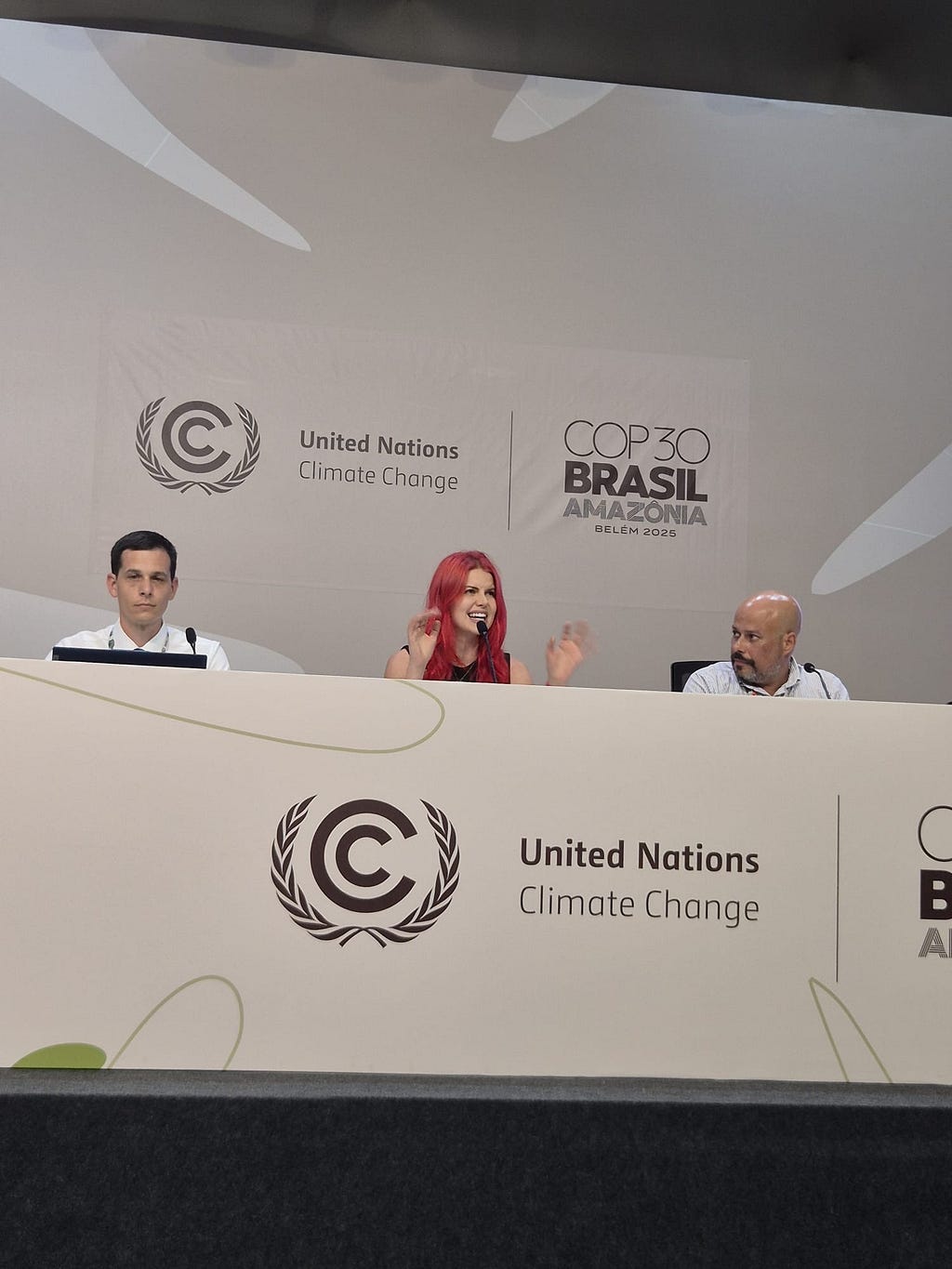
Ekaterina Sky is an impact artist based between Los Angeles and New York whose large scale watercolor paintings have transcribed hidden prayer for the earth. Her work has been presented at COP30 in Belém, Carnegie Hall, Miami Art Week, and LA Climate Week, where she served as Impact Art Program Director in 2025, and she is a fellow of Elected Officials to Protect America. She is the founder of ourlifeforce.org, a reforestation initiative through which each participant plants 165 native trees.
Thank you so much for joining us in this interview series! Before we dig in, our readers would like to get to know you a bit. Can you tell us a bit about how you grew up?
My mom and I traveled from country to country in search of a better life. Every time we arrived somewhere new, I could not speak the language. Children are not always kind to the child who cannot answer, and I was bullied a lot. My mother could not protect me because she could not speak the language either, and I never told her.
Then one day I brought a painting to school and my teacher pinned it on the wall. The whole classroom turned around and saw me. Children came over with their pencils and markers because they wanted to make things with me. For the first time I could connect with people without a shared language. That moment stayed with me: art can take something painful and turn it into something that brings people together.
I have painted since I was six. I studied at the School of Fine Arts in Yaroslavl, then on scholarship at the art school of the Tel Aviv Museum, and later international business in Montreal. English is my fourth language. Art is my fifth, and the only one everyone in the room understands at once.
You are currently leading a social impact organization that is making a difference for our planet. Can you tell us a bit about what you and your organization are trying to change in our world today?
I want to close the distance between feeling and doing.
Most people know that forests are disappearing. Many of us feel deeply concerned, but the problem seems so enormous and far away that we do not know where to begin. We feel something, and we do not know what to do with that feeling.
My art and ourlifeforce.org are two expressions of one mission. The paintings invite people to pause, feel, and reconnect with something greater than themselves. The trees give that feeling somewhere to go. Through ourlifeforce.org, each participant plants 165 native trees: one person’s share of the trees the planet can still hold. It makes a planetary challenge personal and tangible.
We keep looking for complicated technologies to solve our environmental problems. Technology has a role, but nature already knows how to store carbon, support biodiversity, and hold water in the ground. The technology already exists. It is called a tree.
Can you tell us the backstory about what inspired you to originally feel passionate about this cause?
A teacher in Rimouski, Quebec, was the first person who explained climate change to me, when I was a teenager. I never forgot that conversation.
But the experience that changed my life came much later. I had been a professional artist for seven years when I travelled to Borneo in 2019.
Then there was the river. We were travelling along it in a wooden boat and sent a drone up to see the landscape from above. On one side, a living forest. On the other, rows of palm oil as far as the camera could see.
It is one thing to read about deforestation. It is another to witness what has been lost. Borneo’s forests grow over peatlands that have stored carbon for thousands of years, and when the peat is drained and burned, that carbon is released. I could give you the numbers, but numbers would not make you feel what I felt. I wanted people to see that river. That is what art can do. It makes something distant close enough to care about.
Many of us have ideas, dreams, and passions, but never manifest them. They don’t get up and just do it. But you did. Was there an “Aha Moment” that made you decide that you were actually going to step up and do it? What was that final trigger?
It happened when I came home.
I arrived in Borneo a wildlife conservation artist and left as an impact artist with a mission.I used to care deeply about wildlife and I would paint large scale portraits of endangered species yet after that trip I realized that we have to protect the environment they live in and in order to do that we have to provide local communities with resources and networks that they need in order to protect their home. Back in Los Angeles, I started paying attention to what happened after people encountered my work. They were moved. Then they went back to their lives, not knowing what to do with that feeling.
Awareness was not enough. The question changed from “How do I make people care?” to “What can I offer someone in the moment they begin to care?”
The answer was a tree, with a receipt. Something a person could do immediately, knowing their contribution had become a real action in the world.
Many people don’t know the steps to take to start a new organization. What are some of the things or steps you took to get your project started?
First, I did not build an organisation from the ground up. ourlifeforce.org operates as a fiscally sponsored project of the Collidescope Foundation, a 501(c)(3) nonprofit, which gave the initiative a legal and administrative structure from day one. For other artists who want to turn ideas into action: explore fiscal sponsorship before assuming you need your own nonprofit.
Second, I made the idea tangible. Research led by the Crowther Lab at ETH Zurich finds that the Earth has room for about 0.9 billion hectares of new forest, enough for about 1 to 1.5 trillion native trees, according to published estimates. If each of us helps restore about 165, together we can begin to heal the planet at a meaningful scale. The number 165 is the individual contribution at the heart of the initiative, and we sought planting partners who document their work and provide records of the trees planted.
Third, I connected the initiative directly to my art. Someone who encounters a painting should have a clear way to take part in what it represents. The way a project operates should reflect the values in the work itself.
Can you share the most interesting story that happened to you since you began leading your company or organization?
The fire at COP30 in Belém, Brazil, in November 2025.
I was there with a painting called Forests of the World, a work dedicated to the forests of our planet. It was standing on an easel in the Culture Pavilion while I was in another room. When the fire broke out, people began running out of the building. I turned around and went back for the painting. I picked it up, grabbed my backpack, and carried it out through the smoke.
My presentation that afternoon never happened. I had brought the painting across the world to speak beside it, and instead I stood outside a burning building holding it.
I did not save it because of its financial value. I saved it because of what it carries: a message about the forests that I could not bear to lose in a fire. And I think the painting said more by being carried out of that building than it ever could have with me standing beside it speaking.
It has been said, that sometimes our mistakes can be our greatest teachers. Do you have a story about a humorous mistake that you made when you were first starting and the lesson you learned from that?
The same day, actually.
I had carried a professional camera across the world to document everything at COP30. On the morning of the fire, I discovered the batteries were missing. So on one of the most dramatic days of my professional life, I had no camera. The footage that exists was filmed by a friend on his phone.
The lesson was a good one. I had been thinking of myself as the person responsible for documenting the work, when my real responsibility was to do the work. Someone else can hold the camera. You just have to be present.
None of us can be successful without some help along the way. Did you have mentors or cheerleaders who helped you to succeed? Can you tell us a story about their influence?
The teacher who pinned my painting on the wall started everything.
Years later, when I created Prayer for the Earth, a series of paintings with handwritten prayers beneath sustainable 24K gold leaf, I faced a different uncertainty. Who was I to write a prayer that could speak across spiritual traditions? So I took it to mosques, synagogues, churches, and Buddhist temples, to my Kabbalah teacher and my Hindu monk, and asked whether the words honoured their beliefs. I kept listening and rewriting. Those conversations taught me humility.
The people at Health In Harmony in Borneo, who protect forests by supporting the communities who live alongside them, showed me that lasting change requires listening, respect, and an understanding of how everything is connected.
Are there three things the community, society, or politicians can do to help you address the root of the problem you are trying to solve?
First, invite artists into the conversation from the beginning, and compensate them as you would other professionals. Art should not be brought in to decorate a reception after the important decisions have been made. Artists help people understand why those decisions matter.
Second, recognise the value of standing forests. The value of cutting a forest down is easy to measure. The value of keeping it alive, from biodiversity and carbon storage to water and the wellbeing of local communities, is not. We need systems that count it.
Third, plant native trees where people live. In our schools, on our streets, and where communities are rebuilding. In Altadena, six months after the Eaton fire, I painted a mural with community members on the lot where a café had once stood. As we painted, people began talking about what they wanted to plant and what they hoped the neighbourhood could become. Rebuilding is not only about replacing what was lost. It is about imagining what can grow in its place.
How would you articulate how a business can become more profitable by being more sustainable and more environmentally conscious? Can you share a story or example?
I studied international business before I ever sold a painting, so I have always been interested in how purpose and business work together.
Through ourlifeforce.org, we want every tree planted to be documented. That record gives supporters a way to see what their participation accomplished, and partners a way to understand how the project operates.
Credibility is one of the most valuable things a business can build. Many organisations speak about sustainability, but people increasingly want to know what those promises mean in practice. A business that can demonstrate its impact builds deeper trust, attracts people who share its values, and creates relationships that last beyond a single transaction.
Sustainability requires discipline and transparency. It should not be a story a business tells about itself. It should be visible in how the business actually operates.
What are your “5 things I wish someone told me when I first started” and why? Please share a story or example for each.
1. Build the door before you open the window. For a long time I focused on helping people see what was happening to the natural world. But feeling something deeply does not tell us what to do next. Now I think about how to give people a way to participate, not just a reason to care.
2. Transparency is part of the mission. I never imagined that records, receipts, and administration would matter so much to my work. But when you invite people into something you believe in, you owe them a view of what happens next.
3. Create from love, not from fear. There is a place for grief and urgency, but I do not want despair to be the only feeling people associate with the natural world. We care for what we love, and hope creates more action.
4. Be thoughtful about how your work is presented. I now ask organisers to share their written descriptions with me beforehand. It is a small step that keeps the words true to what I actually do and believe.
5. Honour the quiet years. So much of my work happens alone, over months, without anyone watching. I used to think the public moments were the important ones. Now I know the quiet time is where the work becomes what it needs to be. When someone stands in front of a finished painting and becomes still, even for a moment, those months have found their purpose.
If you could tell other young people one thing about why they should consider making a positive impact on our environment or society, like you, what would you tell them?
Never underestimate what can happen when you take one real action.
It is easy to feel the world’s problems are too big for one person. We look to governments, corporations, and institutions and wait for them to make things better. Their decisions matter enormously, but that does not mean we have to give away our own power.
Find something you genuinely care about and ask what you can do today. It does not have to be enormous. It does not have to solve everything. It just has to be real. One action can inspire another person, and we rarely know how far something we begin will travel.
Can you please give us your favorite “Life Lesson Quote”? Can you share how that was relevant to you in your life?
Mine is a line I came to understand through my own life: “I arrived an artist. I left with a mission.”
It reminds me that my years as an artist before Borneo were not separate from the work I do today. They were preparing me for it. I spent years learning how to create, how to communicate through images, how to make something that could speak when words were not enough. Then I encountered something that gave those skills a direction.
Young people sometimes feel pressured to discover their purpose before they begin. I would tell them not to wait. Follow what you love, develop your abilities, and stay open. Sometimes purpose finds you through the very thing you have been practising for years.
Is there a person in the world, or in the US with whom you would like to have a private breakfast or lunch with, and why? He or she might just see this, especially if we tag them. 🙂
Two, if I may.
Yvon Chouinard, because he built a company around a different understanding of value, one that considers the natural world alongside business. I would be curious to hear how he thinks about art, ownership, and our responsibility toward the planet.
And Marina Abramović. Her work has shaped how I think about silence, presence, and the artist’s own life as part of the work. She has shown how powerful it is to create a space where people slow down and experience something rather than simply look at it.
Both, in very different ways, have made work that became larger than themselves. I would love to hear what they have learned along the way.
How can our readers follow you online?
You can find my artwork and projects at ekaterina-sky.com and learn about the reforestation initiative at ourlifeforce.org. I share my work and the stories behind it on Instagram at @ekaterina.sky.art.
This was very meaningful, thank you so much. We wish you only continued success on your great work!
Social Impact Heroes Helping Our Planet: Why and How Ekaterina Sky Of Our Life Force Is Helping To… was originally published in Authority Magazine on Medium, where people are continuing the conversation by highlighting and responding to this story.