

An Interview With Yitzi Weiner
Each main character sets out to make a difference in their community with ripple effects that benefit the planet.
As a part of this series, we had the pleasure to interview Anne-Marie Mawhiney.
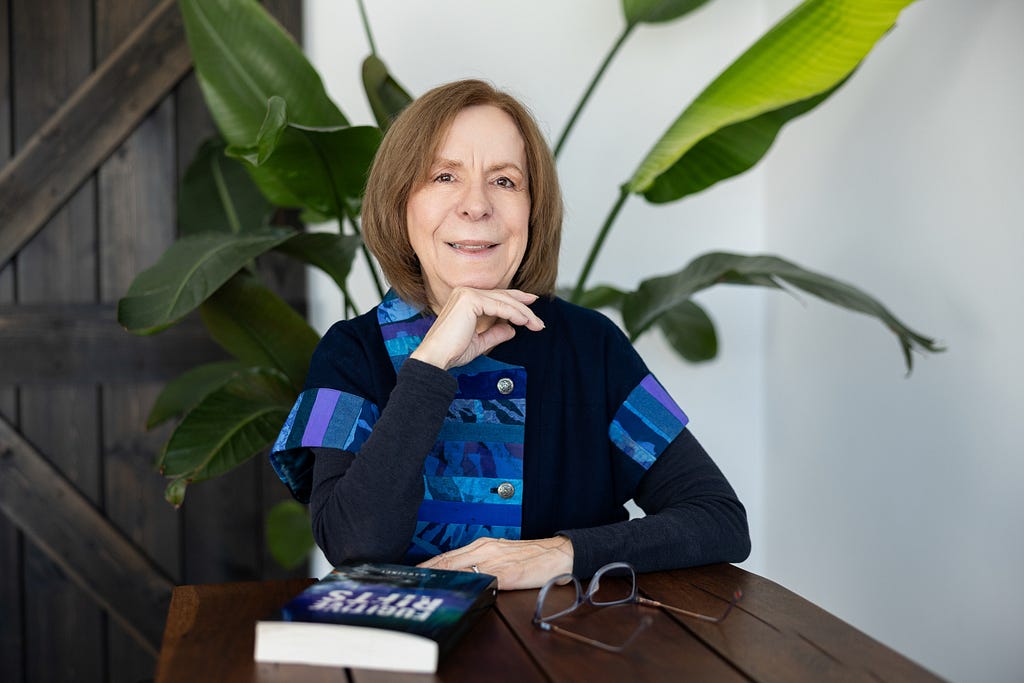
Anne-Marie Mawhiney is the author of Spindrifts (2021), Spelldrifts (2023), and Fugitive Rifts (2025). She lives in Sudbury, Ontario, Canada, known for its successful 40-year re-greening project, which inspired her to write YA Climate Fiction. In May 2026, Fugitive Rifts was awarded the Nautilus Gold Medal for YA Fiction.
Thank you so much for joining us in this interview series! Before we dive into the main focus of our interview, our readers would love to “get to know you” a bit better. Can you tell us a bit about your childhood backstory?
I am thrilled to join you for this interview!
I grew up in a family of three sisters with parents who were teachers, until my mother was fired when they were married, which was the policy in the 1950s for women teachers. Hard to believe, right? Ahead of their time, our parents set out to raise four independent and career-oriented daughters, in a time when this was not encouraged. We moved around in Northern Ontario Canada, first to single-industry mining communities then to a farming area when my father received promotions within the education system. These re-locations meant leaving friends behind and making new friends, which I found difficult, so I escaped into reading, dreaming of becoming an author, and playing the piano. I remain a voracious reader, started writing after my retirement, and have recently returned to my piano.
When you were younger, was there a book that you read that inspired you to take action or changed your life? Can you share a story about that?
When I was in grade six, we read a YA version of Les Misérables called Jean val Jean, by Victor Hugo. I was horrified to learn that someone could be sentenced to be hanged for stealing a loaf of bread to feed his starving family. It opened my eyes to the inequalities in our own times. This started my life-long commitment to advocate for social change, mainly by educating generations of post-secondary students during my career as a university professor. It is not surprising my novels have social and environmental themes.
It has been said that our mistakes can be our greatest teachers. Can you share a story about the funniest mistake you made when you were first starting? Can you tell us what lesson you learned from that?
A few years ago, I was walking in a conservation area near Creston, British Columbia, which is a model for the fictionalized community, Crestview, where the four main characters meet in Fugitive Rifts. I was holding my cellphone to take photos of the mountains, lake, and overall landscape of the conservation area for marketing my book. When I shut off the phone, I accidentally triggered the alarm signaling I was in danger. I became so agitated when the phone rang from 911 (Canada’s emergency number) I dropped the phone. The phone rang again and I pushed the wrong button and disconnected the call. Of course, all this made it seem to the operator I was in danger. When I finally answered the call, I reassured the operator I was fine and she told me she would call off the emergency vehicles heading my way. Then she called one of my emergency contacts, my sister, who was with me, and asked for confirmation I was okay. My sister was laughing so hard she could barely talk but acknowledged everything was fine.
One lesson I learned is how effective that emergency function on our phones is and how important it is that I am mindful of flicking the right place to shut down my phone. Also, when I write a scene where a character is overcome with panic I think back to that moment and use my own experience to recreate the same emotions in my writing.
Can you describe how you aim to make a significant social impact with your book?
In all three of my books, the main characters, who are teens, struggle to find their life purpose. While the worlds in the three books are very different, they all share different versions of social inclusion, respect, and working together. Each main character sets out to make a difference in their community with ripple effects that benefit the planet.
I have had feedback that my books make some readers think about the kind of world they want to live in. I am hopeful, based on this feedback, that some readers may take actions, small or large, to help their neighborhood or community pull together. To make necessary changes I believe working together builds a stronger, more cohesive community, and that even small actions can make a big difference. I write to inspire readers to think about what they want their world to be like and to take steps toward that.
Can you share with us the most interesting story that you shared in your book?
There are several interesting stories in Fugitive Rifts, but I will focus on a group of unhoused people who are evacuated to another location because of an imminent environmental disaster. What happens next will seem unrealistic, however I based this part of the story on Finland’s “Housing First” strategy for unhoused people that has shown significant, positive social and health outcomes over the almost twenty years, so far, of the program.
What was the “aha moment” or series of events that made you decide to bring your message to the greater world? Can you share a story about that?
For me, I would have to say it was a series of events that motivated me to bring my message to the world. In the past number of years, our world has become divisive — social, environmental, and economic institutions have crumbled, and increasing numbers of people are living precarious lives. In 2020, when the first international lockdown occurred, something shifted in our societies’ collective values, mood, and actions. For me, usually an optimist, the world and my safe place in it became threatening. I decided I needed to “go inward” since we couldn’t even go outside our homes. I pulled out my laptop and began to create a world of hope to where I could escape the real world. To my surprise, I found myself writing Spindrifts, a futuristic science fiction about the Land of Hope. I was urged to write a sequel, because it turned out others loved to escape to that world as well.
Looking back, I now realize that the worlds I was building were where I would love to live. They, of course, have moments of difficult situations that bring people together, united on a common purpose, with values that support, rather than divide, communities. These are not perfect, Utopian worlds, but they do have elements of a collective resilience when faced with challenges. In Fugitive Rifts, which is situated in our real world, in our times and into the near future, I incorporated many of the same elements: working together, striving for social inclusion, resilience, and making the world better with small and large actions.
Without sharing specific names, can you tell us a story about a particular individual who was impacted or helped by your cause?
My approach to social change over the years has been inspiring at the collective level rather than on focusing on individuals. My goal has been to plant seeds of change in the minds of students, readers, and others, hoping some will be motivated to nurture change so that lives and communities are transformed. When former students have reached out to me to tell me how I inspired them, I focus on what they have accomplished. Planting seeds is merely a first step in a long journey that, I hope, brings people together to create better communities, socially, environmentally, and with a strong economy so everyone has opportunities to thrive. It is my observation that we may never see the impact we have had on other peoples’ lives.
Are there three things the community/society/politicians can do to help you address the root of the problem you are trying to solve?
My community, Sudbury Ontario is a fabulous case study of positive transformation over the course of forty-five years. Divergent parts of the community — laid-off mining workers, unions, mining companies, local, provincial, and federal governments, university researchers, activists, youths, and retirees — all came together with a vision to rehabilitate the many decades of mining degradation. With concerted effort and extensive collaboration Sudbury has changed from a moon-like burned landscape, dead lakes, and poisoned air to a landscape filled with trees and hiking trails, clean lakes filled with fish, waterfowl, and vegetation, and air we can breathe. There is still a lot of work to do not only with the environment but also socially so that everyone in our community has a chance at a good life.
I believe everyone has a role in addressing social and environmental change, through small and large actions towards building stronger, diverse and healthy communities. Politicians and other community leaders, of course play a role but often change starts at the grassroots.
How do you define “Leadership”? Can you explain what you mean or give an example?
My personal view about leadership is that it is most effective when people come together with different perspectives or standpoints to work toward a shared goal or vision of change. An effective leader understands stronger outcomes occur from a diversity of ideas, and not from imposing their own views or a preconceived outcome
A strong leader is one who believes every person at the table has something important to contribute and creates a climate where each participant is inspired to put forward their ideas even when they are at odds with others’ views. By respecting everyone, the leader sets a tone of respect and collaboration with the whole team.
A seasoned leader understands that diverse views can also create a stronger, more cohesive team as they work through their differences until they reach a consensus on a united vision of what is needed and how to achieve it.
A strong leader also balances the focus on the outcome or product with the process of achieving the end goal. Attending to the project as well as paying attention to team dynamics helps sort through the natural conflict that occurs when people have different ideas. Setting the tone for respectful conflict resolution is key to effective teamwork and the leader plays an important told in ensuring the conflict remains productive instead of destructive.
For the first decade and more of my academic career I had the honor of being invited to be part of a First Nations curriculum project and program led by 21 First Nations of the Robinson-Huron Treaty Area. I was asked to lead the first meeting. I arrived with an agenda and sat at the ‘head’ of the table. I quickly caught on that meetings would not follow the format I was used to.
I learned the value of a different kind of group leadership where every person has their turn at speaking while everyone else listens with respect and without interrupting. There is no one leader. Each person, by virtue of their experience and knowledge, leads a part of the project. I learned the importance of respectful listening, understanding the importance of each person’s words, and learned to respect and trust the process, knowing that the outcome would emerge as it should. The academic program developed through this working group, is now almost fifty years old and is internationally known.
From this experience I learned that leadership is strongest when no one person is in charge of what happens, and each person has valuable relevant knowledge to contribute that will make the outcome better than if one person dominates and wants everything to go through them.
What are your “5 things I wish someone told me when I first started” and why? Please share a story or example for each.
1. Meaningful change takes time. It may seem easy to find a short-term solution for problems but, often, in my experience, this solution can turn out to be ineffective or even harmful. Instead, for effective transformational change, it is critical to dig deep, to understand the history, complexity, the lived experience of the situation, and a range of options before choosing meaningful ways forward. Starting a change action on an informed foundation is more likely to create a transformational shift that is effective in the longer-term. In my home community many of our roads have been in deplorable states for many years. A short-term solution has been to patch potholes and large cracks. This seemed to be the only solution, except the patches seldom held past a few months. With new leadership recently, a long-term plan has meant roads have been torn out, and completely repaved. This can be more disruptive for longer periods, however the road lasts much longer. Social change is like this. We can apply temporary “fixes” that seldom address the issue, or we can take a longer view to remediate the situation. Sometimes a temporary “fix” is necessary to provide short-term relief but if the goal is transformational change, it will take time.
2. Conflict is a natural part of any change process. When I was in my 20s, I thought that almost everyone would see things the same way I did. This, of course, was naïve. I was often confronted with strong responses from team members who had very different views. I would argue to bring people to see my view as the way forward. Early in my career I hated debating and conflict, but with experience I learned to value it because respectful conflict shows trust among team members when disagreements are worked through with mutual respect and focused on a common purpose. Beware, however: the potential for a project to fall apart is high without skillful conflict resolution that brings people together rather than ignoring the early signs that lead to irreparable divisions. The unifying factors for good conflict are a consensus on the product or goal, and strong, mutual respect. Risks to effective teamwork are individual egos, getting stuck in escalating conflict, and hidden agendas that are about power and control rather than with the group’s purpose.
3. Listening is more productive than talking too much or tuning out. As I gained more experience working in teams and committees, I noticed how often what seemed like opposing ideas could be combined into something stronger. I started to listen rather than flooding my thoughts with counterarguments. When my ears were open to others’ ideas, I began to see connections rather than differences and would suggest combining ideas. This often resulted in consensus. With time, other team members also noticed that bringing the threads of different perspectives together wove a stronger and more resilient way forward that often turned out to be more effective in the long-term.
4. Most often the experts are people living the experience. Listen to them. Top-down solutions, in my experience, often do not work because the strategies are completely detached from lived experiences. Instead of assuming what is needed, I suggest that any advocacy group change project include members who can provide the lived experience and advocate for what can actually work to improve lives and conditions. I may have done research and read endless articles about issues, but I was always better informed by the people immersed in the day-to-day realities than by books and studies.
5. Take time to celebrate along the way. There’s nothing like a potluck meal together or a slice of cake during a break to create a sense of group accomplishment, no matter how small or large the progress.
Can you please give us your favorite “Life Lesson Quote”? Can you share how that was relevant to you in your life?
My paternal grandmother was an Urquhart. The (Scottish) Urquhart Crest has the following saying:
“Mean Well, Speak Well, Do Well.”
This saying resonates in my mind and soul as a perfect guide for any person wanting to make a positive social impact. I write stories that I hope will inspire readers to take positive actions that support their family, workplace, community, and beyond. Positive actions, whether large or small, whether as an individual or in a group, are important.
The first step is to think about what your intent is. We see a lot of actions that are divisive and do harm. Let’s be sure that we mean well, that our intent is to assist and support actions that improve lives.
I think we need to bring more kindness and positive energy into our world right now, and it starts with the way we interact with others. Practicing patience, good spirits and encouragements means we speak well and this is as contagious as negativity.
The nice thing about taking meaningful action is how it can draw people together, help others who are struggling, and instill pride. When we do well by helping others, it brings positive energy into the neighborhood. Just imagine what could be accomplished if everyone would take an action of service or assistance in a neighborhood or community?
Is there a person in the world, or in the US with whom you would like to have a private breakfast or lunch with, and why? He or she might just see this, especially if we tag them. 🙂
Sara Paretsky is one of my favorite authors and is also a strong and courageous activist in her community. I would love to have an opportunity to speak with her as I find her so inspiring.
How can our readers further follow your work online?
My website is www.ammawhiney.ca
People can follow me at Twitter/X, Instagram, Bluesky, Threads via @ammawhiney
This was very meaningful, thank you so much. We wish you only continued success on your great work!
Thank you for such interesting questions!
About The Interviewer: Yitzi Weiner is a journalist, author, and the founder & Editor-In-Chief of Authority Magazine. The guiding principle behind all of Authority Magazine’s content is that good stories should be beautiful to heart, mind, and eyes. Yitzi is also the CEO of Authority Magazine’s Thought Leader Incubator, which has guided dozens of leaders to become trusted authorities in their field after becoming syndicated columnists, authors, and media commentators. Yitzi is also the author of five books. At Authority Magazine, Yitzi has conducted or coordinated more than 4000 empowering interviews with prominent Authorities like Shaquille O’Neal, Floyd Mayweather, Kelly Rowland, Bobbi Brown, Daymond John, Lori Greiner, Robert Herjavec, Lindsay Lohan, Cal Ripken Jr., Jillian Michaels, Derek Hough, and the C-Suite executives of companies like eBay, Kroger, American Express, MasterCard, 3M, L’Oréal, Walgreens, Intuit, Virgin, Campbell, Walmart, CVS, Wells Fargo, AT&T, Oracle, ZOOM, Udemy, Samuel Adams Beer, Zappos, Adobe, Capital One, Lockheed Martin, Gallup, Procter & Gamble , Anheuser-Busch, Chipotle, Starbucks, and thousands others. A trained Rabbi, Yitzi is also a dynamic educator, teacher and orator. He currently lives in Maryland with his wife and children. If you are a successful leader in your field, and think you would be a good fit for the Thought leader Incubator, feel free to reach out to Yitzi anytime.
Social Impact Authors: How & Why Author Anne-Marie Mawhiney Is Helping To Change Our World was originally published in Authority Magazine on Medium, where people are continuing the conversation by highlighting and responding to this story.