

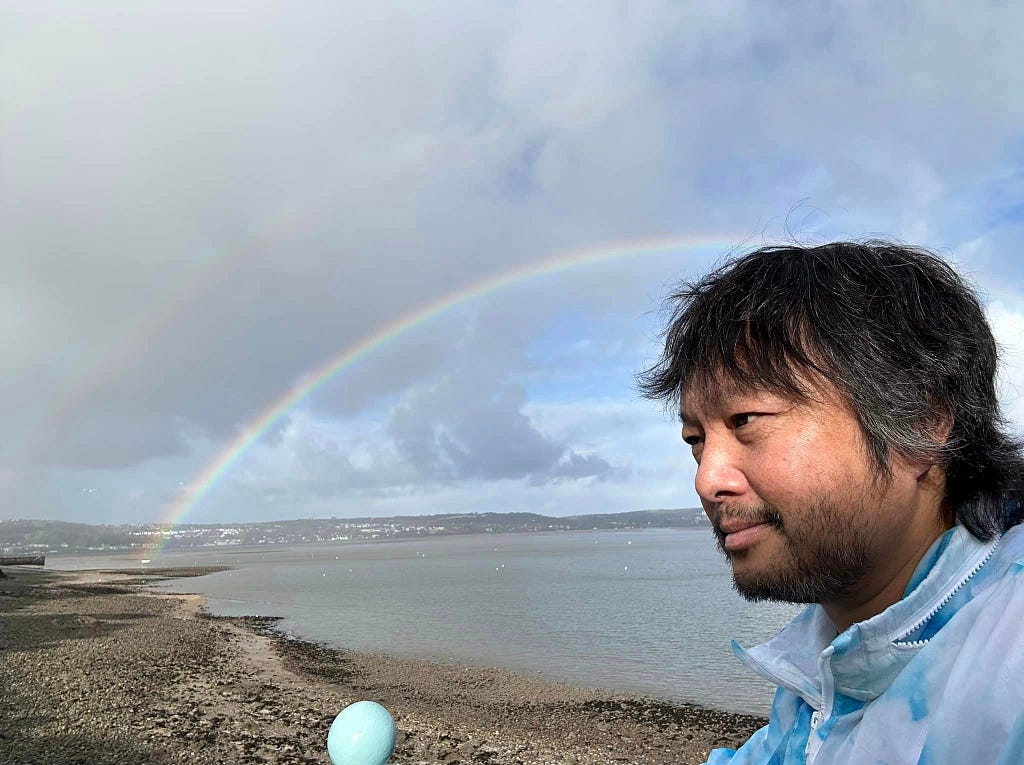

Interview with Guernslye Honorés
I am a stubborn man and my approach might not have changed much no matter what I was told initially. It’s been a strenuous journey but I have no regrets.
As a part of our series called “5 Things I Wish Someone Told Me When I First Became A Filmmaker”, I had the distinct pleasure of interviewing SCUD.
SCUD, a film writer, producer and director, was born in China and moved to Hong Kong as a teenager. After 20 years’ working in the IT industry, he immigrated to Australia, but then returned to Asia to found Artwalker, a studio making numerous controversial yet acclaimed independent films.
“Permanent Residence” was the opening film of the 33th Hong Kong International Film Festival (HKIFF), while “Amphetamine “, also a Berlinale official selection, was the closing film of the subsequent year.
“Voyage” received an “Artistic Achievement Award” from the 49th Chicago International Film Festival and SCUD was the tribute honoree and the first ever Q-Hugo Award recipient.
International Film Festival of Rotterdam (IFFR) will, in the 53th edition, celebrate the filmmaker by a “Focus: Scud” program, a full retrospective of all 10 films in his career.
Filmography
City Without Baseball (2008)
Permanent Residence (2009)
Amphetamine (2010)
Love actually…sucks! (2011)
Voyage (2013)
Utopians (2015)
Adonis (2017)*
Having traveled 100 countries, SCUD left Hong Kong again after shooting the last film, now takes residences in Thailand, Japan, Taiwan and Australia.
Thank you so much for joining us in this interview series! Our readers would love to get to know you a bit better. Can you tell us a bit of the ‘backstory’ of how you grew up?
I was born in Guizhou, the poorest province of China at the time the Cultural Revolution broke out. My grandma made the sound decision to take me to Guangzhou, a southern metropolitan, to live with her for a better chance to survive.
We’re a family of targeted class, that my grandpa whom I’ve never met had been a senior officer of the Nationalist government exiled to Taiwan after the defeat to the Communists, put us in constant danger of starvation and being cleansed. Nevertheless my grandma managed to raise me until my mom got the approval to reunite with her mom in Hong Kong, still a British colony then.
It’s a new world where I learned of the western civilization, the idea of individuality and freedom, the diversities and my sexuality.
Can you share a story with us about what brought you to this specific career path?
I was living in Sydney, to stay long enough for an Australian citizenship. In an ordinary afternoon I had my routine swim then proceeded to reading on a beach. Suddenly something “new” occurred to me, that my depression had to do with the very fact that I’d been fulfilling the dreams of other people but not my own. I’m in fact a person of artistic mind despite my former career in software development. Not long later I came back to Asia to start my film studio, Artwalker.
Can you share the funniest or most interesting story that occurred to you in the course of your filmmaking career?
Call them interesting, most memorable got to be the occasions of our narrow escapes while shooting daring scenes, mostly with full frontal nudity in the public. We went into troubles in Thailand, Hong Kong, and I was once put in custody overnight in Japan. I insisted they release all my actors in exchange of my confession, and they ended up acquitting us all.
Who are some of the most interesting people you have interacted with? What was that like? Do you have any stories?
Michael J Kutza, founder of Chicago International Film Festival, called me one afternoon when my film was there, and we chatted a bit before he decided to cancel an appointment to go see my post-screening Q&A. The volunteers wouldn’t recognize him and he had to pretend to be my publicist to get in! Later he would also appear in a film of mine.
None of us are able to achieve success without some help along the way. Is there a particular person who you are grateful towards who helped get you to where you are? Can you share a story about that?
I met Kristina Aschenbrennerova in Rotterdam when she hosted the premiere of “Bodyshop” earlier this year. She surprised me by telling the audience that my former film, “Adonis”, had a great impact on her for it has “the most handsome casts ever in the history of all cinemas”. I’m sure she’s one to thank for my full retrospect in IFFR later this year, which will mean everything to me and my actors.
Can you please give us your favorite “Life Lesson Quote”? Can you share how that was relevant to you in your life?
The greatest risk in life is wasting your life. It’s not just me and I’ve observed so many missing of opportunities and inconsolable regrets later. If I’ve achieved anything it’s solely because I went all the way while others rescinded.
I am very interested in diversity in the entertainment industry. Can you share three reasons with our readers about why you think it’s important to have diversity represented in film and television? How can that potentially affect our culture?
- Diversity is, and if not, should be the reality.
- Diversity makes the work more vivid and believable.
- Audiences can be coached by what they watch, and the world will be better when people are more informed and accommodating.
What are some of the most interesting or exciting projects you are working on now?
I am in the final post-production of “Naked Nation”, my last film, and I’ve also been revamping my earlier two films for release in Taiwan next year, namely “Plato vs Pasolini” and “Ghost just want to have fun”. It’s a brand new experience of creativity to me.
Which aspect of your work makes you most proud? Can you explain or give a story?
More and more I’ve been told that each of my films pushed the boundaries, that I’ve inspired the conformist Asian filmmakers, from Thailand, Korea, Japan…and even made the Americans appear prude. It’s not necessarily my original intention but I’d take the credit with pride. I do find world cinemas even more conservative than when I was a teenager and would love to be one bucking the trend, even reversing it somehow.
Ok super. Here is the main question of our interview. What are your “5 things I wish someone told me when I first started” and why?
I’m afraid I have to fail this question. I am a stubborn man and my approach might not have changed much no matter what I was told initially. It’s been a strenuous journey but I have no regrets.
When you create a film, which stakeholders have the greatest impact on the artistic and cinematic choices you make? Is it the viewers, the critics, the financiers, or your own personal artistic vision? Can you share a story with us or give an example about what you mean?
It’s got to be my actors. I’ve been the sole investor of all my films. I don’t expect my films to be liked by everyone but some will like them after all. I make films to tell the stories most compelling to me, and share some thoughts. It’s my actors who have had unrestrained faith in me all along, defying secular judgement and sometimes risking their other jobs. Therefore my films were made out of them, also for them.
You are a person of great influence. If you could start a movement that would bring the most amount of good to the most amount of people, what would that be? You never know what your idea can trigger. 🙂
Like being advocated in “Bodyshop”, I wish one day we have the freedom for our bodies to be consumed by loved ones, which will be romantic and environmental friendly.
We are very blessed that some of the biggest names in Business, VC funding, Sports, and Entertainment read this column. Is there a person in the world, or in the US whom you would love to have a private breakfast or lunch with, and why? He or she might see this. 🙂
They’re all dead by now.
Oh, ok, Robert Redford maybe, to thank him for Sundance even though my work has never been selected.
How can our readers further follow you online?
Or my facebook by searching “Scud Cheng”
This was very meaningful, thank you so much! We wish you continued success!
About the interviewer: Guernslye Honoré, affectionately known as “Gee-Gee”, is an amalgamation of creativity, vision, and endless enthusiasm. She has elegantly twined the worlds of writing, acting, and digital marketing into an inspiring tapestry of achievement. As the creative genius at the heart of Esma Marketing & Publishing, she leads her team to unprecedented heights with her comprehensive understanding of the industry and her innate flair for innovation. Her boundless passion and sense of purpose radiate from every endeavor she undertakes, turning ideas into reality and creating a realm of infinite possibilities. A true dynamo, Gee-Gee’s name has become synonymous with inspirational leadership and the art of creating success.
Director SCUD: 5 Things I Wish Someone Told Me When I First Became A Filmmaker was originally published in Authority Magazine on Medium, where people are continuing the conversation by highlighting and responding to this story.