


Building the Sacred: How a Jewish Leader and a Catholic Artisan Family Crafted an Ark of Faith and Friendship
“In the world that we’re in today, when there’s so much division and there’s so much hatred and everything, to get to work on a project like this with Roger… it was actually a spiritual journey. And hopefully, we make some difference in the world that we live in with humanity, with these teens. If we can change a few of these young teens, in years to come, they’re going to be the world.”
I had the pleasure of talking with Roger Korman, Paul Sirofchuck, and Mandy Sirofchuck. In a world that seems to thrive on division, you sometimes find stories that quietly push back, stories forged not in headlines but in workshops tucked away in the woods. This is one of them. It’s a story about a sacred ark, an observant Jew from Philadelphia, a devout Catholic family of artisans from Western Pennsylvania, and the spiritual bridge they built together out of wood, glass, and mutual respect.
The story begins, as so many do, with a search for meaning. Roger Korman found his purpose at Camp Tel Yehuda, a Zionist youth camp in upstate New York. Born in Brooklyn, he found the formal synagogue services of the 1950s discouraging. “There was a heavy emphasis on davening,” he recalls. “I wasn’t a good reader, and I was getting pretty discouraged.” But a trip to Tel Yehuda changed everything. The camp, he says, “just opened up my whole body, soul, mind, to Jewish practice, to inspired spirit, and certainly an identity to the Jewish people and to Israel. And that really changed my life.”
Decades later, now serving on the camp’s Board of Directors, Korman saw a problem. After helping renew the dining hall and other facilities, his attention turned to the camp’s spiritual heart. The Aron HaKodesh, the ark that holds the sacred Torah scrolls, was, in his words, “pretty sad.” He needed more than a carpenter; he was looking for someone with “a divine spirit who could interpret what the Torah means to the Jewish people, what it means for all humanity, and be able to interpret it in a physical form.”
The answer to that search came from an unlikely place: Ligonier, Pennsylvania, where master wood artisan Paul Sirofchuck and his wife Mandy, a stained-glass artist, live and work surrounded by nature. Paul, who left a career in architecture for the fulfillment of woodworking, sees a divine partnership in his craft. “There’s always that other hand that is on your shoulder and guiding you through decisions that you have to make,” he says. Mandy, a journalist by training, found her passion in stained glass, inspired by the Gothic cathedrals of Europe. Raised Catholic in the diverse landscape of Long Island, she was no stranger to Jewish culture.
The project’s pivotal moment came in Paul’s workshop. To help the artisans understand the project’s soul, Roger brought an old, unusable Torah scroll all the way from Philadelphia. “I took it out to Ligonier. I put it on the shop… I undressed it. I unrolled it. And it was a magical moment,” Roger remembers, the emotion still fresh in his voice. “It was a magical moment of two faiths just uniting, and I get goosebumps even remembering it today.” He began to read a few lines in Hebrew, then looked at Paul and Mandy. “This is the Old Testament,” he told them. “This is the word of God.” In that moment, he says, it felt “like an explosion of mutual faith and understanding.”
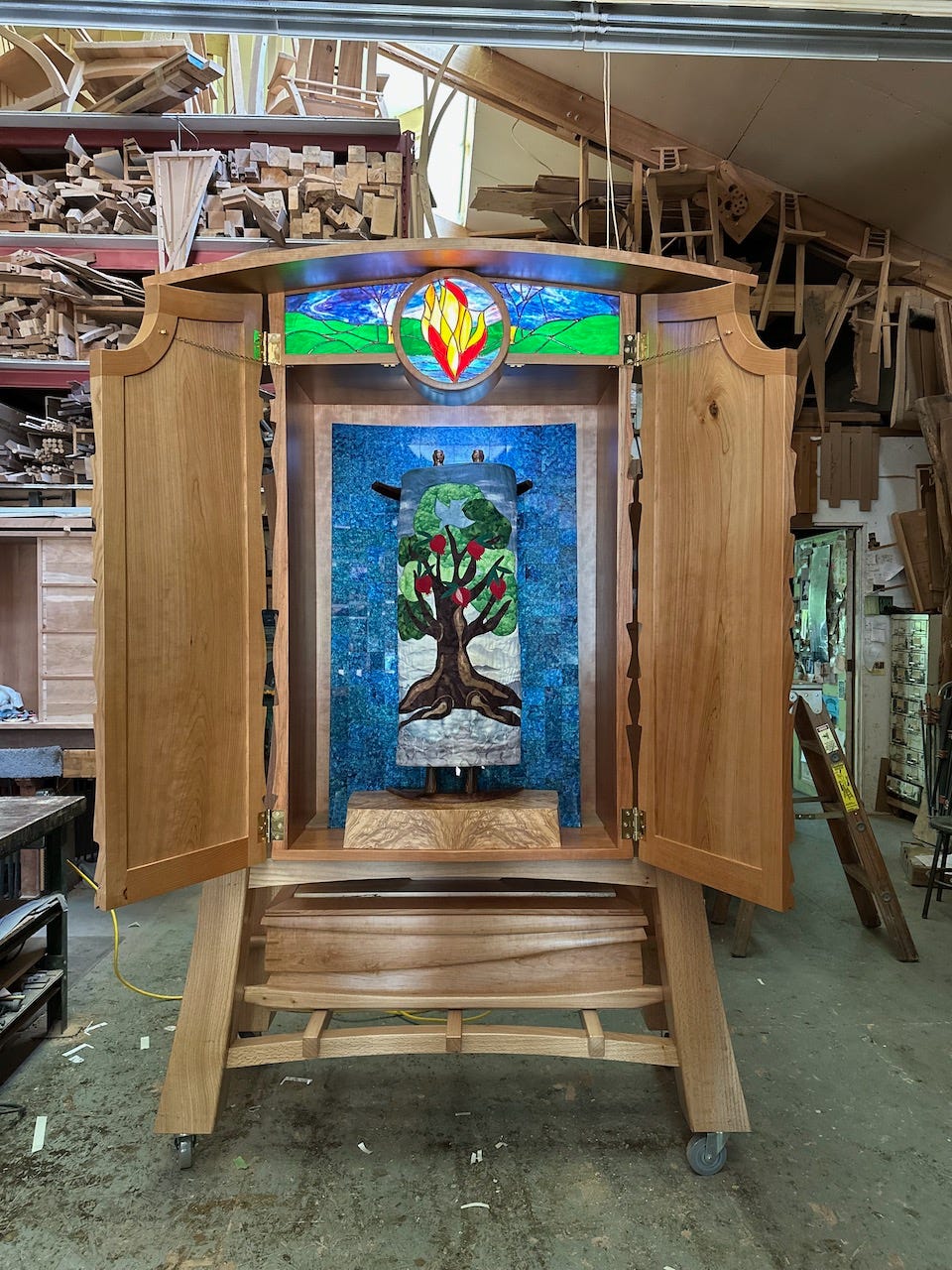
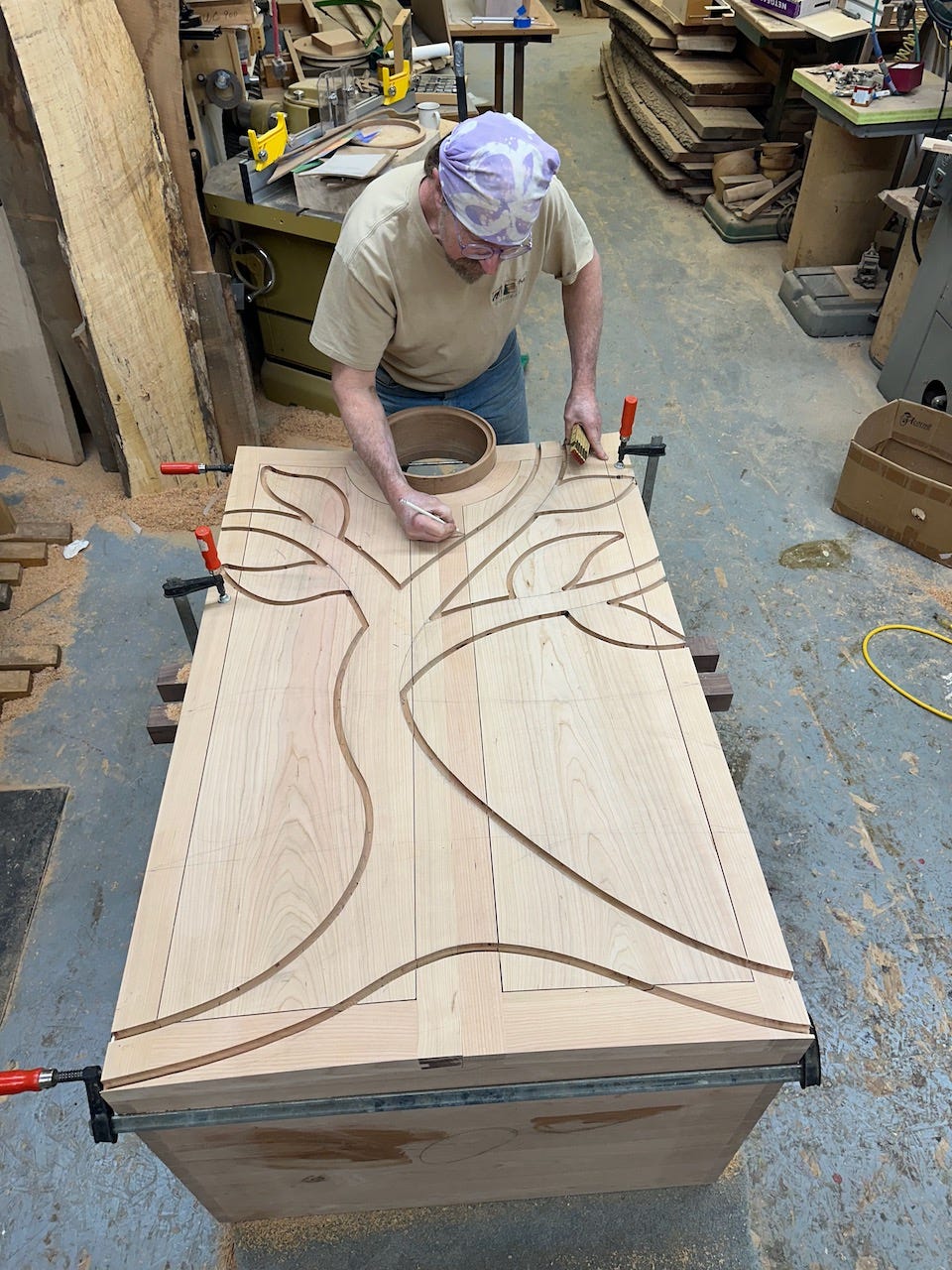
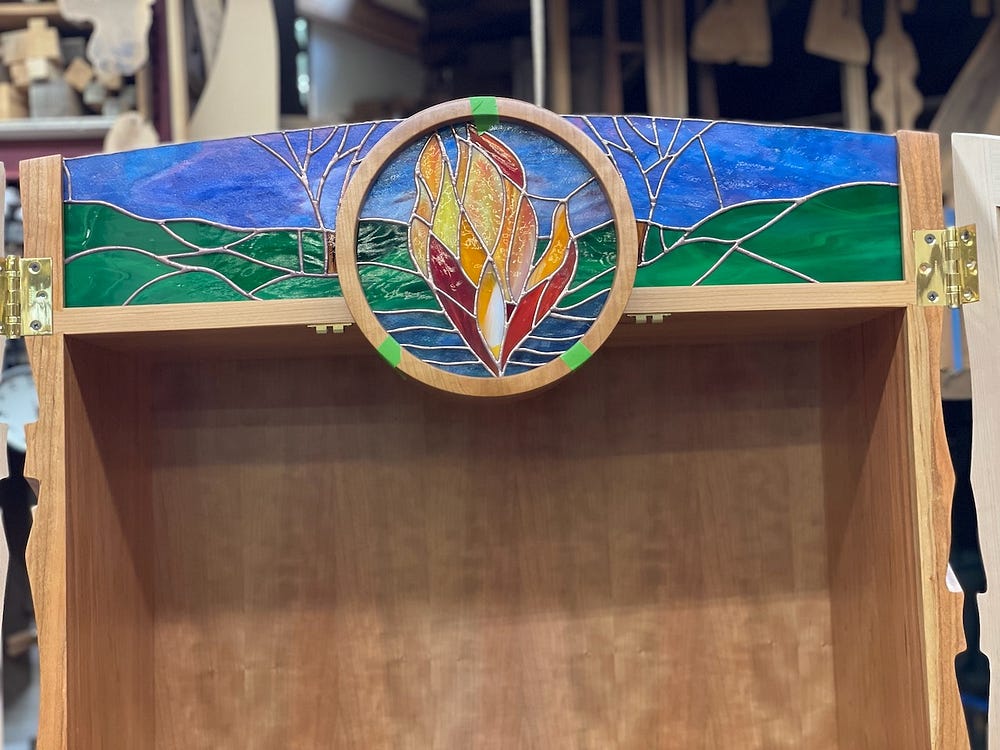
From that explosion, a singular vision emerged. Paul and Mandy, along with their son-in-law Christopher Mayer, didn’t just build a cabinet; they channeled a story. The Aron HaKodesh was imagined as an etz hayim, a tree of life. “The oak legs of it already convey the foundation and base of the tree that holds the cabinet,” Roger explains. The doors, carved from cherrywood, feature five leaves, representing the five books of the Torah. Mandy designed a mantle with five pomegranates and created a stained-glass centerpiece symbolizing the Ner Tamid, the eternal flame, set against a backdrop of mountains and streams mirroring the camp’s landscape. “The sky on that piece,” Mandy notes, “there is no other glass like that. I had one piece of that. That was it.”
The result was more than beautiful; it was profound. When a visiting rabbi from the UK saw the newly installed ark, “he started to cry,” Roger says. “And he said, ‘This is the most beautiful Aron HaKodesh. It’s more than beautiful, it’s meaningful.’”
The project also included a portable ark, allowing the camp to hold a new processional where campers carry the Torah down to the river for Shabbat services. It transformed a passive object into a living, active presence. For Paul, the ultimate goal is to inspire the next generation. He hopes a teen might see the ark, maybe in the middle of the night when the camp is quiet, “and this lit cabinet speaks to them in a certain way that they might leave with some inspiration… they don’t forget that image. And it was a teaching moment as well.”
In the end, the creation of a Jewish ark by a Catholic family became a quiet testament to a shared humanity. Mandy hopes the teens see the story behind the art — the “mutual respect that we had for one another.” For Paul, it was a spiritual journey that strengthened a friendship in a fractured world. “If we change a few of these young teens,” he muses, “in years to come, they’re going to be the world.”
Roger puts it most directly. The project confirmed a core belief. “There’s only one divine God. We celebrate and honor in different ways, but we are all humankind together.” It’s a simple truth, given form in oak and cherry, in colored glass and shared reverence, a silent lesson for anyone willing to look.
Yitzi: Roger, Paul and Mandy, it’s a delight and an honor to meet you all. Before we dive in deep, our readers would love to learn about each of your personal origin stories. I guess we’ll start with Roger because you’re on my left side. Roger, can you tell us the story of your childhood, how you grew up, and the seeds for all the amazing things that have come?
Roger: Okay. I’ll try to keep it to less than a whole encyclopedia. I was born in Brooklyn. I was actually born on the Lower East Side of Manhattan. I grew up in Brooklyn and I participated in a conservative synagogue. Over time, the formality of the synagogue in those days, the 1950s, really was discouraging me from, I would say, being an inspired Jew.
It was a heavy emphasis — I’ll use a word that Yitzi knows — it was a heavy emphasis on davening. I wasn’t a good reader, and I was being, I guess I was getting pretty discouraged. My brother told me to go to this camp, the camp that he went to, which is a Zionist team leadership camp, Tel Yehuda. It’s the team leadership camp of the Young Judea organization. It’s the oldest Zionist organization in the United States, youth or adult. And there, it just opened up my whole body, soul, mind, to Jewish practice, to I would say, inspired spirit, and certainly an identity to the Jewish people and to Israel. And that really changed my life.
I learned Hebrew. From Hebrew I then was able to study texts with a greater understanding. I went to Israel on the Young Judea year program when I was 17. I’ve been back to Israel several times. Then I came back to Tel Yehuda for many years as teachers of leadership, in leadership, various roles of Hadracha. And really, I also met my wife there and we had kids. The kids went there. Now our grandchildren are going to the camp. And it’s really been the source of not only just my socialization as a person, but my identity as a Jew and as a human being.
And now, my wife Fanny and I are on the board of directors and we’re in the process of renewing the entire camp, piece by piece by piece. We got to the the point of looking at the Aron HaKodesh at the spiritual part. Now that we’ve secured the dining room facility and all the other facilities, we looked at the Aron HaKodesh and Benu between us, it was pretty sad.
I looked around for someone who had — the only thing I could describe it as is a divine spirit who could interpret what the Torah means to the Jewish people, what it means for all humanity, and be able to interpret it in a physical form. In not only just an Aron HaKodesh, but Paul built a shulchan, a table, and also a portable Aron because we have a Makom Tefilah. We have a Makom Tefilah outside by the river. And so it’s actually these three pieces that Paul and Mandy designed and executed.
Mandy: Well, I’ll go next since I’m also from Brooklyn. I didn’t grow up in Brooklyn. I grew up in Suffolk County, Long Island, and grew up in the Catholic faith. I’ve always been Catholic, and growing up in New York, it was a very diverse community. I went to a public school, had a lot of Jewish friends. And as a matter of fact, my father’s stepmother was Jewish, Esther Goldstein. So, I did have Jewish relatives. So, I was not foreign to the Jewish faith and Jewish customs. I’ve been to a Bar Mitzvah or two.
Growing up in that environment, I think I’m open to diversity and I went to Temple University, which was another very diverse college. I’ve been around different cultures, different faiths. I was also exposed to a lot of art even though my background is not art initially. I am a journalist. I have a degree in journalism from Temple, but I did pursue art after that because I actually had decided while I was in journalism school that I would have rather been in art school, but they told me I would have to start all over again and I couldn’t afford that. So I took courses afterwards.
But so I’ve combined journalism, public relations, graphic design, and fine arts. I got very involved in stained glass when I was in high school, actually, because I did a research paper on medieval stained glass and I had been to Europe and I’d seen beautiful Gothic cathedrals and things like that with stained glass. I was very intrigued by that. When I graduated from college, I took a college-level course in stained glass and I’ve taken many courses since then. That’s how I got into the stained glass end of things. And that’s how I got involved in this project. Paul and I have always worked together on design. I’m a very two-dimensional person and Paul was always three-dimensional, so we worked very well together in that regard.
Paul: I grew up in Western Pennsylvania in the mountains and the hills. I was always outside playing in nature. I went to Temple University for architecture, studied architecture, and became an architect. That’s where I learned the design part of where I am today. I wasn’t getting my fulfillment from architecture, so I started doing woodworking which I had done as a child actually, and that’s what brought me the most joy was actually designing projects and working with wood. Living in the woods in Ligonier, where we live in nature and we harvest our own trees.
It has brought me closer to my faith, I think because a lot of times when I do projects, there’s always another hand involved when I’m done with it because it comes out differently than what I had anticipated it would come out as. So that’s the spiritual side of what woodworking brings me back closer to my faith. So I love doing projects that have meaning. Instead of just a table and chairs, I can do a more spiritual project whether it’s for whatever faith, Catholic, Jewish, whatever. Liturgical pieces have always enthralled me because I can use my skills, my God-given talents and my skills, which I truly believe that’s where the talent comes from. I’ve learned it and I can execute it, but there’s always that other hand when you, especially when you’re alone in your shop and you’re working, there’s always that other hand that is on your shoulder and guiding you through decisions that you have to make.That’s what I brought to the project. I am Catholic in my faith as well, but I certainly learned a lot about Judaism with Roger, so I’m learning all the words and everything too.
Yitzi: Roger, can you share with us the most interesting or memorable or meaningful story that transpired in the course of this project?
Roger: I knew what we wanted in terms of the pieces themselves. I tried to represent. I actually took a Torah, a Torah pasul that was not being used. I took it out to Ligonier. I put it on the shop, on the work table. I undressed it. I unrolled it. And it was a magical moment. It was a magical moment of two faiths just uniting, and I get goosebumps even today when I took it out and I can read Torah, and I just started to read a few lines. Then I looked at Mandy and Paul and I said, “This is the Old Testament. This is the word of God.” And it was just like an explosion of mutual faith and understanding.
Then, the Etz Hayim book influenced the design we were going to create.. I brought one out and we were kidding around, we started to talk about how do you design this piece or pieces? I can’t remember exactly whether it’s in Leviticus or Exodus, and I said, “Look Paul, we don’t have to figure out how to design this thing. Look, the dimensions are… God gave you the specs. Three cubits by two cubits by one cubit.” We didn’t do the gold cherubim. Yeah, I said, “No, that’s a little bit too much.” There was this, I would say, this magical moment of united faith and understanding of what binds us as human beings, as part of a divine spirit. It just carried through in everything that Paul and Mandy designed. I had nothing — I guarantee you there ain’t nothing in the end product that you can say is my contribution. It’s all from their incredible design talents and really spirituality, that they understood what we wanted to achieve. Paul has, I think, his own words to describe what he wanted to achieve.
Yitzi: Mandy, from your experience and your artistry, can you share some of the design elements and what they represented and what you wanted to convey?
Mandy: Mine was probably the easiest because I think Roger was somewhat specific. He wanted a symbolization of the eternal flame and that was going to be in the center. How exactly it was going to be incorporated into the door, well that would be Paul’s job. Because he also wanted the glass to represent the setting where the camp was located, it was easy for us because it was very much like where we live– mountains, sky, and streams. I had very specific parameters. Paul already had the outline of where the door — the cutout for the door and all that.
My job was just to take a pattern size and incorporate these elements of the divine flame, the mountains, the streams, and working into glass. I had to find some really cool glass, which I did. I had a few pieces. As a matter of fact, Roger, the sky on that piece, there is no other glass like that. I had one piece of that. That was it. If I made a mistake, it wouldn’t have worked out the same. I went through all of my glass. I held it up to the sunlight. I held it up on my light table and it was just perfect because even with the lights not shining behind the door, the blues would still look pretty, the greens would still look pretty. That was the biggest design challenge for me was getting the right glass.
Paul: Roger will tell a good story of how the cabinet, and the construction of the oak legs and the tree of life and the five leaves.
Roger: I can explain it, but I can’t in any way describe how Paul came to it. I mean, what I did was I drew a box, just a box with the arc on top and a cabinet underneath. Out of that, Paul imagined, because we kept coming back to etz hayim. The rollers, they understand that the rollers are the etzim. We had a meeting with a sofer on how to design the etzim, what woods to use, could they be decorated. And so there was a deep element of understanding of what the meaning of the project was.
I have to digress and I think the midrash about the vessels of light and the sparks being too powerful and the vessels break and the sparks come to earth. I love that midrash and I always think that there are divine sparks in everything, right? I think Paul’s talent is to take wood — and you see the wood slabs. We have pictures of what he started out with. They’re just slabs of wood — and he reveals the essence of the divine through his hand, through his work. The cabinet itself is imagined as a tree. The oak legs of it already convey the foundation and base of the tree that holds the cabinet, the Aron itself, and the tree of life.
Mandy designed the mantle with five pomegranates for the obviously, the Humash Torah. Then Paul and Mandy together came up with the idea that the doors — and it’s a shame you can’t picture the doors — is an incredible representation of etz hayim with five leaves. The cabinet is cherrywood, the legs are oak, and they have a mass to them and it conveys strength, but at the same time, there’s a delicacy when you open up the carving. You see the beautiful mantle that Mandy designed, the stained glass representing our valley and of course the Ner Tamid. Its a beautiful backdrop of blue, like a techelet of blue behind the Torah.
We hosted a Rabbi from the UK at camp last summer. His name is Rabbi Adam Drucker, and he walked in once we had just delivered and unwrapped it and he started to cry. And that’s the only way I can explain it. And he said, “This is the most beautiful Aron HaKodesh. It’s more than beautiful, it’s meaningful.” I tell Paul, “Well, we need a box kind of thing to hold something,” and he comes up with this phenomenal design and executes it with his son-in-law, with Mandy and Paul’s son-in-law Christopher Mayer. Christopher… you should see… it’s a shame we don’t have pictures of the etzim on the top. He in laid turquoise. There’s just so many nuances to their design that this is why I want to turn it back to Paul because it really then became a project about inspiring teens.
Paul: In the end it certainly has been a pleasure to work on it and very inspirational for me myself. Christopher and I had many conversations about how we were doing different things on it. To figure it all out and to put it together so that it physically does what it’s supposed to do — that’s the architect in me trying to do this and to figure out how that’s going to happen in wood, but still be a work of art is the tricky part.
In the end, it’s a very spiritual journey because there’s always more than I had expected when I stand back and I know that the hand of God has helped me to bring this to life. With the hopes that the teens got to go out and see it in use at one of the camp meetings, but to actually see the teens. Our hope is that the teens that are going to see this in the future would certainly be inspired. Maybe they’re not close to their faith now, maybe they come in during camp in the middle of the day or middle of the night, nobody else is there but this lit cabinet speaks to them in a certain way that they might leave with some inspiration from camp.
They may not know for months, years, 20 years down the road, they may say, “That really affected me,” like Roger was affected by attending the camp. That it may affect the rest of their life and bring them closer to their faith and an understanding of their faith. I think the cabinet with some of the symbolism that’s in it — with the tree of life and the eternal flame and I think it becomes a teaching cabinet as well that they can use at camp. That the Rabbi can let the kids benefit. Kids that are, they’re talking to themselves and they’re talking to their friends and they’re not paying attention, but I think if they see something that would be inspirational to them and things can be pointed out, now they have a picture in their mind, an image in their mind that they go back to, they dream about it, they sleep with it, they live with it, it comes back to them years from now and they don’t forget that image. It was a teaching moment as well. They’ve learned something closer, they’ve learned something about their faith that might bring them closer.
Roger: I want to talk about one element that we created. We have the Aron and we have the table, the shulchan. The shulchan again is in the same motif as the Aron: massive legs that again convey power and strength. However, when we have Shabbat and the weather is good, Shabbat’s held outside by the river. It’s a beautiful location overlooking the river. The third element became a portable — literally an ark. If you see in the pictures, there’s this box underneath it with a carving that represents the river.
But with the services, Shabbat services begin by campers being chosen to carry the ark out. They put the Torah in the ark, and then they have a processional. So the Torah comes in being carried. It’s active, it’s alive, it’s not passive. Sure it’s magnificent when it’s sitting in the Aron HaKodesh, but when it’s carried down to the river, there’s a grandeur of an entrance. It’s like the queen, right? It’s like “She has arrived.” It’s a very sacred box. It emits that sacredness by the carving and the handles and the oak.
I think to have the four campers that are chosen, it becomes a real honor for them to actually be chosen and get to carry it down there. That’s something too that I think, they think that it could be remembered. Will it be? I don’t know, but it could be something that comes back and says, “Yeah, I was at that camp. It had an impact on my life. I want to go back to the camp. I want to send my kids to the camp.” As I said, just as Paul said, some camper, maybe he has a feeling, maybe he doesn’t, but now he’s carrying the Torah and he’s carrying it in… and it’s a bit of a walk. And so there’s a sense of weight and the Torah has a physical dimension to it in addition to its spiritual dimension. And then after service, after tefillot, there’s a recessional, so four other campers are carried out. It’s a sense of… tefillah, prayer begins with the Torah and ends with the Torah. And it’s just magical what Paul and Mandy have created. And Christopher, got to give him credit since he carved the box. He carved the ark.
Yitzi: What do you think you’ll take away from this experience? What do you think will stay with you for the rest of your life from the experience of making this Aron?
Roger: For me, it’s that there’s only one divine God. We celebrate and honor in different ways, but we are all humankind together. And we’re all God’s creation, and for me, this is the ultimate achievement — if you say the achievement. This is a purpose of humanity, community and fellowship. And I’m honored to have been able to have done that with the Sirofchucks and the Mayers.
Mandy: And I think too, how many similarities there are even within our differences. The rituals… oh yes, there’s only one God. The way Catholics look at God and the way Jews look at God and the way ceremonially we experience that… we have items in our faith that we use when we might have a procession, or we use a tabernacle which would be like your Aron to hold what would be the holy of holies. And when that is removed for a special occasion, it’s put into a monstrance, which would be like your ark. And the priest, the celebrant to carry that, has a special shawl that has to be wrapped around that, which is like your mantle for the Torah. And so there are so many similarities, which even though there are differences, you can see how similar we are in worshipping God.
Paul: Yes, I think there are a lot of similarities. I think in the world that we’re in today, when there’s so much division and there’s so much hatred and everything, to get to work on a project like this with Roger, in our friendship. It’s just developed our friendship so much more than doing furniture for a house even. Because of the spiritual journey that it was on. It wasn’t just a piece of furniture, it was actually a spiritual journey. And hopefully, we make some difference in the world that we live in with humanity, with these teens, with… if we change a few teens that make the world a better place. I’m getting up there with Roger, I’m 64. If we can change a few of these young teens, in years to come, they’re going to be the world. I think that’s the best we can hope for– that this spiritual journey that we were on also continues into the future with some teens that are using this, and then they also make an impact when they’re older.
Mandy:, I was just thinking too, maybe something that those teens might come away with, if they know that a Catholic family was involved with this, is the fact of the mutual respect that we had for one another. We were asked by Jewish people to create this and we created it for their very special services out of respect for their beliefs and the way they believe. I’m hoping that this joint effort will be evident to future teens, showing mutual respect for our other faiths. We can worship together even differently.
Yitzi: I want to wish you both continued success, good health, and blessings, and I hope we can do this again next year.
Roger: Thank you very much.
Building the Sacred: How a Jewish Leader and a Catholic Artisan Family Crafted an Ark of Faith and… was originally published in Authority Magazine on Medium, where people are continuing the conversation by highlighting and responding to this story.