


An Interview With Yitzi Weiner
It is no measure of health to be well-adjusted to a profoundly sick society.
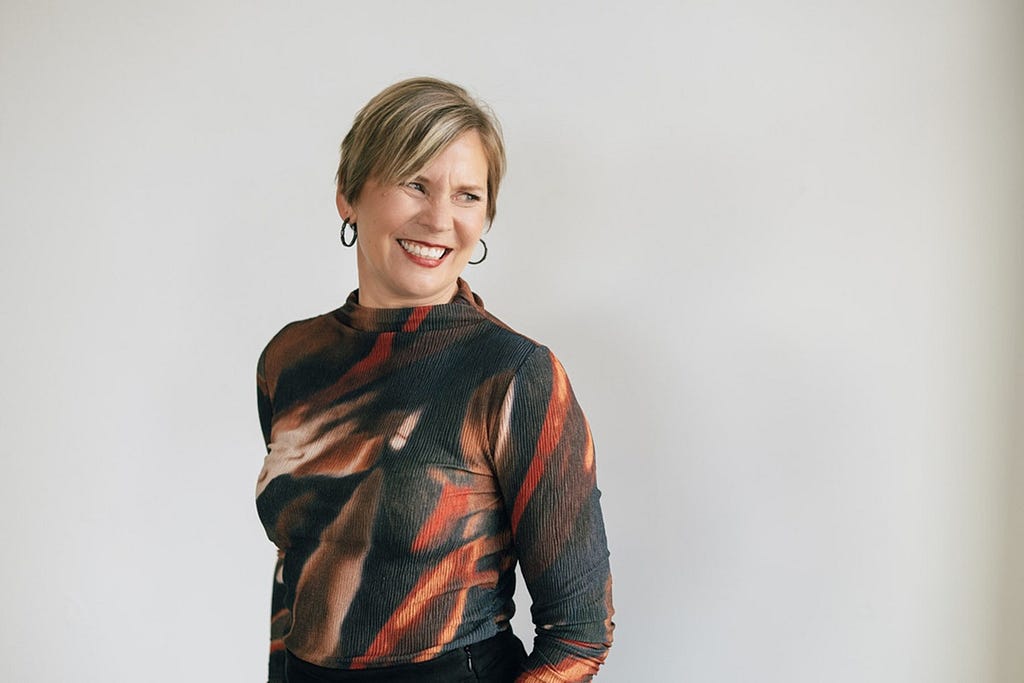
As part of my series about “authors who are making an important social impact”, I had the pleasure of interviewing Keri Mangis.
Keri Mangis is a TEDx speaker and multi-award-winning author whose work stands at the crossroads of culture, consciousness, and transformation. She challenges the status quo with a clear, courageous voice, calling us to move beyond platitudes and into the deeper work of remaking ourselves in times of crisis. With over twenty years of study in yoga, Ayurveda, alchemy, Jungian psychology, and archetypes, Keri brings depth, nuance, and urgency to the cultural conversation.
Thank you so much for joining us in this interview series! Before we dive into the main focus of our interview, our readers would love to “get to know you” a bit better. Can you tell us a bit about your childhood backstory?
I grew up in Fargo, North Dakota in the 1980s. I was the oldest daughter, responsible, self-aware, and slowly learning and integrating the ways of my Scandinavian female heritage. All around me the women were strong, stoic, and endured all kinds of pain and discomfort. I can still see my grandmother’s arthritic farm hands as she washed the dishes in water so hot no one else could stand it.
Much of what we were taught was through visuals and example, not words. I observed, as the women did the cleaning, cooking, and housework and the men watched football and drank beer. I paid attention to the silence — the silent fights, the quiet enduring, the stoic masks that insisted nothing was wrong. I didn’t know what I wanted at that time — but as a child, you don’t know there are other options. And so, I absorbed the conditioning, deep in our bones. And even when I moved away for college, these are the life lessons that followed me for many years.
When you were younger, was there a book that you read that inspired you to take action or changed your life? Can you share a story about that?
While I was young, I read a lot. But it was simple stories, like Nancy Drew, Hardy Boys, and other mystery novels. I loved all the Flowers in the Attic books, too. But no, I wouldn’t say any of these books created a turning point. That happened when I read The Celestine Prophecy, probably in 1996. It blew my midwestern, Protestant, well-behaved-girl conditioning out of the water. These ideas, these questions! This opened possibilities within me about all the ways one’s life can go, and what we are here for. These ideas were further expanded when I read Conversations with God, maybe a year or so later.
But — as we often do as humans, the inspiration lasts only so long. Eventually, getting married and having two children took precedence over the itch to continue to discover. It didn’t resume until 2002, when I fell into a deep depression, signed up for a yoga class from a master teacher, and slowly began to open the pearl of my own mind once again.
It has been said that our mistakes can be our greatest teachers. Can you share a story about the funniest mistake you made when you were first starting? Can you tell us what lesson you learned from that?
For me, my greatest mistake has always been believing that I needed to be the expert. The guru. The one who knows. Early in my career, I had so many teachers and styles that I admired and drew from. This is what we’re supposed to do, I know that now. But there is a difference between drawing inspiration from others, and trying to become them.
I remember once, I led a sold-out weekend retreat for students who had known me and my style, at that time, for a little over a year. I had just come from another teacher’s intensive workshop, and so I tried as hard as I could to be just like him. I thought that’s what people would want for this big weekend: something bigger and better than me.
It was a successful weekend. But one woman came up to me afterwards and said, “Thank you. I learned a lot. But I missed you.” It has stayed with me all these years, and I can now chuckle about it — because I can still remember and have compassion for that version of myself who didn’t yet believe she could be admired and respected just by being herself. If I could talk to that version of myself today, I would tell her: “I know you have to go through this — it’s part of the process. But one day you’ll feel so settled in who you are, you couldn’t mimic anyone else if your life depended on it.”
Can you describe how you aim to make a significant social impact with your book?
In my book, I talk about the weight and persistence of the status quo — that is, the “way things are.”
When we humans get busy just living our lives, we tend to go on autopilot. Well, so does a society. It’s not about whether the habit is a good one or a bad one — unconscious behavior leads to staleness of ideas, growth…even our own evolution.
Collective change starts with noticing: How it seems there are the same kinds of people in power. How when it comes to the wealthy, there always seems to be a get-out-of-jail-free card, whereas for the poor, there’s never enough money or resources to help them. How despite our efforts as individuals to live in a better world, we keep spitting out the same problems and limitations as ever before.
If, through my work, I can encourage people simply to notice this phenomenon, that is such a great start. Because the status quo — and those who benefit from it — doesn’t want to be observed. It wants us to continue to blame one another. Fight amongst ourselves.
So, stopping: that is the first step. Noticing. Acknowledging where we have benefited from, allowed, or even perpetuated the current system.
Can you share with us the most interesting story that you shared in your book?
In 2013, I took a solo pilgrimage to Myanmar. It was during a liminal time in my life. I was between identities, and needed to do some inner reflection and exploration. Where better to do that than far away from everything I knew!
I did have a guide each day, which was amazing, because I got so much more inner access than a regular tourist ever would. Maybe even more than I was comfortable with!
One day, my guide, Sine, pulled over on the side of the road on our way to our new destination. (It did not escape my awareness that he could have left me right there, and perhaps I would never have been found again — it was that rural.)
He asked me to follow him, and so I did, to a very small home. He began a conversation with the women there, and soon, they invited me in. My guide served as a translator as I got to know this family. There was a little boy. I learned he was five. They were fascinated with me, and I with them. They brought me tea, and snacks, and while I thought they would ask me a lot of questions about America, they spent more time proudly talking about their country, their lives. I soaked it in.
When we left, I asked Sine: “How do you know that family”?
He chuckled, “I don’t.”
What was the “aha moment” or series of events that made you decide to bring your message to the greater world? Can you share a story about that?
My “aha moment” was more of a cycle than a moment. It went something like this:
Follow the script I’d been given. Stay dedicated to the path I think I’m supposed to be on, even as my body sends increasingly urgent signals that something is wrong. Ignore those signals until I can’t anymore. End up in a medical emergency, questioning everything I thought I knew about myself and my life.
Find the right support. Hear, for the first time in my life, it’s okay — you don’t have to do or be anything right now. It sinks in.
Rest. Heal. Get back into the world, trying to implement what I’ve learned.
Fall back into old habits.
Repeat medical emergency. Because I’m human.
Finally, something shifts for good. I start writing about my journey — first for myself, then in small writing groups, then with wider audiences. I build up courage as I realize: people can relate — if not to my specific story, then to the shape of it. The falling, the returning, the falling again.
Now I know — my cycles of breaking down and rebuilding have not been detours off the path. They have been the path. And I’ll likely need reminding of that again before long! That’s what makes me human. And that’s exactly why I’m here.
Without sharing specific names, can you tell us a story about a particular individual who was impacted or helped by your cause?
The book may be new, but the cause to bring people to greater consciousness has been ongoing since I started teaching yoga in 2002.
I remember that, for me to organize all the concepts I was learning, I decided to start each class off with a theme: letting go, grounding, balance, etc. I never knew how/if they impacted the students or if they were just there to stretch their calf muscles.
Until, after a student missed a class, and when she returned she asked, “What was the theme last week?” This was the beginning of knowing that I could support others through their questioning by simply opening up and revealing my own process. It wasn’t a situation where I had answers and was bestowing them onto my students, like a guru. Rather, the themes were exactly what I was pondering that week in my own life, and that’s what resonated.
Are there three things the community/society/politicians can do to help you address the root of the problem you are trying to solve?
The root of the problem, as I see it, is simple: We hold an us vs. them view of the world. This is what we’ve been taught through phrases like, “Dog eat dog” and “early bird gets the worm.” This is considered duality consciousness. Here are a few ways we begin our evolution to a more unified consciousness.
1) Find meaning. We humans are wired to seek meaning. For this, we create and tell stories — both collective stories and personal ones. It is important for us to understand the why behind our doing. For someone in leadership to be successful, they must know their why. They need to be able to express the meaning behind it all, rather than just running through a task list. In an era of transactional politics and pay-to-play power, someone who leads from a sense of meaning will always stand apart.
2) Meditate. Meditation is a process through which we study our own minds. Only in doing this, can we be sure we are listening openly, rather than defensively. That we are seeing clearly instead of with blinders. Meditation is not just for spiritual people, it’s for anyone who needs to stay grounded, responsive, and aware.
3) Practice compassion. To be a good leader, one must be able to empathize with others. They need to work actively on removing their preconceptions about others and their journeys so that we can support everyone.
How do you define “Leadership”? Can you explain what you mean or give an example?
As a spiritual teacher and guide, I have never been comfortable in a leadership role that involves the word “telling.” As in, telling others what to do, how to think, how to feel. For me, leadership is showing how I face myself. How I open myself up, examine my own thoughts, upbringing, conditioning — with compassion, a sense of humor, and an abiding knowing that this is what it is to be human.
Leadership is about bringing people into their whole humanity, not emphasizing only the so-called strengths, but building the courage to bring everything we are into all that we do.
To me, successfully “leading” others would be someone saying to me: “Wow, after {listening, reading, talking with you}, I’ve been examining my own mind, and I need to sit with this for a bit, because it’s wild what’s going on in there! And I never knew! And now, I see it everywhere I go!”
What are your “5 things I wish someone told me when I first started” and why? Please share a story or example for each.
1) Others can’t effectively support us if they haven’t been at least that far down the road.
This does not mean that they must have had the same exact experience! But — they must have grappled with the same depth of loss, betrayal, disillusionment. If they have not felt those depths for themselves, how can they confidently tell you that you’ll be okay?
I learned this from the receiving end: There came a time when all the traditional psychologists and therapists who tried to help me could not meet me in my depths. They only tried to pull me out of it–give me mindset tips and ways to “overcome.” It wasn’t until I finally got referred to someone new, and she said to me, “It’s okay for you to stay down. I know where you are, I’ve been there myself. It may take weeks, months, or longer. But I know you will be okay — because I am.”
2) The simplest, grounded expressions and explanations are the best.
This is still a learning-in-process for me, because I like to share everything I know! But recently, I sat with one of the smartest people I know, and she said, “I am your target audience. But I need things really simple, because that’s all the time I have to engage. If you make me think too much, I’ll probably move on.”
From her advice, I shared a very simple, straightforward post: A 3-things style post of how to stay awake and aware in times of crisis. For me, it seemed so basic. But it was one of my best performing posts ever.
3) We all have occasional imposter syndrome, we all get stuck in comparison, we all overthink and worry about others judging us.
Another one that is still in process is just the constant knowing that we are all human. I learn and re-learn this every time I reach out to someone who I find intimidating for a coffee or get-together. And while I am still often impressed, the intimidation goes away as I realize — they, too, are making mistakes and learning as they go. They too sometimes wonder if it’s enough, if it’s worth it, if anyone cares. This heals me in real time.
4) Our message will find its people, but probably not on our timeline.
There is a particular kind of loneliness in early creative or spiritual work: you are saying something true, you know it is true, and yet the silence can be painful. I spent years writing, teaching, and speaking into what felt like a void.
But you never know when or how your work meets someone else. That’s the beauty of being a creator: our work lasts forever.
5) No matter what expression your work takes, the hardest work you’ll ever do is practice self-acceptance — for all of the stages of our lives.
It doesn’t matter what career you are in. We are ultimately on a human journey and everything stems from knowing and loving who we have been, who we are, and who we might become. The work is for this acceptance to be unconditional — not, “Well if I” or “When I” or “If I had.” Nope. All of it. Every day. The shortcomings, the wins…it all changes us and grows us and that’s why we’re here.
For me, the hardest is accepting my younger self, who spent years trying to please the powers that be. I believed in so many of the promises of our culture, and hoped that by “going along to get along”, I would be happy. Sometimes, I see those years as lost. But with self-acceptance practice, I see them as the training ground I needed to walk to find the passion I have for my work now.
Can you please give us your favorite “Life Lesson Quote”? Can you share how that was relevant to you in your life?
Hands down, Jiddu Krishnamurti: “It is no measure of health to be well-adjusted to a profoundly sick society.”
What a sense of relief this quote has given me! I’ve often shared it with others, and I always parrot this when one of my two daughters asks, “How come it seems everyone else can keep up this pace, but I need downtime?”
It reminds me that there is a price to be paid to live a life of awareness. To hold to one’s integrity. To not let the society lull me into a false sleep. And that I am willing, every single day, to pay that price.
Is there a person in the world, or in the US with whom you would like to have a private breakfast or lunch with, and why? He or she might just see this, especially if we tag them. 🙂
Jane Fonda. Speaking of someone willing to pay a price to hold to one’s integrity! Jane became the target of so much hate when she stood up for what she knew was right. She still does this today. She doesn’t let anyone intimidate her. And especially now, in her 80s, she is the embodiment of what it looks like to stay conscious, compassionate, and caring in a world that would rather have us obedient and compliant.
How can our readers further follow your work online?
The easiest starting point is through social media: Instagram and TikTok, where I am sharing some of my grounded, easy ways to move deeper and deeper into my work. Especially from the bio link in my Instagram, there are additional links to my talks, books, and other resources.
This was very meaningful, thank you so much. We wish you only continued success on your great work!
About The Interviewer: Yitzi Weiner is a journalist, author, and the founder & Editor-In-Chief of Authority Magazine. The guiding principle behind all of Authority Magazine’s content is that good stories should be beautiful to heart, mind, and eyes. Yitzi is also the CEO of Authority Magazine’s Thought Leader Incubator, which has guided dozens of leaders to become trusted authorities in their field after becoming syndicated columnists, authors, and media commentators. Yitzi is also the author of five books. At Authority Magazine, Yitzi has conducted or coordinated more than 4000 empowering interviews with prominent Authorities like Shaquille O’Neal, Floyd Mayweather, Kelly Rowland, Bobbi Brown, Daymond John, Lori Greiner, Robert Herjavec, Lindsay Lohan, Cal Ripken Jr., Jillian Michaels, Derek Hough, and the C-Suite executives of companies like eBay, Kroger, American Express, MasterCard, 3M, L’Oréal, Walgreens, Intuit, Virgin, Campbell, Walmart, CVS, Wells Fargo, AT&T, Oracle, ZOOM, Udemy, Samuel Adams Beer, Zappos, Adobe, Capital One, Lockheed Martin, Gallup, Procter & Gamble , Anheuser-Busch, Chipotle, Starbucks, and thousands others. A trained Rabbi, Yitzi is also a dynamic educator, teacher and orator. He currently lives in Maryland with his wife and children. If you are a successful leader in your field, and think you would be a good fit for the Thought leader Incubator, feel free to reach out to Yitzi anytime.
Social Impact Authors: How & Why Author Keri Mangis Is Helping To Change Our World was originally published in Authority Magazine on Medium, where people are continuing the conversation by highlighting and responding to this story.