


Creating Powerful, Thriving Digital Communities: Claudia Dommaschk Of Wisdom Exchange On How To Cultivate Connection & Community In A Click-to-Connect World
A thriving community, both online and in the real world, requires trust. And trust grows through small, consistent gestures, including honoring confidentiality, treating one another with kindness, and working through conflict.
As a part of this series, we had the pleasure to interview Claudia Dommaschk.
Claudia Dommaschk is a licensed Marriage and Family Therapist (LMFT) with nearly thirty years of clinical experience, a long-time student of Gestalt Practice, and the founder of Wisdom Exchange, an international online community exploring how to cultivate belonging in a fractured world. Her work lives at the meeting point of clinical practice, embodied inquiry, and community-building. Through her writing and teaching, Claudia invites people to slow down and recover the relational wisdom that becomes possible when we learn to listen deeply and respond courageously to what this moment is asking of us.
Thank you so much for joining us in this interview series! Our readers would love to get to know you a bit better. Can you tell us a bit about your background and how you grew up?
I grew up in the San Francisco Bay Area, speaking German at home and English everywhere else. When I entered kindergarten, the teacher, knowing I had immigrant parents, worried about my English skills. So she tested my vocabulary by showing me a picture of slippers, and all I could think of was “Hausschuhe.” She looked at me like I was from Mars! This was the first time I felt judged for being different.
That experience had a huge impact on me. Learning to value difference became central to almost everything I do, from parenting my kids to conducting couples therapy and facilitating a digital community.
What inspired you to get involved in building digital communities?
In March 2023, when GPT-4 came onto the scene, I remember thinking that it would become increasingly difficult to distinguish what was real from what was fake. To help me make sense of this technological development, I called a small group of friends I trusted and invited them to meet regularly online.
Week after week, we talked about the world and about our lives. And while we disagreed at times, we soon discovered that when we stopped trying to convince one another of our point of view and remained receptive to what others were perceiving, we could hold more of reality together than any one of us could hold on our own.
That initial meeting inspired Wisdom Exchange, an international online community consisting of small, interconnected groups exploring the art of belonging.
Was there a moment when you realized the power of authentic online connection? Can you share that story?
Please note that all identifying information in the following story has been changed to protect the privacy of all those involved. In my book, The Communal Heart, I recall participating in a conversation about the role of institutions in organizing culture. One member expressed skepticism about institutional power. She spoke of personal pain shaped by her family’s history of being harmed by systems meant to offer protection. Another member had spent much of his life in public service. He spoke with heartfelt conviction about institutional integrity, recalling situations in which these systems protected his community’s well-being.
At first, the virtual room felt tense. Their perspectives seemed irreconcilable, and for a brief time, it looked as if the conversation might slide into defensiveness or even disengagement entirely. Then someone in the group asked, “Would each of you be willing to share the personal experiences that inform your view?” That question changed everything. Held by the community’s presence and the trust we had established among us, each began to speak from a more vulnerable place. One recounted the memory of watching her mother be denied medical care, while the other listened intently to understand her. When it was his turn, he shared how a local fire department once saved his childhood home from burning down. Because they spoke from lived experience, they shifted from debate into dialogue.
Even though they didn’t reach an agreement, they found a sense of each other’s humanity. For me, this is how belonging is cultivated: through an appreciation of our differences, held in a recognition of our similarities.
What’s the most important lesson you’ve learned along the way that influences how you operate now?
In times of conflict, choosing to turn toward one another, rather than away, can be one of the most courageous moves we can make. It may seem counterintuitive, but rupture, if repaired, can strengthen relationships.
In your opinion, what defines a thriving digital community?
A thriving community, both online and in the real world, requires trust. And trust grows through small, consistent gestures, including honoring confidentiality, treating one another with kindness, and working through conflict. When we trust one another, we’re more likely to share what is really going on for us. And when honesty is met with curiosity rather than judgment, we are more likely to turn toward one another than away.
What are some common mistakes people make when trying to build digital communities?
The most common mistake is assuming “the more the merrier.” Relational intimacy, at the heart of belonging, doesn’t scale easily or quickly. It scales at the speed of trust and usually works best in groups of three to seven because the larger the group grows, the more relationships there are. For example, a group of seven people has 21 different one-to-one relationships. At some point, it becomes difficult to track what is happening between everyone in the group, which, in turn, reduces social cohesion.
Another mistake communities make is being afraid to create a boundary around themselves. While the boundary may feel exclusive, it is protective. Wisdom Exchange has a set of relational agreements that every new member agrees to, and everyone goes through a “thresholding call” upon entering to make sure they understand them. In this way, our boundary becomes a membrane; it helps keep our community healthy by keeping the relational container strong yet permeable.
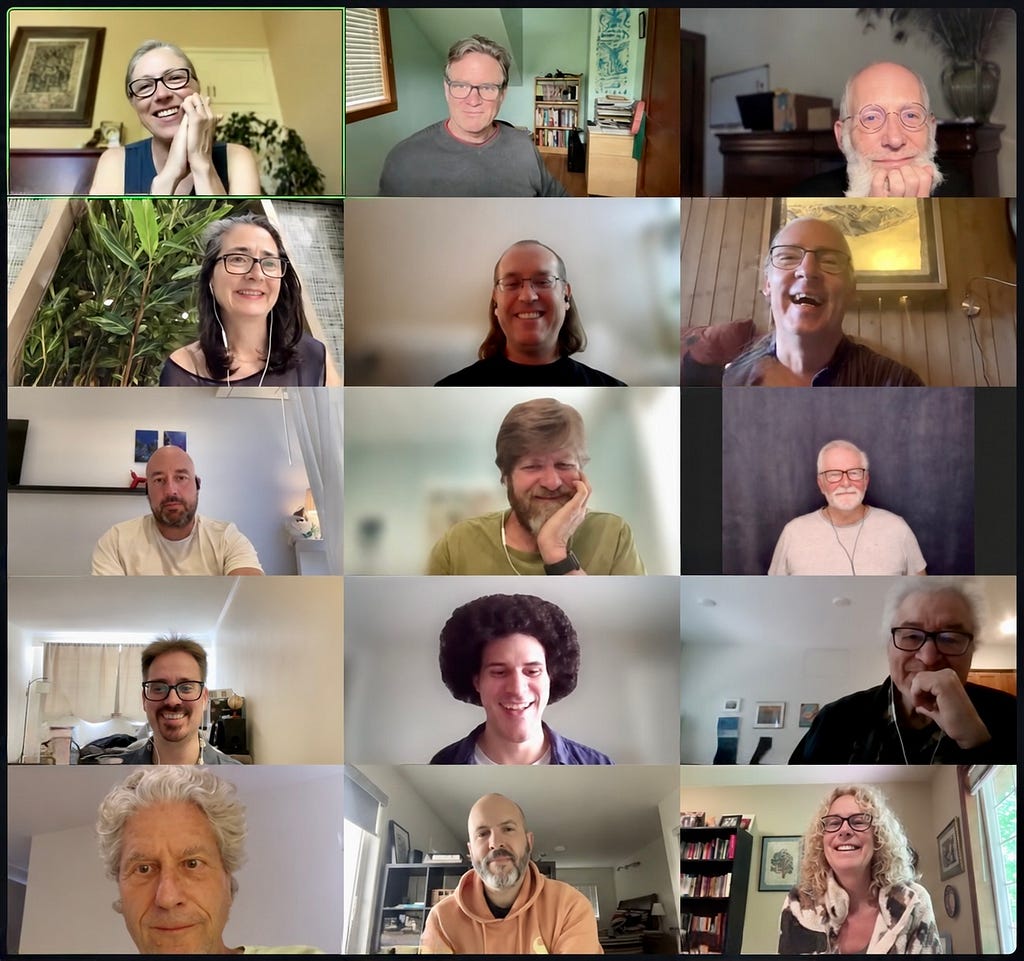
I’m going to try a few of your tips, and I’m hopeful our readers will, too. What are your “Five strategies to cultivate a powerful, thriving digital community?” Please share a story or example for each.
- Real Identity
We ask our members to show up with their real names and locations, including a current photo of themselves. Because we know who our members are, our interactions are grounded in accountability, which helps us relate to one another as real people rather than as anonymous online identities.
2. Presence
Rather than rushing immediately into content, we begin our gatherings by arriving together through a presencing practice. We may start with a few minutes of following our breath or attending to our sensations. Cultivating presence, or embodied awareness, helps us move out of our usual problem-solving mode and become more receptive to one another. We have found that this shift encourages more authentic connection in the conversations that follow.
3. Confidentiality
In my experience, people are less likely to risk being vulnerable if they wonder where their words might travel. We therefore commit to keeping what is shared confidential unless we have explicit permission to share it outside the group.
4. Repair
Every relationship, and therefore every community, eventually encounters conflict. When misunderstandings occur, we encourage people to return to one another and talk about what happened. We have found that relationships can grow stronger and deeper through the process of repair.
5. Emergence
We typically begin the conversation from what people are bringing into the room rather than with a predetermined agenda. Some of our most memorable conversations are the ones nobody could have planned. Emergence requires trusting that wisdom may arise between us rather than from one person who already possesses it.
How important is meeting offline, in real life? What is the best way to make that happen? Can you share a story?
While meeting in real life is not necessary for a thriving online community, it can enhance it. At Wisdom Exchange, the community as a whole meets once a year for three to four days. Members also meet on their own throughout the year, especially when they find themselves in towns where other members live.
Our annual gathering gives us the time to be with one another and have conversations that extend beyond our 90-minute Zoom meetings. It also helps us integrate our online impressions of one another with the experience of being together in person. These annual gatherings have been so rewarding that we are looking to expand into in-person satellite Wisdom Exchange groups in California, Oregon, and New York.
How do you handle negativity, trolling, or disengagement in a digital space?
Since we aim to cultivate a sense of belonging, if someone doesn’t uphold our relational agreements and isn’t willing to repair when a rupture occurs, we ask them to leave. This reduces the problem of negativity and trolling.
However, we consider occasional disengagement to be a normal part of relating. All we ask is that members remain in relationship as they move through it, which means checking in occasionally about when they may be ready to re-engage and what they might need from us to do so.
What are some practical strategies for encouraging real interaction, beyond likes and emojis?
While we have a digital platform dedicated to asynchronous conversation, most of our interactions happen in real time, supported by text threads between meetings. We find these conversations so compelling that emojis and likes may add feeling to our messages in between, but they don’t replace actual conversation.
What platforms or tools have you found most effective for cultivating meaningful digital engagement?
We mostly rely on Signal to maintain privacy and data sovereignty. We also use Zoom for our live gatherings and Mighty Networks for asynchronous conversation, planning, and organizing.
Are there certain types of content or activities that tend to spark stronger connection in online spaces?
We have found that the most nourishing conversations arise from collective inquiry. Rather than setting an agenda for what to talk about, we usually place a question in the center of the room and remain open to what emerges. Questions like “What have you noticed this week, either near or far from home, and how are you responding to it?” or “Is there anything unfinished in your relationships, either here or outside of Wisdom Exchange?”
While personal growth is not an explicit goal of our community, it can often result from showing up and inquiring together into the questions that we care most about.
Success is often a matter of perspective. I’ve always resonated with Henry David Thoreau’s quote, “It’s not what you look at that matters, it’s what you see.” How do you see success — or define success — for yourself now?
In our modern world, success is typically measured by reaching a goal. These days, I experience success differently. Success is reaching the other and allowing the other to reach me. So increasingly, I define success as connection.
We are very blessed that some of the biggest names in Business, VC funding, Sports, and Entertainment read this column. Is there a person in the world with whom you’d like to have a private breakfast or lunch with, and why? He, she or they might just see this. 🙂
I’d love to share a meal with Cynthia Bourgeault. Her ability to find meaning in everyday life profoundly inspires me.
What is the best way for our readers to further follow your work online?
You can find my work on cultivating online community at The Communal Heart. You can also reach me by email at claudia@thecommunalheart.com.
Thank you for these thought-provoking insights. Here’s to your continued success!
Creating Powerful, Thriving Digital Communities: Claudia Dommaschk Of Wisdom Exchange On How To… was originally published in Authority Magazine on Medium, where people are continuing the conversation by highlighting and responding to this story.