

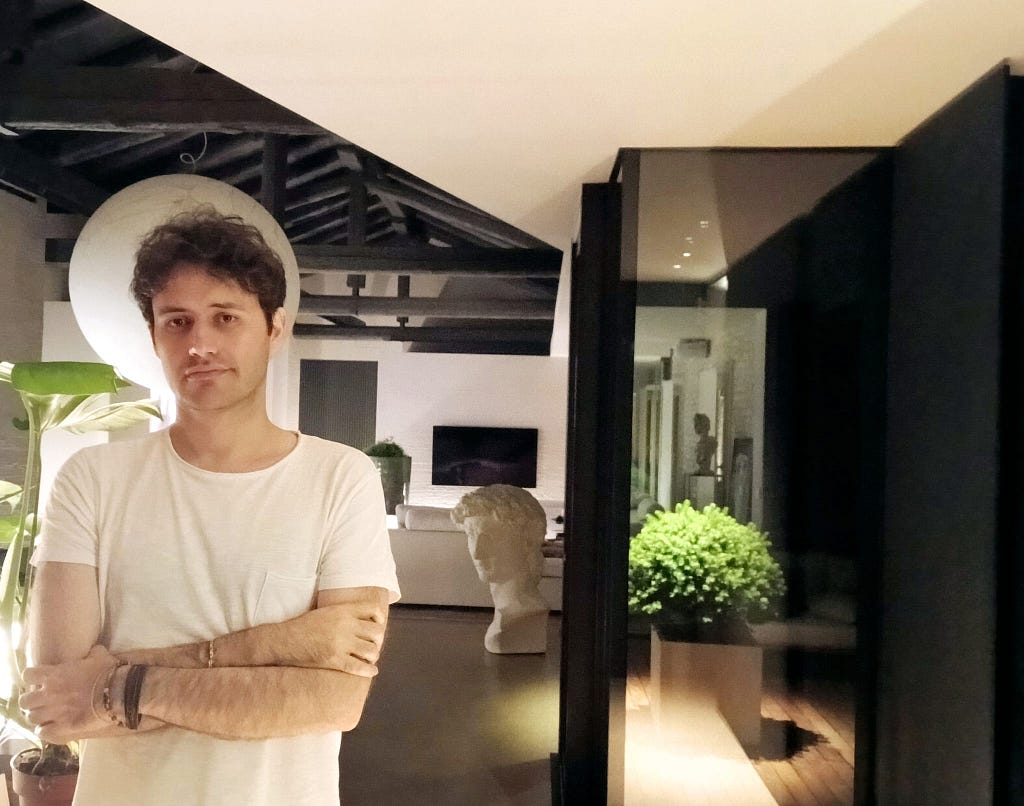
Creating Powerful, Thriving Digital Communities: Luigi Capoani of European Youth Think Tank On How To Cultivate Connection & Community In A Click-to-Connect World
An Interview With Karen Mangia
A real community emerges when people feel they are building something together and when collaboration produces something tangible.
As a part of this series, we had the pleasure to interview Luigi Capoani.
Luigi Capoani is the founder and president of the European Youth Think Tank (EYTT), a nonprofit platform based in Strasbourg that connects young researchers across Europe and promotes interdisciplinary scientific collaboration. He is also a lecturer in International Economics and Economic Development at Ca’ Foscari University of Venice, with research interests in innovation, complex systems, monetary economics, and international economic networks.
Thank you so much for joining us in this interview series! Our readers would love to learn more about you. Can you tell us a bit about your background and how you grew up?
Since childhood, I grew up with a strong interest in how societies and civilizations evolve over time. I have always been fascinated not only by economics, but also by technology, physics and scientific progress. This curiosity has naturally drawn me toward big questions such as: “How is innovation changing societies? Why do some systems evolve faster than others? And how do ideas ultimately shape human development?”. For me, innovation has never meant only economic growth. Economics matters, of course, but it is only a small component of a much bigger picture. The impact of scientific research and technology on cultures and societies gradually improves people’s quality of life and continues shaping their perceptions, even in the way they imagine their future. Over time these interests matured into the study of international economics, macroeconomics, monetary economics, and interdisciplinary research. Today they have become my profession as I teach International Economics and Economic Development at Ca’ Foscari University of Venice, and much of my work focuses on innovation, complex systems, and international economic networks. My academic path developed in a very international environment, between Italy, the UK, France, and other European experiences. In many ways, that international dimension also shaped the creation of the European Youth Think Tank (EYTT), which we later founded in Strasbourg. In those years, I started noticing a common pattern among many young researchers. Talent and ideas are often there, sometimes at a very high level, but access remains uneven: they lack opportunities to network, collaborate, publish, or simply grasp practical knowledge about how academia actually functions. That realization became one of the reasons behind EYTT. We created it as an innovation-oriented and nonprofit platform, aimed at connecting young European researchers and helping them to transform ideas into real projects, collaborations, and scientific publications. Besides being president, I also coordinate many of the activities directly, from interdisciplinary team building to research development and international collaborations. While putting determination and hard work in the project, at some point, we realized that a very common paradox exists in academia: it is impossible to publish without credibility, but it is also extremely difficult to build credibility without publication opportunities. Digital communities became part of our answer to that problem, being not just a tool for networking, but rather as a way to create access to collaborations, interdisciplinary teams, practical knowledge, and opportunities to conduct research. Even our EYTT logo reflects this philosophy. On one hand, the letter “Y” refers to youth, but also to the idea of different paths crossing and generating new directions. On the other, the “T” stands for think tank and is visually designed as a Tau. It represents the ideas of balance, harmony, and connection between different elements. In many ways, it reflects the kind of interdisciplinary ecosystem we wanted to build.
What inspired you to start building digital communities?
It did not take me much time to realize that research adapts naturally to digital environments. At the end of the day, what really matters are ideas, and today ideas can easily circulate between people living in completely different countries almost instantly. Above all, research is also a very particular kind of work. There are moments of intense collaboration and discussion, but there are also long periods of individual reflection and independent thinking. Because of that, digital structures work surprisingly well for research communities. Our goal was much more complex than simply establishing a platform for networking. We wanted to build something more meaningful, a structure capable of connecting people from different disciplines, institutions, countries, and levels of experience. Through EYTT we started creating interdisciplinary teams involving economists, physicists, data scientists, social scientists, and researchers from very different backgrounds. Without doubt, the value added is that these collaborations often produced ideas that probably would not have emerged inside more traditional academic structures. And it is not all! Our community is also becoming a space where early-career researchers can learn how to navigate academic systems. In fact, many struggle not because they lack talent, but because they are left to face publication processes alone: peer review, submissions, revisions, journals. None of this is really obvious when you start but is easier to apprehend if it is done collectively. Therefore, what we learned over time is that connection alone is not enough. A real community emerges when people feel they are building something together and when collaboration produces something tangible.
Was there a moment when you realized the power of authentic online connection? Can you share that story?
Yes, definitely. I think one of the clearest moments was when we started seeing people from completely different backgrounds naturally collaborating on similar intellectual problems. We saw economists working with physicists, data scientists collaborating with social scientists, and researchers from different countries building projects together without ever meeting face to face. What made those connections authentic was the fact that they were built around ideas. These were not superficial online interactions. They arose from shared curiosity, research interests, and a genuine desire to build something intellectually meaningful together. I strongly believe digital environments work particularly well for this kind of activity because they allow people to meet intellectually even before they meet physically.
What’s the most important lesson you’ve learned along the way that influences how you operate now?
One of the biggest lessons I’ve learned is that investing in young people produces an incredible return in terms of innovation and research. You never truly know which young researcher may eventually become an important innovator or even a genius in their field. What you can know for sure is that those young people have an enormous amount of untapped creative potential. When young researchers from different backgrounds interact, the level of imagination and openness can honestly be remarkable because they are often willing to explore unconventional patterns. This is the motivation for continuing generating environments where young people can experiment, think independently, and develop intellectual autonomy. Nevertheless, while the creative potential is absolutely there, the real challenge becomes access and lack of flexibility in the academic world. Young researchers usually have fewer networks, not enough visibility and less familiarity with international publishing systems. Naturally, that makes it harder for them to publish or even to be taken seriously compared to already established figures. If we keep placing future innovators inside rigid or excessively hierarchical systems, part of that potential can easily be lost.
In your opinion, what defines a truly thriving digital community?
To me, a thriving digital community is one that genuinely contributes to the circulation of ideas and knowledge. Digital tools are powerful because they drastically reduce the cost of exchanging information and collaborating intellectually. Ideas can move much faster than in the past, and that accelerates and multiplies innovation. When a digital community creates real discussion, freedom of thought, and genuine collaboration, it becomes much more than a platform. It becomes part of the infrastructure of innovation itself.
What are some common mistakes people make when trying to build digital communities?
One of the biggest errors is building communities that eventually will turn into passive platforms. In many digital environments, especially traditional social media, people primarily consume content created by others instead of actively engaging and participating. This was definitely not our intention, we aimed at creating something different from that. For us, a real intellectual community should be based on active participation and shall presuppose genuine exchange of ideas. Sometimes social media platforms face the risk of turning into what I call a “socialcracy”, or to be more precise, a sort of “social network-cracy,”. In other words, a community where visibility becomes concentrated around a small number of actors while most users remain passive. We wanted to build something closer to the values of democracy, free thought, and open intellectual exchange. People should not simply consume ideas. They should actively contribute to building knowledge collectively.
I’m going to try a few of your tips, and I’m hopeful our readers will, too. What are your “Five strategies to cultivate a powerful, thriving digital community?’ Please share a story or example for each.
1. Investing in young people.
Young researchers often have extraordinary creative potential, but they need digital or physical environments in which they can genuinely express it. At the European Youth Think Tank, we have seen many young people further investing in their academic patterns and starting PhD programs, after completing their master’s degrees. This has happened also thanks to the support and encouragement they found within our community. This is something that makes us very proud, because it means we have contributed, at least in part, to motivating a new generation of researchers and innovators.
2. Believing in innovative ideas.
The concrete example of such a statement is the creation of the European Youth Think Tank itself. A lot of young people never follow their intuitions even before trying, just because those ideas seem unconventional and unachievable. But innovation happens if it is supported and fueled by intellectual courage. At the beginning, the project of our community appeared hard to realize: building an independent international network of young researchers focused on interdisciplinarity and innovation was far from obvious. Nevertheless, we believed in that intuition and we followed it with faith and determination. Over time, we managed to transform it into a concrete reality with collaborations, publications, and international projects.
3. Betting on interdisciplinarity.
For us, it is fundamental and is the beating heart that keeps our community together. I strongly believe that social sciences should constantly interact with hard sciences, from physics to economics, from philosophy to mathematics, and vice versa. Not by chance, some of the most interesting innovations emerge from the intersection between different disciplines. In our reality, this approach is not only a shared thought but an everyday task: many of our research projects and articles are the direct results of mixed teams composed of economists, physicists, data scientists, and researchers from different academic backgrounds. This interdisciplinary mechanism has produced tangible results since several of these works have been accepted and published in important international journals, demonstrating how collaboration across disciplines can generate innovative and academically valuable research.
4. Preserving intellectual independence.
In our experience, original ideas come primarily from people who think independently. However, the contemporary academic environment often promotes researchers aligned with current fashionable trends or dictated by immediate utility, limiting young people’s initiative toward unexplored fields of research. Above all, the precariousness and lack of reliability among creative youth permeates the various fields of academic research, discouraging innovation and holding back potential developments. Many young researchers are highly dependent on supervisors or hierarchical structures that influence research directions and even determine whether collaborations continue. As a result, researchers are often pushed toward projects that are currently fashionable or more likely to receive funding, rather than toward genuinely innovative ideas. Always keeping in mind that innovation requires a long-term vision, the European Youth Think Tank instead tries to give young researchers greater intellectual space and freedom, encouraging them to pursue original projects and to believe in ideas that may initially appear outside dominant trends.
5. Remembering that one of the greatest forces behind human progress is innovation itself, both technological and theoretical.
Scientific progress has been transforming and shaping human history and nowadays it continues to improve our quality of life, it helps building more and more knowledge, and it sustains the accomplishment of social development. That is why research and the free circulation of ideas matter far beyond immediate economic return. A clear historical example has been inspiring us along our journey: it is the Scientific Revolution. Without that intellectual and cultural spark, soon evolved into a widespread transformation, many later milestones would not have been possible, including the Industrial Revolution and major political and social transformations that reshaped modern societies. In other words, it is the production of knowledge that can be recognized as one of the main driving forces behind human development.
How important is meeting offline, in real life? What is the best way to make that happen? Can you share a story?
I think that it is extremely important. While offline and direct meetings remain fundamental for building trust, friendship, and genuine human interactions, digital communities help reduce the limitations of geographical barriers, allowing seamless collaboration between people from different countries and backgrounds. For our team, remote interactions constitute essential elements of our structure, since our research work often requires independence, flexibility, and time for reflection. In many ways, scientific research adapts very well to digital environments. However, coming together in person becomes particularly important when celebrating shared accomplishments and important milestones. These informal social moments create stronger bonds among us and reinforce our sense of collective identity. In fact, while formal collaborations drive our work, it is the shared experiences that transform a network of researchers into a real cohesive community. That is why I believe the best approach is a hybrid model, combining the advantages of digital collaboration with opportunities for in-person interaction. For example, within the European Youth Think Tank, many collaborations and projects are developed remotely between people living in different regions. Yet whenever we have the opportunity to meet in person, especially after important achievements or successful projects, those moments significantly strengthen the group dynamic and create a deeper sense of connection between members.
How do you handle negativity, trolling, or disengagement in a digital space?
Our primary strategy to face some of these challenges is traceability: we mainly use professional and organizational platforms where research activities and collaborations are easily tracked. Thanks to this transparent approach, we have seen through the years that disengagement becomes far less likely. Moreover, the majority of our researchers are highly motivated young people, driven by a genuine interest and an intrinsic curiosity for academic research. We have rarely encountered serious cases of disengagement; on the contrary, young people’s passion contributes not only to enhancing their individual academic careers but to building the collective knowledge we are committed to disseminate. Ultimately, research activity is also naturally measurable through contributions, collaboration, writing, data analysis, and project development, which creates a strong sense of responsibility within the group.
What are some practical strategies for encouraging real interaction, beyond likes and emojis?
Through the shared passion for knowledge, we attempted to establish an environment that was much more than a simple reaction to content. The European Youth Think Tank is made up of people who actively exchange ideas, proposals and constructive feedback. For us, real interaction lies in direct communication, group discussions, teamwork, and regular meetings. Whenever possible, we try to organize in-person meetings, because face-to-face interaction strengthens trust and creates stronger relationships within the community. We believe that meaningful collaboration is built through dialogue, shared projects, and collective achievements rather than through passive engagement.
What platforms or tools have you found most effective for cultivating meaningful digital engagement?
For a reality such as the European Youth Think Tank, access to digital platforms means assuring smooth collaborations across countries and across researchers. The platforms we use most frequently are Google-based tools and applications, because they provide an integrated ecosystem that is practical, accessible, and efficient for collaborative research work. Shared documents, online meetings, collaborative editing, and cloud-based organization tools are particularly useful for coordinating international and interdisciplinary teams. For us, these platforms are extremely valuable because they are much more than practical utilities. They are the effective bridges empowering the next generation of innovators.
Are there certain types of content or activities that tend to spark stronger connection in online spaces?
Issues that researchers consider themselves particularly attached to are those that tend to provoke the most engagement. When articles are published or important projects are completed, they often create a strong response and a deeper sense of connection within the community. Some research projects are more niche in nature and aimed at a targeted audience, and while they remain very important academically, they may generate a more limited engagement outside the expert circles. At the same time, we also produce more accessible and public-oriented research content, which tends to create broader interaction and visibility online. Strengthening the more informative aspect and widening the accessible dimension of our outputs is something we are increasingly working on.
Success is often a matter of perspective. I’ve always resonated with Henry David Thoreau’s quote, “It’s not what you look at that matters, it’s what you see.” How do you see success — or define success — for yourself now?
I honestly do not believe there is only one definition of success. For some people, success can be measured through economic or professional achievement. But for me, there is also another dimension: having a real impact on other people and contributing, even in a small way, to human progress. Scientific advancement has probably been one of the most transformative forces in human history. Research and knowledge are what ultimately improve prosperity, quality of life, and long-term development. Because of that, I think success also means doing something that goes beyond simple routine existence. There are many people who are not known in public but have a huge impact on others’ lives. A parent, for example, who transmits curiosity, values, or critical thinking to a child may indirectly shape someone who later contributes positively to society. In that sense, every person has the potential to matter. Even a small idea can create consequences that extend far beyond what we immediately see.
We are very blessed that some of the biggest names in Business, VC funding, Sports, and Entertainment read this column. Is there a person in the world with whom you’d like to have a private breakfast or lunch with, and why? He, she or they might just see this. 🙂
Yes, I think it is a great opportunity that so many influential and prominent profiles read this column. We would certainly be very interested in meeting private investors who appreciate innovative ideas, someone who is ready to trust the young people’s potential and strongly believes in the transformative power of research. For us, this could be extremely important, especially because supporting independent and interdisciplinary research often requires people who are willing to invest in long-term innovation and intellectual development. In addition, as our papers primarily focus on economics, physics, and finance, it would be an honor for us to meet eminent scholars and Nobel Prize winners to discuss our vision and push further the current limits of interdisciplinary research.
What is the best way for our readers to further follow your work online?
The best way is simply to reach out to us, share ideas, and become part of the community. We are always interested in connecting with researchers, innovators, interdisciplinary professionals, and people interested in the future of knowledge and innovation. Another way is to follow the scientific work and publications we produce, many of which are available online and indexed on Google Scholar.
Thank you for these thought provoking insights. Here’s to your continued success!
About The Interviewer: Karen Mangia is the author of four best-selling books, a sought-after keynote speaker, and a seasoned leadership expert who has helped thousands of leaders navigate the complexities of the modern workplace to build thriving, inclusive communities.
Creating Powerful, Thriving Digital Communities: Luigi Capoani of European Youth Think Tank On How… was originally published in Authority Magazine on Medium, where people are continuing the conversation by highlighting and responding to this story.