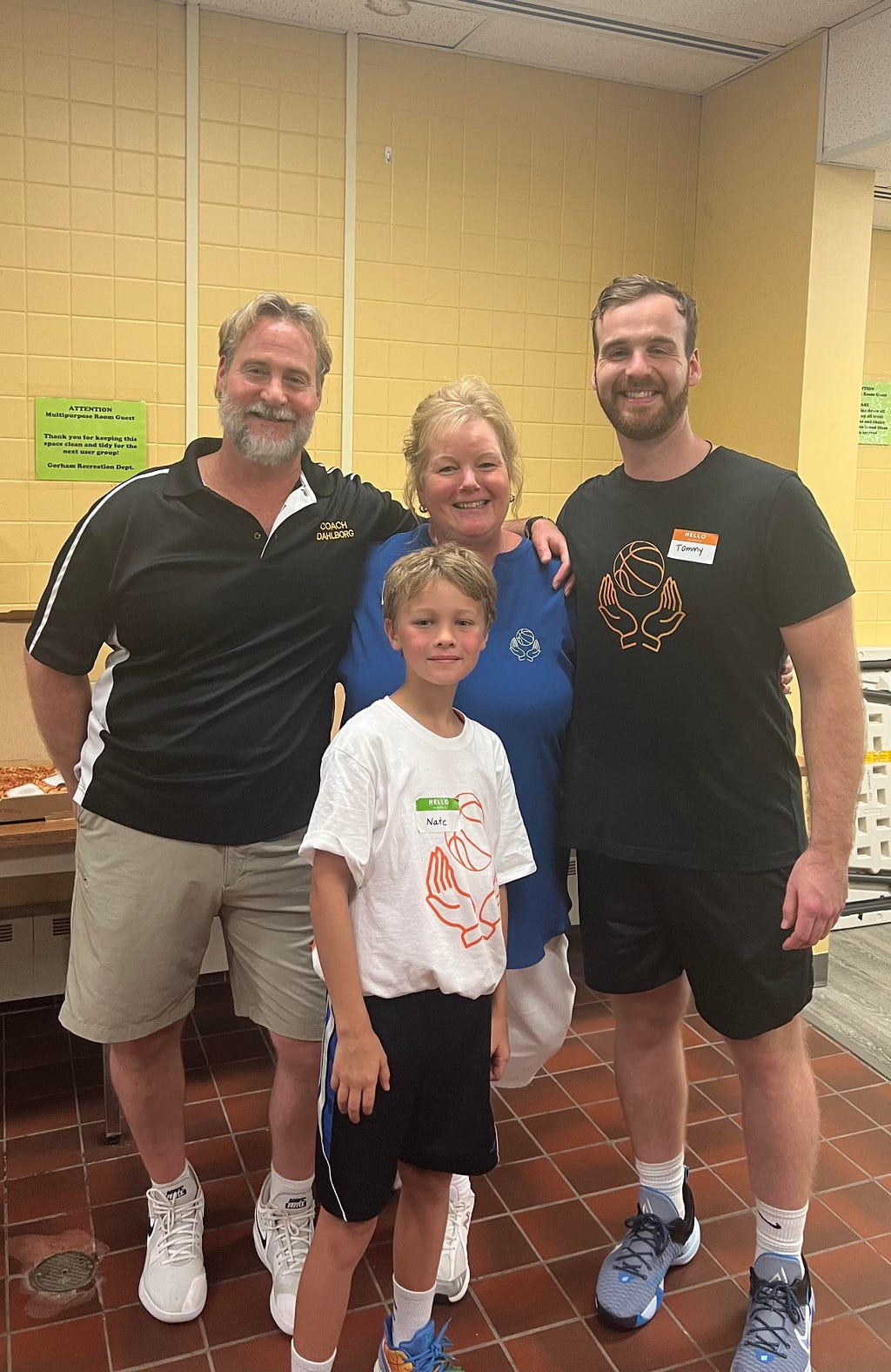
Tom Dahlborg of TBKID Youth Sports Programs: 5 Things I Wish Someone Told Me Before I Became A Founder
Without forgiveness, without reconciliation, we have no future.
As part of our series called “5 Things I Wish Someone Told Me Before I Became a Founder”, we had the pleasure of interviewing Tom Dahlborg.
Named a Healthcare Disruptor and a Mental Health Champion by Authority Magazine and a Ruckus Maker by The Patient Experience Community, with over forty years of extensive leadership experience, Tom is a disciple of Jesus, a devotee of Mother Mary, a founder, and a voice for children, for agape-centered care, for servant leadership. Tom is also an internationally recognized speaker and writer with expertise in leading with love, heart and mind communication, multivariate economics, mitigating adverse childhood experience (including bullying and amplifying positive childhood experiences, and bringing “love in action” to all we do. A coach to leaders. A coach to young men and women.
Thank you so much for joining us in this interview series! Can you tell us a story about what brought you to this specific career path?
As the founder of Dahlborg HealthCARING Leadership Group, my day job for many years has been to pray with, to pray for, and to coach CEOs, CFOs, COOs, and other leaders throughout the healthcare system, to ensure they understand the Both/And:
The system must be financially solvent to ensure longitudinal survival and goodness sharing — and new technology, AI, pharmaceuticals, innovation, quality improvement, system design, and evidence-based medicine each has a place in this process, AND
The system must be designed and led with honor and integrity, with compassion, empathy, relationship, instilling trust — and with love for all (for God, for clinical and administrative staff, and for patients and families and communities).
Both/And.
I am also blessed to pray with and pray for and coach doctors and nurses and individuals throughout the healthcare system to recognize they are truly loved by God, and each day have the opportunity to shine His light so very brightly for the benefit of all.
All of this with a goal of system transformation — from a healthcare system to a healthCARING system.
For many years, I was also a coach of young men. A youth basketball coach — coaching children from the age of 8 to 18.
And in many ways, I found coaching youth sports was far more challenging (and rewarding) than coaching healthcare leaders.
NOTE: Both critically important, however, and both impactful.
The challenges of helping children who are trying to understand and manage through (and many times literally survive) is profound …
The divorce of their parents
Loneliness and isolation
Body image issues
The death of a parent
Drug use
Abuse
… and so many other Adverse Childhood Experiences (ACEs).
Now I got into coaching young men via a circuitous path.
You see, our son Tommy was born with neurological challenges, and he was also a big kid. And as a big kid with these challenges, he was targeted and he was bullied relentlessly, predominantly by adults.
Yes, by parents and eventually by coaches.
And it broke Tommy’s heart, and it broke our hearts.
At the time, my bride and I thought we were alone in this — without a community. Alone with the fact that adults were bullying a child. Our child. And we kept asking:
“What have we done?”
“What have we done wrong?”
“What do we do for our baby?”
“What do we do that will not make things worse for Tommy?”
And it wasn’t until some years later, when I began working for the National Institute for Children’s Health Quality (NICHQ) that I had additional access to experts, and I learned.
For example, I learned that:
27% of children report being bullied by other parents.
37% of children report being bullied by teachers.
42% of children report being bullied by physical education teachers and coaches.
And I learned the connection between bullying and suicidal ideation and suicide itself (NOTE: These statistics are pre-pandemic and early data is showing these outcomes are only worsening.):
Suicide is the third leading cause of death among young people, resulting in about 4,400 deaths per year, according to the CDC.
For every suicide among young people, there are at least 100 suicide attempts.
That is 440,000 or almost half a million children attempting suicide per year.
And a study in Britain found that at least half of suicides among young people are related to bullying.
And I continue learning.
And through this learning journey, I founded TBKID Youth Sports Programs, our ministry, (as a division of Dahlborg HealthCARING Leadership Group) to “run toward the roar” and support children, families, coaches, educational systems, sports programs, communities.
Can you tell us a story about the hard times that you faced when you first started your journey?
Some years ago, my bride and I were sitting on our deck enjoying the wilds of Maine when our son Tommy joined us …
“Mom. Dad,” he said. “I need to tell you something. When I was in fourth grade the pain was so great, I put a belt around my neck. Mom. Dad. I didn’t want to live anymore.”
This discussion with our son occurred a year AFTER I published the first edition of the book: The Big Kid and Basketball … and the lessons he taught his Father and Coach.
The “stop bullying” messages within that first edition of the book had led, up to that point, to speaking opportunities, workshops, articles, news stories, and other engagements around the country and beyond about the dangers and impact of bullying.
And yet here I was, not even aware of the level of pain my son felt … the level of pain he felt from bullying … and the drastic measure he almost took.
There but for the Grace of God.
And the lessons learned here were — gratitude and humility.
Gratitude — that my son did not take his life but rather is here today continuing to bring God’s light into this world in all he does, in all he is, and as a key figure within TBKID Youth Sports Programs.
Humility — a reminder to hit my knees, to look up, to ask for forgiveness, to always be humble and seek to learn and grow and be better to support others, and to seek His help in all things.
A song of ascents.
I lift up my eyes to the mountains –
where does my help come from?
My help comes from the Lord,
the Maker of heaven and earth.
Psalm 121:1–2
Where did you get the drive to continue even though things were so hard?
Both the journey with my family and with my community, and the impact on others (especially children).
From children who have participated in various aspects of our programs writing poems and songs to love and support others, e.g.,
Kay’s Song
Through her darkest time, while experiencing her own suicidal thoughts, Kay (11-years old at the time), who suffers from epilepsy and ADHD, found the courage to express her feelings in the form of a poem she hoped would help other victims of bullying.
And in so doing, gave permission to me to include her brilliant poem (now a song) into our The Big Kid and Basketball … and the lessons he taught his Father and Coach book, and to share her poem and story when I am speaking and running workshops around the country.
Kay’s Song
chorus: (intro)
Oh, oh we are all the same…
Oh, oh we are all the same you can’t blame me…
Verse1.
Now listen to me, we are all human being, this is just time -consumin’, boring as watching paint dry
They get us in the blind spot, it’s like a never-ending bad dream,
it’s a day you will never forget yeah-a-yeah in the blink of an eye, time goes by
It’s a hot potato, it’s a huge issue, that keeps on going and going and never stops but gets worse!
It’s like a curse from Mr. Universe, It’s everywhere, it’s in the air!
chorus:
Oh, oh we are all the same you can’t blame me, this is not a game
Oh, oh we are all the same you can’t blame me, this is not a game
We don’t want to live this way. Bullying is not OK!
Verse2.
People think it’s rare, it’s more common than you think, sadly people ignore it, and feels like
a School’s death trap.
It’s just cruel, you’re left with a broken heart, bullying is like a creature of the school, it feels like
a stabbing pain. This needs to be stopped!
We’re all human, we are all different in our own way, it’s kinda like a never-ending Monday!
Yeah, it’s a curse from Mr. Universe, It’s everywhere, it’s in the air!
chorus:
Oh, oh we are all the same you can’t blame me, this is not a game
Oh, oh we are all the same you can’t blame me, this is not a game
We don’t want to live this way. Bullying is not OK!
(Bridge) Middle8:
Don’t ignore someone’s tears, maybe that’s how it feels, when the world every day telling you what you should, what you shouldn’t be.
Take a leap, then instead love it all, celebrate, beauty is everywhere, be the change that you want or you wish to see…
chorus:
Oh, oh we are all the same you can’t blame me, this is not a game
Oh, oh we are all the same you can’t blame me, this is not a game
We don’t want to live this way. Bullying is not OK!
To coaches who with humility, with open hearts and minds, recognize they themselves have an opportunity to do better, to be better:
“I was that coach you describe. The coach focused strictly on winning to the determent of my players and families. I am so sorry. And I will change.”
To teachers (and entire schools) engaging in new and creative ways:
“We were challenged by one of our SEL Teachers to take the Bullying Pledge and come up with creative ways to express talking about bullying. And together with our students we did [using The Big Kid and Basketball … and the lessons he taught his Father and Coach book as the core of our curriculum and the arts as our canvas in which to create.]”
So, how are things going today? How did grit and resilience lead to your eventual success?
This journey has been profound.
The lessons learned to date, the moments feeling alone, feeling unworthy, feeling less than, the moments on my knees pleading, praying, seeking help …
And throughout, with my bride, my children, our pups, and my God, together we have discovered a grit within (Jesus’ fire) and a resiliency (yes — messy and ugly AND clear and beautiful) and we have continued to show up and to together create and innovate.
In fact, our next creation is coming to life as we speak in a powerful way …
The Light book series, researched and written by me and illustrated by my daughter Samantha Dahlborg, uses story (words and pictures) to engage children and families, teachers and coaches, to tackle the challenging subjects each face. The stories are designed to help children find their own voice, their own agency, love for themselves, all through the power and love of God.
This book series also serves to provide parents, teachers and coaches with tools and resources to help. Each book in the series is designed to connect deeply at multiple levels while shining a Light on the importance of relationship, trust, and God’s love.
The Light: Gifts is the first book in this series and focuses on body dysmorphia (inspired by a real event), while also highlighting the impact on children of bullying, what good coaching looks like, and how a child can learn to love oneself through God’s love. The book focuses on a talented young basketball player who does not see himself as the special person he truly is.
And the early read has already netted wonderful feedback:
“Your ideas are so relevant to what I see and hear every day. 8th grade is such a powerful and yet powerless age for kids, and the issues that you brought up are all things that I have faced during my 25 years teaching in this grade. Unfortunately, I have had several students over the years who chose to take their own lives in the years after they left my classroom (we had another one just this past year), and if the work in my classroom can change the trajectory of even one student’s life, big or small, it is time well spent.”
8th Grade Teacher
We are also planning future books in the series which will focus on (with working titles):
Belonging … The Light: My Voice is Powerful
External Pressures … The Light: My Decision
Loss of a Pet … The Light: Lost and Found
Additional key focus areas impacting children, e.g., the pandemic, other
The first book in the series is designed to be a picture book for 6- to 8-year-olds with accompanying parent, teacher, and coach guides and tools.
Future books in the series will morph based on topic and target audience, e.g., the SUD focused book in the series: target audience 8- to 13-year-olds / format: graphic novel.
This book series will reassure children that God loves them, they are never alone, they each are empowered by the Holy Spirit and thus have His power within (agency), they are lovable, and they are loved. This book series will also reassure parents, teachers, and coaches, that they too are not alone, God loves them, and there are resources available to them. That said, many ask me why this book series is so important at this time …
“Home from school and separated from peers during crucial developmental phases, young children and adolescents were clearly among the people most negatively impacted, in various ways, by the pandemic lockdowns.”
“One study, focusing on children ages 4 to 10, found that the level of lockdown greatly affected mental health and behavioral issues, with England’s first complete lockdown greatly exacerbating issues from hyperactivity to depression.”
“We were seeing a small but statistically significant increase in emotional disorders,” [in particular, depression and anxiety.] “And this is before we hit the pandemic.”
“Between 2007 and 2017, the number of children aged ten to fourteen who committed suicide more than doubled.”
“A recent study published in the Journal of Affective Disorders found that about a third of child suicides occur seemingly without warning and without any predictive signs, such as a mental-health diagnosis.”
“As the United States approaches 2 full years of the COVID-19 pandemic, mental illness and the demand for psychological services are at all-time highs — especially among children.”
Although Christianity is on the decline in the United States, three-quarters of U.S. teens want to learn more about Jesus. And thus, with this inspiration TBKID Youth Sports Programs continues to evolve and produce based on where God leads us to do good — as Quint Studer would say, “To honor our Calling.”
Can you share a story about the funniest mistake you made when you were first starting? Can you tell us what lesson you learned from that?
Well, while not funny, this mistake I made was profound and informs me and my ministry to this day.
By the time Tommy was in 8th grade, I had become the head coach for his middle school rec basketball team with Boris Becker (no, not that Boris Becker) as my assistant coach.
Going into a new season (and especially as a new head coach) I made many assumptions. Many spot on. One in particular way off.
Our team practiced at the Village School (an older small gym with bright fluorescent lights and slippery floors). And on some occasions pinnies (mesh type practice vests used to distinguish one team from another during scrimmages) were not available at this location.
I reviewed my roster and identified (based on my assumptions) which children might have a concern with playing “shirts versus skins”.
[Shirts vs Skins — means one group of boys is wearing their t-shirts and the other group of boys is not wearing a jersey (done so that during the heat of action of a scrimmage each team can easily see who is on their own team and who is not)].
Knowing Tommy (and having discussed it with him prior) I knew he would be uncomfortable at this age playing on the ‘skins’ team. I then looked at the rest of the roster and made assumptions. Who else would more likely be uncomfortable playing without a jersey? And after much thought I made a list. If the pinnies are not available for our practice, I will divide the team up this way for the scrimmage.
We have a solid first practice and as we get to the 15-minute mark left in practice I blew my whistle and yelled “who wants to scrimmage?!”
As an aside, have you ever seen sharks “smell” blood in the water and go into a frenzy around whatever was bleeding. Well, that doesn’t compare to eighth grade boys hearing that magic word “SCRIMMAGE!” They came from everywhere. Those on the court already … came running, jumping, yelling, smiling. Those at the water bubbler did 180’s and sprinted to midcourt. Even those in the bathroom came running (hopefully after washing their hands first).
“OKay boys,” I said. “This is our first scrimmage. We will be playing shirts versus skins. Those on the ‘shirts’ team are Tommy, Michael, Jacob, James, Anthony and those on the ‘skins’ team will be Asa, Richie, Mark, Jimmy, Billy.
NOTE: Aside from Tommy, these names have been changed.
Body Image
Despite public perception, body image issues and eating disorders are not exclusively female problems. The oft-cited figure is that about 1 in 10 eating disorders occur in males, but latest research shows this number to be closer to 1 in 4. Male or female the issues with body image is a challenge we need to first be aware of and second determine how best to manage.
In this case, my assumption was wrong.
As soon as I said the name of one particular boy, he immediately yelled, “No! I will not be on the ‘skins’ team!” and ran out of the gymnasium and into the night.
My criteria to determine who I believed would be least likely to have a body image issue was wrong. I screwed up. And I screwed up big. Thank God Coach Becker (who was close to this young man) was there.
As I focused on the other 11 players (focused is a tough word because my heart was out the door with Coach Becker and this boy), Boris sat with this boy, talked with this boy, and encouraged him to return to practice.
When this boy came back into the gymnasium, I handed over the rest of the team to Coach Becker and then I sat with this boy, listened to this child, and then softly and calmly let him know that I had made a mistake, I was sorry, and I would fix it.
And to my astonishment this boy immediately jumped up and ran over to the ‘shirts’ team and proceeded to dominate the scrimmage with his jumping, rebounding, blocking shots, and hustle — with his heart (the reasons I wanted him on this team in the first place).
Body Image Issues are a Big Deal
Studies have found that the desire to bulk up by boys with body image issues was linked to future abuse of drugs, alcohol, muscle-enhancing supplements and steroids. And those boys seeking to be thinner were more likely to develop depression.
I screwed up and in doing so I adversely impacted a child … and I learned.
As a coach these are the MOST important things …
Humbling oneself and recognizing you do not know all
Praying for guidance, for God’s help
Seeking out experts and becoming aware of these types of issues (beyond the X’s and O’s in this case)
Developing authentic relationships with players and families so that challenging conversations can take place with honesty and while balancing heart and mind (I believe we ended up getting there)
Talking with your team proactively about issues such as this (BIG missed opportunity)
With your team and/or the individual or (if appropriate) the family, determining how best to manage
And NEVER making these types of assumptions
… again, these are the things that are most important. These are the things coaches of boys and girls must understand.
And to this day, this experience, this mistake informs how I lead, how I serve, how I coach AND this is another driver (another “WHY”) I founded TBKID Youth Sports Programs — so others can learn from my mistakes and not repeat them.
What do you think makes your company stand out? Can you share a story?
TBKID Youth Sports Programs stands out for many reasons, including our Faith, our Family, our Community, living our purpose-driven by real world experiences, our love for God, one another, and all those we are blessed to support.
TBKID Youth Sports Programs also stands out because of our three-focus curriculum (which was created early on via our assessment (our learning) process and is now a staple of our camps):
TO BUILD: Many children are not seeing the goodness within themselves (God’s light within them) AND in many cases were thus challenged to see the goodness in others — thus one focus of ours is to teach (and role model for) children to both build up self and others.
TO INCLUDE: Many children feel excluded (isolated, alone) in school, at home, in the neighborhood, in life — often many children we do not suspect — thus another focus of ours is to ensure inclusion, not just so someone feels they belong — but because they truly do (and they are loved).
TO REFLECT: Many children who do not see God’s light within them, also are not well positioned to grow and improve and thus another focus of ours is to reflect on the entirety of each of our journeys, our goodness AND our opportunities, and with humility and love in our hearts to seek out God to continue to grow, to improve, to be better.
And with this all in mind, the story I will share has to do with our “TO INCLUDE” focus:
I remember at the start of day three of one of our TBKID Youth Sports Basketball camps, after the “TO BUILD” and “TO INCLUDE” sessions, seeing a father along the sidelines watching.
I went over to him and introduced myself and having not seen him prior, shared a little about the program and the Build Day and the Include Day.
And his response …
“Now I understand. My daughter came home after the camp last evening and reached out to her friend who she felt had recently excluded her.”
And I listened.
And he continued …
“The two girls had a rich discussion, and the friend apologized and let my daughter know that she did not mean to make her feel that way.”
And then he paused before saying, “Tom, my daughter is typically shy, she doesn’t often speak — her truth. Tom, she spoke her truth. She found her voice. Thank you and your family, your team, for this program. You are already making a difference.”
Which tips would you recommend to your colleagues in your industry to help them to thrive and not “burn out”?
Seek support. You can choose to not be in this alone. You were inspired by something and/or someone to found your organization (your ministry) and to achieve specific goals. Ideally, you were inspired to make a difference for others.
With this inspiration you are now well positioned to share your purpose, your why, your driver. To tell your story and to engage others who too seek to walk the same (or similar) path you are braving.
And as you prepare to do so, be sure to hit your knees, look up, and ask for clarity as to God’s will (Thy will be done), for His help, for His guidance.
We are not meant to simply live, we are meant to carry our cross and live with purpose for the greater good — for God.
With this understanding, with this purpose, with God on our side, regardless of the circumstances we are positioned to find peace (to thrive).
And now with this framing and your inspiring story, seek out additional support and be unstoppable (as Sharon (M.) Weinstein, MS, RN, CRNI-R, CSP, CVP, FACW, FAAN, shares so brilliantly in her recent TEDx “Think different to be unstoppable”).
None of us is able to achieve success without some help along the way. Is there a particular person who you are grateful towards who helped get you to where you are? Can you share a story?
My son, Tommy, who I am so grateful to be inspired by, learn from, to share this journey with.
And as an example of him inspiring …
Drayke was a child (12 years old) from Utah who died by suicide in 2022 after being bullied.
Below is a letter from my son Tommy to Drayke and every child who has died by (or attempted or has thought of) suicide.
My heart breaks for you.
It hurts me deep in my soul knowing that this darkness consumed you. That it led to this.
What breaks my heart the most is knowing how close I was to doing the same thing you did and having lived on.
Healing.
Growing.
Living now with joy.
Still battling some of those same demons from long ago.
But living with a deep sense of joy despite those demons.
You didn’t get that chance.
No, the darkness took you far, far too soon.
You were a light in this world, and the darkness fought to drown out that light.
It fought so, so hard.
As did you.
Then a heartbreaking day came when the only option in your mind was to end it.
To die.
On that day, the darkness presumed itself the victor.
But a victor it was not.
Your light goes on.
Your light ignites a fire in our spirits, a fire in our souls.
A fire that annihilates the darkness.
A fire that brings the rest of us together, in your name, to make things better.
We will make things better.
My heart is with you.
My heart is with your family.
Help us to help the others that feel the way you do.
Lend us your light.
God bless you.
I love you,
Your Brother, Tommy
My heart breaks every time I share this message from my son. My heart continues to break for Drayke. My heart is breaking for all children who are (and have) felt this way. For all those children who have followed through with ending their life. For all the families. For the communities.
Yes, I am grateful for Tommy as he continues to inspire me to stay the course to continue our work, our ministry, to help all those we can.
And if you are reading this interview, if you, your child, your family are facing these battles, please don’t go it alone. We are in this together. Me and my family tried to go it alone and we almost lost our Tommy.
We continue to learn. We continue to seek to help.
Together we will find a way.
I am so grateful to and for Tommy for facing the darkness, for sharing with such courageous vulnerability, for helping others.
“Together we will stop bullying and we will amplify positive childhood experiences for ALL children.”
How have you used your success to bring goodness to the world?
To answer this question, I would like to share a story …
I was blessed to learn with so many, as a community came together to Stop Bullying (thanks to a terrific organization: CivicCon).
And I remember at the end of the first night, my heart full and yet being truly exhausted, a gentleman, with a long white beard and a bright Light in his eyes, lifting me up…
“I am so glad I came tonight. You made me cry more than once. Thank you,” he said.
And then him showing up early the following morning for our “Stop Bullying Together” workshop and sharing again with such heart and mind clarity and loving brilliance…
“I ride my bike throughout the community. And I smile at all. Not all smile back, but that is okay. I smile.”
And, when he is not on his bike…
“I talk to a lot of people on the street. I make a point to connect with them. Connection is important. We are all in this life together.”
Smile.
Understand.
Connect.
I see a large part of our success is the spreading of the love others share — to ripple love.
What are your “5 things I wish someone told me before I started leading my company” and why. Please share a story or example for each.
1. The Power of Community
Last year, I believe, I was reading the Boston Globe piece, 𝑩𝒖𝒍𝒍𝒊𝒆𝒔, 𝒃𝒂𝒔𝒌𝒆𝒕𝒃𝒂𝒍𝒍, 𝒂𝒏𝒅 𝒘𝒉𝒂𝒕 𝑰 𝒉𝒂𝒗𝒆 𝒍𝒆𝒂𝒓𝒏𝒆𝒅 𝒇𝒓𝒐𝒎 𝒃𝒐𝒕𝒉 by Caitlin Shetterly …
… and I was reminded of our family’s journey through bullying, our son’s suicide attempt, and the profound impact on us by the incredible basketball program in Gorham, Maine, with leaders such as Alan Grady and Cindy Hazelton …
… I was reminded of Meghan Torjussen of WMTW Channel 8, Portland, Maine, and Destiny Cook of the Gorham Times, and so many others, creating awareness to stop bullying in basketball, in Maine, and beyond …
… I was reminded of Shernita Wiggins-Wynder and her impactful work with her students to stop bullying (and Pantea Vahidi’s incredibly supportive and compassionate role) …
… I was reminded of Carlos Kyles and his anti-bullying journey and his faith-fueled passion and right action …
… I was reminded of Becky Haas and her incredible trauma informed care work and the impact she makes …
… I was reminded of Quint Studer and Eduardo Lara and Linda “Sonshine” Moorer (Sonshine’s Corner) and Rick Outzen and Kevin Robinson and the Pensacola News Journal, and many others, and their partnership with the community and with CivicCon to stop bullying …
… I was reminded of all those who inspire and encourage and impact through their own journeys and passions and creations and goodness, such as Jennifer Stevens-Smith and Amy M. Le and Jennifer Bowe and Kay Kendall and Patricia Rullo and Kristin Walker …
… and I was reminded of all the incredible children, parents, families, coaches, and communities …
… and my immense gratitude for each.
They fill my heart with faith, hope, and love.
And it is this community of love that keeps me going.
Truly, it takes a community. It takes a community of love to love thy neighbor and to “go”, as Jocko Willink says, to make a difference.
2. Lean into the Experts
A highly reliable organization (or high-reliability organization (HRO)) is an organization that has successfully developed systems to ensure catastrophe (harm) is avoided despite a high level of risk and complexity. Often air traffic control systems and nuclear power plants are cited in the area of HROs.
As we continue our ministry to protect and support children, we too are working to ensure our work is highly reliable. And to do so, seeking to adhere to the 5 Key Tenets of HROs …
Preoccupation with Failure
Reluctance to Simplify
Sensitivity to Operations
Commitment to Resilience
Deference to Expertise
… and it is the 5th Tenet which I would like to highlight here as another thing I wish someone told me before I started this work. Expertise, rather than authority, takes precedence in an HRO. When we are seeking optimal safety, betterment, greatest impact (and doing so especially within a complex adaptive system such as a family, a school system, a sports program, a community) on-the-ground subject matter experts are essential for situational assessment and response.
When my bride and I struggled early on with how best to support our child (and today as we seek to support all children) we now know to seek out experts and do so with humility and openness with an eye always on learning and becoming better — better able to honor our calling to help others.
3. The Limitations of Measurement
Over time, and through much research and experience, I learned more and more about metrics and how best to leverage. Like many, I too used to be a proponent of the theory “if you can’t measure it, you can’t manage it.” I figured, “Hey, if Deming and Drucker (two quality and performance experts) said it, who am I to argue?”
But they actually NEVER said it — and — they NEVER believed it. Many of us simply like to create “bumper stickers” of sayings that align with our own thinking.
In the work we all do in healthcare, in business, in non-profits, etc., we have been wasting resources and people chasing after data that is not helpful, does not turn the dial, and does not position ourselves, our teams, and our organizations to flourish. And again, over time, I have learned from people like:
W. Bruce Cameron, author of A Dog’s Purpose, who said, “Not everything that counts can be counted, and not everything that can be counted counts.”
And W. Edwards Deming, the father of the quality movement, who said, “It is wrong to suppose that if you can’t measure it, you can’t manage it — a costly myth.”
And more recently from Paul Zak, a neuroeconomist, who found through his research, “When it comes to people, not everything that goes into being effective can be captured by some kind of metric. Not enthusiasm. Not alignment with an organization’s mission. Not creativity. Not innovation. Not the willingness to go above and beyond. Not the love of self and of others.”
And thus, I wish someone told me before I started this work to make peace with the fact that some performance indicators simply cannot be measured. People are more than numbers and much of an organization’s success relies on human factors which are often impossible to measure — and yet most important.
4. The Essentiality of Forgiveness
My research and my journey has taken me figuratively throughout the world and throughout time, and one key figurative stop on this journey was in Calcutta to learn love from Mother Teresa.
“If we really want to LOVE, we learn how to FORGIVE.” — Mother Teresa
And this wisdom hit on multiple levels:
When we say, “I forgive you,” the true loving message we are sharing at a heart level, at a mind level, at a soul level, is “I hold on to you and let go of the pain you’ve caused me.”
When we say, “Please forgive me,” the true loving message we are sharing at a heart, mind, and soul level, is “Please hold on to me and release the pain I’ve caused you.”
“Without forgiveness, without reconciliation, we have no future.” — Desmond Tutu, Anglican Bishop, Theologian, Anti-apartheid and Human rights activist
With forgiveness, we open ourselves, our teams, our organizations, our communities, up to renewal, to healing, to a new beginning, to success — and to loving future. And thus, I wish someone told me before I founded this ministry the true profound power (the freeing nature) of lovingly prioritizing humanity, prioritizing one another, prioritizing love and light over pain, over anger, over resentment, over revenge, over darkness — and how doing so eliminates many of the barriers we have actually created unnecessarily to the achievement of our goals.
5. What Gandhi Truly said
What many people believe Gandhi said, “Be the Change you wish to see in the world,” is actually not truly what he said, nor exactly what he meant.
What Gandhi really said was far more complex and far more meaningful:
“We but mirror the world. All the tendencies present in the outer world are to be found in the world of our body. If we could change ourselves, the tendencies in the world would also change. As a man changes his own nature, so does the attitude of the world change towards him. This is the divine mystery supreme. A wonderful thing it is and the source of our happiness. We need not wait to see what others do.” — Mahatma Gandhi
And thus, I wish someone told me before I started this ministry, this truth Gandhi was expressing: “We must focus on changing our own nature.” We must focus on changing ourselves. That the real change we seek comes when we seek God’s help and then go within and do the work of inner transformation. To look into our own mirror, to examine ourselves with open hearts and minds, with courage and vulnerability, and to learn to lead and serve and love like Jesus again.
Then we are well positioned to climb any mountain, overcome any barrier, to honor our calling, to honor God’s will.
Can you share a few ideas or stories from your experience about how to successfully ride the emotional highs and lows of being a founder?
For me, transforming the often prescribed seven-second pause into a sacred interlude has made all the difference…
For those who may not be familiar, the “seven-second pause” is a mindfulness technique of breathing deeply for seven seconds, allowing our prefrontal cortex to engage which promotes thoughtful decision-making over impulsive or emotional reactions.
And some years back, I remember at a Quint Studer-sponsored event, a terrific speaker discussing this pause and the relational impact.
Since that time, I have continued to learn the power of pausing (𝙞𝙣𝙩𝙚𝙧𝙢𝙞𝙨𝙨𝙖) and how to elevate to the next level through a sacred progression to successfully ride the emotional highs & lows of being a founder (and more) …
𝙈𝙚𝙙𝙞𝙩𝙖𝙩𝙞𝙤 — Meditation
𝙊𝙧𝙖𝙩𝙞𝙤 — Prayer (Talking with God)
𝘾𝙤𝙣𝙩𝙚𝙢𝙥𝙡𝙖𝙩𝙞𝙤 — Contemplation
And then and only then moving into …
𝘼𝙘𝙩𝙞𝙤 — Action (God-inspired righteous action)
NOTE: To elevate even further for greater goodness impact, it is essential to add to one’s practice …
𝙇𝙚𝙘𝙩𝙞𝙤 — Reading of the Word with the intention and openness to receive Divine inspiration and understanding (with open eyes and ears) for each phase of one’s 𝙞𝙣𝙩𝙚𝙧𝙢𝙞𝙨𝙨𝙖.
“𝘍𝘰𝘳 𝘵𝘩𝘪𝘴 𝘱𝘦𝘰𝘱𝘭𝘦’𝘴 𝘩𝘦𝘢𝘳𝘵 𝘩𝘢𝘴 𝘣𝘦𝘤𝘰𝘮𝘦 𝘤𝘢𝘭𝘭𝘰𝘶𝘴𝘦𝘥;
𝘵𝘩𝘦𝘺 𝘩𝘢𝘳𝘥𝘭𝘺 𝘩𝘦𝘢𝘳 𝘸𝘪𝘵𝘩 𝘵𝘩𝘦𝘪𝘳 𝘦𝘢𝘳𝘴,
𝘢𝘯𝘥 𝘵𝘩𝘦𝘺 𝘩𝘢𝘷𝘦 𝘤𝘭𝘰𝘴𝘦𝘥 𝘵𝘩𝘦𝘪𝘳 𝘦𝘺𝘦𝘴.
𝘖𝘵𝘩𝘦𝘳𝘸𝘪𝘴𝘦 𝘵𝘩𝘦𝘺 𝘮𝘪𝘨𝘩𝘵 𝘴𝘦𝘦 𝘸𝘪𝘵𝘩 𝘵𝘩𝘦𝘪𝘳 𝘦𝘺𝘦𝘴,
𝘩𝘦𝘢𝘳 𝘸𝘪𝘵𝘩 𝘵𝘩𝘦𝘪𝘳 𝘦𝘢𝘳𝘴,
𝘶𝘯𝘥𝘦𝘳𝘴𝘵𝘢𝘯𝘥 𝘸𝘪𝘵𝘩 𝘵𝘩𝘦𝘪𝘳 𝘩𝘦𝘢𝘳𝘵𝘴
𝘢𝘯𝘥 𝘵𝘶𝘳𝘯, 𝘢𝘯𝘥 𝘐 𝘸𝘰𝘶𝘭𝘥 𝘩𝘦𝘢𝘭 𝘵𝘩𝘦𝘮.
𝘉𝘶𝘵 𝘣𝘭𝘦𝘴𝘴𝘦𝘥 𝘢𝘳𝘦 𝘺𝘰𝘶𝘳 𝘦𝘺𝘦𝘴 𝘣𝘦𝘤𝘢𝘶𝘴𝘦 𝘵𝘩𝘦𝘺 𝘴𝘦𝘦,
𝘢𝘯𝘥 𝘺𝘰𝘶𝘳 𝘦𝘢𝘳𝘴 𝘣𝘦𝘤𝘢𝘶𝘴𝘦 𝘵𝘩𝘦𝘺 𝘩𝘦𝘢𝘳.”
Matthew 13:15–16 NIV
From the 7-second pause to the Inspired Sacred Intermissa has positioned me to stay the inspired course as a founder and I believe will help many others do so too.
You are a person of great influence. If you could start a movement that would bring the most amount of good to the most amount of people, what would that be? You never know what your idea can trigger.
Jesus’ Sermon on the Mount, and within this sermon The Beatitudes, outlines His teachings on love, humility, forgiveness, and righteousness, and is a foundational text for not only Christian ethics and discipleship but ethics for all of humanity.
The movement would not be mine, but His, for us all to seek to walk humbly and love and support one another as we each seek to live these ethics — always …
The Beatitudes
[Jesus] said:
“Blessed are the poor in spirit,
for theirs is the kingdom of heaven.
Blessed are those who mourn,
for they will be comforted.
Blessed are the meek,
for they will inherit the earth.
Blessed are those who hunger and thirst for righteousness,
for they will be filled.
Blessed are the merciful,
for they will be shown mercy.
Blessed are the pure in heart,
for they will see God.
Blessed are the peacemakers,
for they will be called children of God.
Blessed are those who are persecuted because of righteousness,
for theirs is the kingdom of heaven.
How can our readers further follow your work online?
Dahlborg HealthCARING Leadership Group Website: https://dahlborghlg.com/
TBKID Youth Sports Programs: https://dahlborghlg.com/youth-sports
Books
Healthcare: https://dahlborghlg.com/h2h2-book-page
Stopping Bullying: https://dahlborghlg.com/tbkid
Blog
Healthcare: https://tdahlborg.wordpress.com/
LinkedIn: https://www.linkedin.com/in/thomasdahlborg/
And I can be contacted directly here: https://dahlborghlg.com/contact
This was very inspiring. Thank you so much for joining us!
Tom Dahlborg of TBKID Youth Sports Programs: 5 Things I Wish Someone Told Me Before I Became A… was originally published in Authority Magazine on Medium, where people are continuing the conversation by highlighting and responding to this story.