


“Jews are quietly, and in some cases loudly, being pushed out to the margins of these spaces.”
When Luda Isakharov was invited to address the University of Oregon’s commencement ceremony in June 2024, some of her fellow students wanted her removed from the stage. A petition circulated after her name was announced. Students argued that they did not feel safe having a Zionist speak at graduation. University administrators approached her to ask whether she was still comfortable delivering the address. Her answer was unequivocal: “Absolutely, yes, I’m doing it.”
Before she spoke, protesters staged a walkout. Isakharov went ahead with her speech, sharing the story of her Jewish identity, her immigrant family, and the community that had sustained her through college. She had spent years accumulating the credentials of an accomplished young leader. Yet standing before thousands of graduates and their families, she chose to emphasize something less easily measured: the Jewish friendships, holidays, and traditions that had given those years their deepest meaning.
The moment captured a contradiction that continues to shape her work. Isakharov had risen through the leadership ranks of a university committed to inclusion, only to experience what she describes as exclusion because of her Jewish identity. Now, as Associate Director at the Anti-Defamation League’s Ratings & Assessments Institute, she is attempting to measure a similar problem in an unlikely setting: the American arts and culture world.
Her understanding of antisemitism began long before university politics.
Raised near Portland, Oregon, Isakharov grew up hearing about the experiences of her parents, Jewish immigrants from the former Soviet Union. Her mother came from Russia, her father from Uzbekistan. Both brought memories of a society where Jewish identity could restrict educational opportunities, invite slurs, and expose people to physical mistreatment. Their experiences made the religious freedoms of American life particularly meaningful to their daughter.
Her heritage also gave her a personal understanding of Jewish diversity. Her father’s family is Bukharian Jewish, while her mother is Ashkenazi. That combination matters to Isakharov, particularly when public conversations reduce Jews to a single racial, religious, or economic stereotype.
At the University of Oregon, she studied political science, global studies, and Russian and Eastern European studies, became student body president, and earned a prestigious Truman Scholarship in 2023. Her career appeared headed toward conventional public service.
Then October 7, 2023, changed the atmosphere around her.
Isakharov describes losing friendships, encountering slurs, receiving hostile messages, and becoming a public target as campus tensions escalated. Her position in student government made those experiences especially visible. “It was amazing, until it wasn’t amazing,” she says of her university leadership.
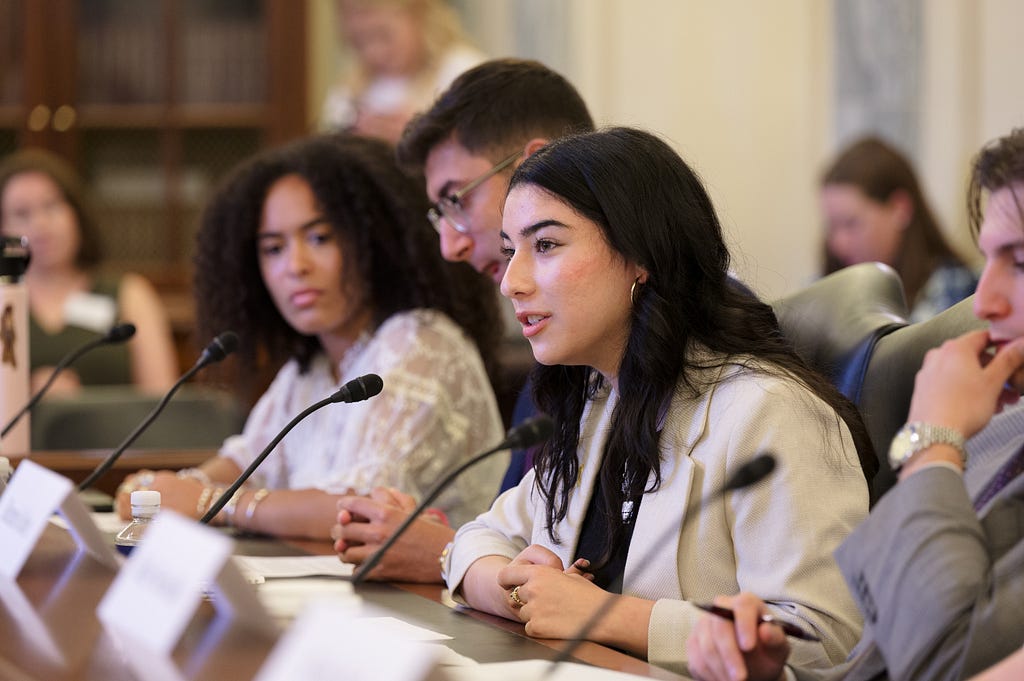
The controversy surrounding her commencement address became a defining public episode. She subsequently spoke at a U.S. Senate roundtable on combating antisemitism and participated in a panel alongside the Democratic National Convention. But the exposure also helped redirect her ambitions. Jewish organizations, including the ADL, had supported her during the campus controversy. She began to see an opportunity to help others confronting similar experiences.
At the ADL, she initially worked with students and universities. Her message to those seeking assistance was simple: “I’ve been through this myself. I’m here to help you.”
Eventually, her work moved from campuses to cultural institutions, where exclusion can be considerably harder to identify.
At the ADL’s Ratings & Assessments Institute, researchers evaluate organizations through data, institutional policies, and measurable standards. When Isakharov began examining reports of antisemitism involving museums and galleries, the original plan was relatively contained: assess 40 major American art museums and publish a scorecard.
The research expanded into something more ambitious.
Launched on October 1, 2026, the ADL’s State of the Arts initiative examines Jewish representation and reported discrimination across museums, publishing, and the performing arts. Its components include Behind the Frame, an assessment of 40 museums; Missing Chapter, which draws on more than 30 interviews with authors and publishing professionals; and Dark Stage, a tracker of incidents affecting performers.
For Isakharov, the challenge is that some of the most consequential experiences leave little documentary evidence. An artist loses a professional relationship. A curator hears that colleagues are uncomfortable working with him. A publisher becomes reluctant to take on a particular subject. Such experiences may raise concerns about discrimination without conclusively establishing why a decision was made.
“It is very hard to prove 100% that it was antisemitism,” she acknowledges when describing one curator’s experience.
That distinction is central to her research. Turning personal accounts into defensible findings requires separating suspicion from evidence, while recognizing that informal exclusion may never appear in an institution’s official policies.
The work has also led her to question how cultural organizations understand Jewish identity. According to the ADL’s museum assessment, none of the 40 institutions explicitly mentioned Jews or Jewish identity in their diversity and inclusion statements. Isakharov argues that treating Jewish identity exclusively as a religion overlooks the history, ethnic diversity, and cultural contributions of Jewish communities.
Her own biography complicates that narrow classification. And she worries that when Jewish stories disappear from museums, books, and performances, audiences lose opportunities to encounter the variety of Jewish experience.
Much of her working day is less public than her earlier activism. She describes many hours immersed in research, alongside conversations with artists, curators, and cultural experts. She is careful about confidentiality, declining to repeat private accounts without permission. Having experienced public hostility herself, she understands why artists may hesitate to risk their relationships or careers by speaking openly.
There is another, more personal contrast in Isakharov’s story. She spends her professional life constructing measurements of discrimination, yet her understanding of a meaningful life rests on values that resist numerical assessment.
When asked what idea she would most want to spread, she does not offer a new political initiative or institutional framework. She turns instead to Jewish religious practice, community, charity, and the fulfillment she finds in observing mitzvot.
“There’s no need to reinvent the wheel,” she says.
She is careful to distinguish those personal convictions from the ADL’s secular mission and expresses appreciation for the non-Jewish colleagues who share its work. Still, her answer reveals something that her professional title cannot: beneath the researcher and public advocate is a woman who sees Jewish continuity as something lived through ordinary acts of faith, generosity, and belonging.
It is a perspective that brings her back to the graduation speech she refused to surrender. Public recognition mattered, but community mattered more.
Today, Isakharov is trying to ensure that Jewish artists and their stories remain part of America’s cultural institutions. The challenge is different from confronting a petition or addressing a stadium. A public protest can be witnessed. A quietly withdrawn invitation may never be explained.
For someone whose own experience of exclusion unfolded so publicly, making those less visible experiences understood
Yitzi Weiner: Luda, it’s so nice to meet you. Before we dive in and talk about your amazing work with the ADL and this report, our readers would love to learn about your personal origin story. Can you share with us the story of your childhood, how you grew up, and particularly the seeds of all the amazing leadership that has come since then?
Luda Isakharov: Well, as I said, I grew up outside of the Portland, Oregon area, and I’m a child of two immigrants from the former Soviet Union. My mother is from Russia, and my father is from Uzbekistan. I grew up hearing these stories of antisemitism and how they were excluded from spaces, had to deal with slurs, had trouble getting into the universities they wanted, and in some cases even dealt with physical abuse. So I never took my Jewish identity for granted, or the fact that I had the privilege to practice Judaism.
Even growing up in a place where there weren’t many Jews, it was very central to who I was. However, I didn’t become super involved in activism until my university days. I went to the University of Oregon, and I was very involved in student activism and politics. I was the student body president at the University of Oregon. It was amazing, until it wasn’t amazing. After October 7th, I experienced a lot of antisemitism personally.
Although I never thought I would work in the Jewish world or at the ADL, so many Jewish organizations supported me and advocated for me, including the ADL. I felt like we really were in need of young, strong voices who have walked through these experiences and experienced the cancellation and the boycotting personally. I think many of my colleagues of an older generation haven’t experienced that post-October 7th cancellation and doxxing. And that’s what brought me to the ADL, thank God, and to this work.
Yitzi Weiner: Would you feel comfortable sharing a bit about your experience with antisemitism at the university? Can you share what exactly that meant and how it manifested?
Luda Isakharov: Sure, I can share a little bit. It was a whole spectrum. It’s just like what we see in the art world in my work now. So much of it happens quietly, and it’s so much of what other students experienced like me: losing friendships, hearing slurs, getting looks, and getting comments from professors. For me, I think it was on a bit of a different level. Being a student body president and a leader on campus, I received emails calling me different, very inappropriate slurs that I won’t repeat.
An example of how it all came to a head is that as a student body president, you get offered to speak at your commencement, your graduation ceremony. That’s in front of a whole football stadium of 10,000 people, families, and friends, and it’s something I really looked forward to. When I was announced as the speaker, a petition started going around campus to remove me from speaking. Students were saying, “Oh, I don’t feel safe to speak if a Zionist is on stage.” I was even approached by the campus administration, and they asked if I would still feel comfortable or if I still wanted to do it. I said, “Absolutely, yes, I’m doing it.”
I ended up speaking, and it was an amazing moment. It felt like a true win. I spoke about my Jewish identity, the story of my family, and how none of my accomplishments really felt like the most memorable part of my college experience. The most memorable part was my Jewish community, the holidays, and the learning. That’s what is really going to stick with me. To see that covered in the news and having that be the story, rather than the walkout and the protest that happened right before I went up on stage, felt like a positive way to end the whole experience.
Afterwards, I was able to use my voice nationally and speak a bit about my story. I testified at a United States Senate roundtable on combating antisemitism about my story, and I spoke on a side panel at the Democratic National Convention. Then I settled down and started doing the real work behind the scenes instead of being at the front of the scenes. That’s been really cool because when I started at the ADL, I was working with students and campuses, and I was able to tell them, “I’ve been through this myself. I’m here to help you.” Even now, I don’t work with students as much; I work with artists. However, I know how they feel, and I know their fear to speak to us, to report, to speak out, or to lose relationships or their careers, because I’ve been through it myself. I think it makes doing my job a lot easier when I can empathize with the people I’m working with.
Yitzi Weiner: Okay, amazing. Let’s talk about what you’re working on. Tell us a bit more about what you focus on at the ADL. Tell us about your portfolio, what you do, and what your day-to-day looks like.
Luda Isakharov: Sure. I work in the ADL’s Ratings and Assessments Institute. We go in and evaluate different sectors on consistent data and metrics, and then we use the findings, whether that’s a scorecard or a written report, to make it public and drive change in those spaces. When I came to the team, I started helping with all of the work, including the campus report card and the AI index. However, the portfolio that I really have led and own is our arts and culture portfolio. We set out about a year ago to understand what’s going on in the arts and culture space, because we had received an uptick in incident reports in art museums and galleries.
We know how to do scorecards, so we said, “Let’s do a scorecard on art museums.” They’re comparable, large institutions. We picked 40 art museums across the country in partnership with our expert panel and started diving in and doing research. As we were doing that research, we realized that the problem is so much broader than art museums and these big institutions. It’s literally ingrained in the fabric of our arts and culture space across the United States, where Jews are quietly, and in some cases loudly, being pushed out to the margins of these spaces.
So we decided instead of just launching a one-off scorecard of art museums, we were going to launch a whole initiative called “State of the Arts.” To start in our first iteration, we looked at three different sectors. We looked at art museums, representing the visual arts. We looked at the literary space and publishing in a report called Missing Chapter, where we interviewed over 30 authors. Then we released a live case tracker of all these incidents that have happened on stages and in performing arts venues since October 7th. There are also some other companion pieces to the report and resources for artists.
All on their own, it might not feel that serious that an artist got heckled on a stage or there was an incident at a museum. Put together, however, it shows a trend that this is a really serious problem across the whole arts and culture sector that needs to be addressed. That’s the portfolio I lead, and we launched it on October 1st. It’s been a huge success already. A handful of museums are engaging with us, trying to get their grades up, and making policy changes right now that will ultimately help the Jewish community. Our regional offices are preparing to help museums recognize Jewish American Heritage Month this May and are doing this work. We’re also looking to expand into other corners of the arts where this is happening to see how we can quantify it with data and put some numbers to it.
My day-to-day is really amazing. My job combines so many things that I love. On any given day, I could spend four to six hours with my head down doing research. I also spend so much of my time meeting with artists and experts from the space, hearing their stories and perspectives. Everyone has a different angle and view on everything, but when you start having 30, 40, or 50 of these conversations, you start having deja vu and hearing a through line. The coolest part is I don’t just talk to them, hear the story, and say, “Bye, I’ll never speak to you again.” I get to come back to them in a few months and deliver a product, or I get to say, “This is exactly how the ADL is going to help you,” which is a very gratifying part of the job that I love.
Yitzi Weiner: Unbelievable. Would you be able to share some of the people that you work with, or some of the artists that have been experiencing this?
Luda Isakharov: I don’t know if I can share private conversations without their permission, but I will say there are a bunch of artists featured on the record on the website that you’re welcome to talk about. We have the international bestselling author Jean Meltzer, Alyssa Rosenheck, and the visual artist Allison Zuckerman, who shared their stories. There are nine authors who shared their stories and quotes on the site. Those are just some examples of the authors and artists we spoke to who are amazing and brave in sharing their stories. As I said, I know how hard it is to rip off the band-aid and speak out about something, and I don’t take it lightly that they chose to share their stories with us so publicly.
Yitzi Weiner: Have you observed that this trend all started since October 7th, or was it happening before?
Luda Isakharov: Our research shows that this rise in the exclusion of Jews and Israelis in arts and culture happened long before October 7th. It has been rising over the past decade. These art spaces are really great at having inclusion frameworks, which were very needed because there were so many other communities historically left out of the arts. In creating these inclusion frameworks, however, Jews were categorized as white and therefore left off these reports.
In our museum report, Behind the Frame, we looked at every single museum’s DEI or inclusion statements, and not a single one mentioned the word “Jewish,” “Jewish identity,” or “Jews,” let alone antisemitism. So this was happening before October 7th, but October 7th really spiked it. It peaked after October 7th, bringing this issue that had been happening for a long time to the surface. It also made it almost socially acceptable to say, “We openly do not work with Zionists,” or “We openly will not work with Israeli artists or Jews.” It has definitely gotten much worse since October 7th.
Yitzi Weiner: Have they actually said those words, that they will not work with Jews?
Luda Isakharov: We see it in a more covert way, where it’s phrased as, “We don’t work with Zionists.” That’s what is so hard about this space, and that was why it was so difficult to build a methodology for this research, because so much of this antisemitism happens below the surface. It’s a gut feeling. It’s a phone call where someone you were working with no longer wants to work with you. Or, for example, a curator told me he was informed that the artists didn’t feel safe or comfortable around him. We can’t necessarily prove 100% that it was antisemitism because they didn’t explicitly say, “It’s because you’re Jewish,” but they said they didn’t feel comfortable, and he is openly Israeli with an Israeli name. Things like that anecdotally lead us to believe this is a problem, and we had to work really hard to put the data behind it to take something happening below the surface and prove it above the surface. It was a challenge, for sure.
Yitzi Weiner: You used that term two times already: “I don’t feel safe around this Jewish person.” What does that mean? What do they mean by that?
Luda Isakharov: I don’t know; it’s very hard to say. I’ve never met a Jewish student or artist who is dangerous and not bringing value to a community. I think it’s just covert language that’s symbolic for something else, or a socially acceptable way to say, “I don’t want this person here.”
Yitzi Weiner: If someone were to say that about any person of color — “I don’t feel safe around that person of color” — that would be extremely racist. Why is it acceptable to say, “I don’t feel safe around that Jewish person”?
Luda Isakharov: This is a thousands-of-years-old problem that Jews have faced: being othered and pushed out of spaces for reasons that don’t make sense, are irrational, and cannot be explained.
As far as the arts and culture space and academia go, we see that people don’t really know where to place Jews. In inclusion frameworks, they’re considered white, and in power dynamics frameworks, they’re considered to hold power. Because of that, institutions struggle to understand how to include them. We even saw this in the museum space during our advocacy, which showed us that we have a lot of work to do as a community in educating people on who the Jewish people are.
For example, a big thing we pushed for was the recognition of Jewish American Heritage Month. The way we graded it was simple: if a museum recognizes no heritage months and remains fully neutral, we give them 100%. There’s no issue with that; we understand. However, if they recognize several other groups and heritage months, but specifically do not recognize Jews, that’s a problem for us, and that’s a zero. When we pushed some museums on why they don’t recognize it, they responded, “Oh, we don’t recognize it because it’s a religion, and we don’t recognize religions.”
That might sound fair on the surface, which is why I say we have so much education to do. We had to respond and explain that the Jewish American people are a distinct culture and heritage, not only Jews around the world, and they have contributed immensely to the arts, culture, film, music, painting, and photography. To exclude them because you’re viewing them through the narrow window of only being a religion is wrong. That’s the work we have to do as the ADL and as a greater Jewish community: to increase education and understanding of who the Jewish people are.
Yitzi Weiner: Amazing. What about the fact that a majority of Jews aren’t white? Why isn’t that discussed?
Luda Isakharov: One hundred percent. That’s a huge factor too: the sheer diversity in Jews, Jewish viewpoints, and Jewish backgrounds. On the website, we featured an amazing photographer named Peter Decherney, who specifically does film photography of Jewish communities in Africa. It’s beautiful work, and it’s so important that his work is shown and funded because it highlights that diversity. I think he’s in Morocco right now taking photos of the Moroccan Jewish communities that remain there.
That’s why it feels so terrifying to me to see data showing that Jewish people are being pushed out of arts and culture. How else are we going to educate the broader non-Jewish American community on who we are other than through the arts? Most people aren’t taking antisemitism classes or Holocaust education courses, but they are going to their local museum. There, they might see a painting of a Jewish person with a darker skin tone or a lighter skin tone, or a woman or a child, and that becomes their first impression of a Jew. If those paintings aren’t being seen or that music isn’t being heard, that absence will shape how our children and future generations see the Jewish people. It’s so much more serious than even what we see right now.
Yitzi Weiner: That’s amazing. You mentioned support from the broader Jewish community. Of course people should support the ADL, but in addition to that, what can each of us do? What do you think we should be doing to fight antisemitism from your perspective?
Luda Isakharov: When it comes to arts and culture, we shared several paths on our website for how Jewish readers or museum patrons can help. Our ultimate goal is to make sure that we’re accepted in mainstream spaces; we shouldn’t have to rely solely on support from other Jews. Still, it is so important right now for Jewish people to buy Jewish books, support Jewish artists, show up to their shows and performances, purchase tickets, visit museums, make requests, and write reviews. Trust me, the haters and the antisemites will go and write 500 negative reviews, so every positive review and show of support counts.
Whether or not you have major funding or money, everyone can play a role in supporting these Jewish artists at a time when they’re being pushed out. The market really works in the US: when people buy these books, authors continue to get renewed, and publishers continue picking them up.
Beyond that, it’s vital for Jewish artists to continue creating art, showing up in these spaces, reporting the incidents that happen, and refusing to be silent about them. It’s the same thing I always told students: the best thing you can do to fight back is to go on campus, be proudly Jewish, apply to Harvard, apply to the schools you saw on the news, and continue to show up. I say the same thing to artists now: now is not the time to go hide in a corner.
Yitzi Weiner: Okay, this is our signature question. You’ve been blessed with a lot of success, and you must have learned a lot from your experiences at the ADL. Looking back to when you first started, can you share five things that you wish more Americans understood about the Jewish people? Five misconceptions you would like to unravel?
Luda Isakharov: Number one, right off the top of my head, is that the warmth of the Jewish people is not captured at all by mainstream media and mainstream perceptions of Jews. So many antisemitic tropes portray us as greedy or cold, and that couldn’t be further from the truth. Jewish people are the warmest, most welcoming people. Our doors are always open. Everyone I know hosts Shabbat dinners where everyone is welcome — Jews, non-Jews, politically aligned or not. I wish people knew how warm we are, and that you can find that warmth in Jewish communities anywhere in the world.
Two, as we touched on earlier, is the diversity of the Jewish people. There are so many people in the United States who have never met a Jewish person before, perhaps in parts of the South or elsewhere. And if they have, maybe the Jewish people they knew fit a specific stereotype, perhaps Ashkenazi or from a certain wealth bracket. Yet Jews all over the United States and all over the world look different. I myself am a Bukharian Jew; my father’s family is from Uzbekistan, and I’m mixed, as my mother is an Ashkenazi Jew from Russia. I have friends who are Persian, Moroccan, and African Jews, as well as converts and people who married into Jewish families, or Baalei Teshuva. We come from so many different walks of life, and we’re all equally Jewish in the eyes of God. That is something people really don’t understand, especially given how stereotypically we’re portrayed.
Three, people underestimate the Jewish people and our resilience. To bring it back to the arts or to students — students are my favorite example — you would think that after everything that happened at the University of Oregon, the Chabads, the Hillels, and all the Jewish programs would be empty. The truth is, they’re fuller than they’ve ever been before. When I was on campus during the massive encampment, our Chabad was overflowing; there weren’t enough seats for students. In my freshman year, when everything was calm, there were maybe 30 or 40 people. People underestimate our resilience. They make a mistake when they try to push us out of these spaces, because we just come back stronger and fight back.
For number four, I also wish people knew about the Jewish value of charity and how much we help each other. I’ve seen the beauty of that working at the ADL: how much Jews help each other and build each other up, whether it’s in the philanthropic world supporting organizations like the ADL, rallying around small businesses that are about to go under because of boycott efforts, or supporting artists who are having a hard time selling their art. It’s beautiful how philanthropic the Jewish community is. Whether you’re religious or not religious, it’s ingrained in the fabric of who we are to be charitable and to give tzedakah. That ties right into the previous point: our resilience is partially because we support each other.
My fifth one is that the Jewish people have an inseparable connection to the State of Israel, whether you’ve been to Israel or haven’t been to Israel. People don’t fully understand the connection we have with that place: that we’ll always have that safety net, that we pray in that direction every day, and that our history is so interconnected there. What our Israeli brothers and sisters go through, the pain they go through, we feel here, and vice versa. Yeah, that’s five.
Yitzi Weiner: Amazing answer. Thinking slightly broadly, Luda, this is our final aspirational question that we ask all of our interviewees. Because of your amazing work and the platform that you lead, it’s not an exaggeration to say that you’re a person of enormous influence. If you could spread an idea or inspire a movement that would bring the most amount of good to the most amount of people, what would that be? Because you never know what your idea can inspire.
Luda Isakharov: It’s hard for me to come up with my own idea as an influential person, honestly, because as a Jewish people, we have the gift of being given a book and instructions on how to live our lives and practice our values. Those values and rules apply beyond the Jewish people, too, so I don’t need to come up with anything original.
It goes back to the speech I gave at graduation. At the end of the day, we’re very accomplished, ambitious people, and we fight and work very hard. Still, nothing brings us more fulfillment — or brings me and my family more fulfillment — than being in community with each other, celebrating our heritage, learning the history of our ancestors, being connected spiritually, doing mitzvot, and giving back, which is what I get to do in this job and what my amazing colleagues do every day.
There’s no need to reinvent the wheel. I wish to see the Jewish community more united and getting back to basics. The things that we are commanded to do aren’t rocket science, and if we all do our part, the world will be a much better place. I don’t need to give an original answer; it’s all already there.
Yitzi Weiner: I love what you said so much, because you’re the first person to give that answer. If I’m understanding you correctly — tell me if I’m misunderstanding you — you’re saying that the way we can bring the most amount of good to the most amount of people is if we unite as a people and keep the mitzvot, and through that we will spread the most amount of light into the world. Am I understanding you correctly?
Luda Isakharov: One hundred percent, yeah. Obviously, we’re not a religious organization, and I work with so many non-Jewish people who give their lives and their time to supporting and fighting for the safety of the Jewish people, which is amazing. I never want to say anything that excludes them, which is why I framed it the way I did. But 100%, I want to see unity and light. Just being Jewish and living our values can fix the world more than we know. It’s amazing that we do this research and security work, and we have to be vessels here in the physical world, but at the end of the day, there are higher things than that.
Yitzi Weiner: I love it. I love what you’re saying and how you’re saying it. I’ve done a lot of interviews like this, and you’re the first person who has ever said that. It’s so beautiful. When you say it’s basic, that’s the irony: sometimes the things that are the most basic are the things that are the most forgotten.
Luda Isakharov: True. Well, I’m happy to spread that message.
Yitzi Weiner: Luda, how can a reader read more about your work and the report? How can a reader support your work and the ADL’s work in any possible way?
Luda Isakharov: I love that question. As I said, we just launched State of the Arts on October 1st. It’s an amazing initiative. The website is state-of-the-arts.org, with hyphens in between “state-of-the-arts,” and of course, readers can also find it on adl.org.
I personally am willing to connect with any artist, or anyone really, who is experiencing antisemitism in these spaces and wants to talk to us and share their story. Their stories are not only important data for us, but they’re also important for us to hear so we can help. People can email rai@adl.org if they want to speak to us about anything, share information or a connection, or invite us to speak. This is just the beginning; we’re just getting started.
ADL’s Luda Isakharov Fights Covert Antisemitism in American Arts and Culture was originally published in Authority Magazine on Medium, where people are continuing the conversation by highlighting and responding to this story.