


Social Impact Tech: Mary Kate Fain of Soapbox On How Their Technology Will Make An Important Positive Impact
To this day, I find it amazing and hilarious that no one knows that Donald Trump’s website is running my feminist software.
As a part of this series, we had the pleasure to interview Mary Kate Fain.
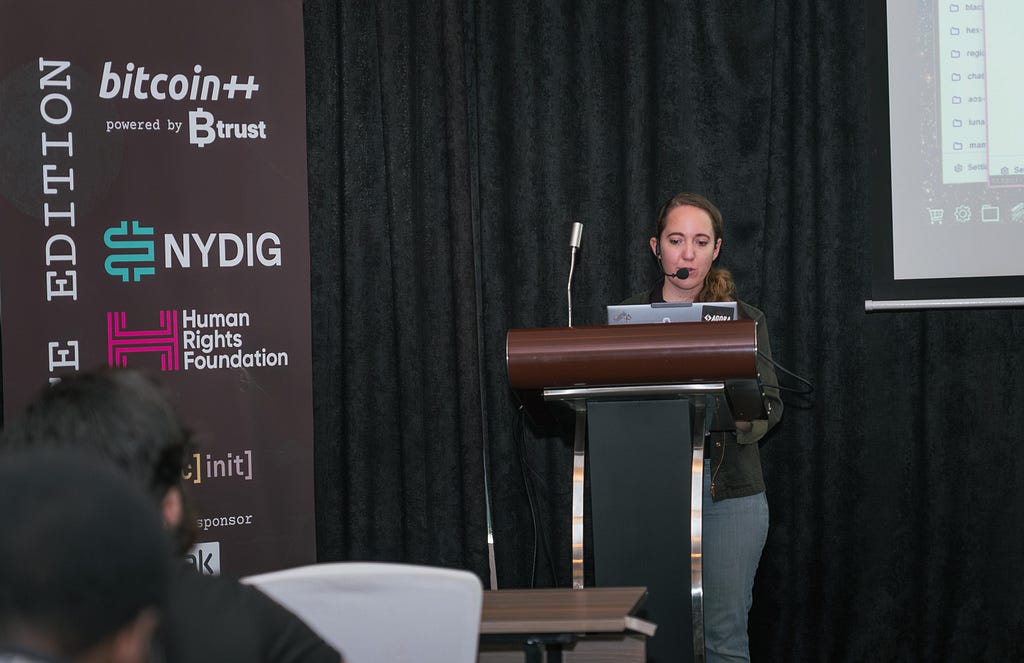
M. K. is a passionate advocate for digital freedom with a track record for building spaces for silenced groups online. In 2019 she founded Spinster, the largest women’s community on the decentralized web. She is the former Communications Director for the Women’s Liberation Front, and her work has been profiled in outlets such as the Atlantic and Vice.
Thank you so much for joining us in this interview series. Before we dive in, our readers would love to learn a bit more about you. Can you tell us a bit about your childhood backstory and how you grew up?
I grew up in a small town outside of Pennsylvania as the oldest of six kids. My family was never well off. We got free lunches at school, donations from church for food, and we lost our home in the 2008 housing crisis. But my sisters and I were raised with a strong sense of right and wrong. I didn’t realize we were “poor” by American standards growing up because my parents instilled in us a sense of justice for anyone who was worse off than us, anywhere in the world.
Can you share the most interesting story that happened to you since you began your career?
In 2019 my husband Alex and I made Spinster, a feminist social platform for women who were being censored and harassed online. We built it with open source software, so anyone could use it. In 2022 then-former President Trump launched his website Truth Social from a fork of our software. To this day, I find it amazing and hilarious that no one knows that Donald Trump’s website is running my feminist software.
None of us are able to achieve success without some help along the way. Is there a particular person who you are grateful towards who helped get you to where you are? Can you share a story about that?
The person I am most grateful for and who has supported me the most throughout my career is my husband and partner, Alex. Alex has always believed in whatever dream I had, even when I barely believed in it myself. While I tend to be very practical and realistic, he is a fearless risk taker. That energy has complemented mine extremely well, and allowed us to grow and succeed well beyond what either of us could do alone.
Can you please give us your favorite “Life Lesson Quote”? Can you share how that was relevant to you in your life?
It can often feel like one person stands no chance at making a difference in the grand scheme of suffering we are up against in the world. Whether it’s human war and conflict, authoritarian regimes, climate change, or the Big Tech corporations we are facing… all of these issues feel hopeless when tackling powers and industries that are infinitely more powerful than any one individual. But I am reminded of MLK’s quote, “The arc of the moral universe is long but it bends toward justice.” It is only with some belief that things can be better that we can keep going and keep fighting. I have to believe that there is some hope, even when the fight seems futile, or I wouldn’t be able to keep trying.
You are a successful business leader. Which three character traits do you think were most instrumental to your success? Can you please share a story or example for each?
Listening to others: Growing up poor taught me that the people closest to a problem understand it best, and I’ve carried that into everything I build. Last summer we took Agora to Kenya to put it in the hands of women running small businesses, many of whom had been shut out of the traditional banking system their whole lives. What I learned sitting with them was that they didn’t care about the technology at all. They cared about getting paid and keeping their own money safe, without a bank or a middleman deciding whether they could access it. Hearing that directly from the women using our tools is what kept us honest about what we were really building for. The best decisions we’ve made have all started the same way: by listening to someone the system had already failed.
Adaptability: I always try to be willing to go where life takes me, and remain open to learning, meeting new people, and finding new opportunities where my vision is valued. The clearest example is the different causes I’ve worked with in the past. I come from feminist organizing, and a younger version of me would have assumed the Bitcoin and free-speech-tech world had nothing for her. But the more I learned about how censorship and financial control actually operate, the more I realized these issues are closely connected at the top. Today we build alongside human rights activists in more than 40 countries and with partners I never expected to find, including many women’s rights activists in countries like Iran where the issues of feminism and free speech deeply intersect. If I had let my old assumptions make the call, Agora would never have existed.
Big picture strategy: Early on I could see that a handful of companies had quietly taken over the things people depend on most online: how we talk, how we organize, how we move money. Most people were fighting one of those battles at a time. I wanted to see the whole board. That’s why Soapbox doesn’t build a single app. We build a decentralized alternative for each layer: Ditto for social media, Armada for community, and Agora for fundraising. Any one of them on its own is just a feature. Put together, they’re the beginning of an internet that people actually own.
Ok super. Let’s now shift to the main part of our discussion about the tech tools that you are helping to create that can make a positive social impact on our society. To begin, what problems are you aiming to solve?
Our tool Agora is designed to address the problem of “fundsorship:” when political, financial or platform-level restrictions limit people’s ability to access money or aid. While online fundraising is marketed as a simple, convenient way to raise funds for any cause across the globe, this is not always the case. Amidst our precarious geopolitical reality, successfully raising money is increasingly only half the battle: banks, governments and technology platforms can still determine whether those funds ever reach the recipient. And this censorship leaves real people in the lurch — cut off from funds that would drastically change their situation.
How do you think your technology can address this?
Agora is an open-source fundraising platform that enables peer-to-peer Bitcoin fundraising without traditional intermediaries, circumventing fundsorship completely. With Agora, any person can raise funds for any cause they choose, and there are no barriers for the recipients to claim the donations. Our technology offers another path for people excluded from conventional crowdfunding and financial infrastructure.
Can you tell us the backstory about what inspired you to originally feel passionate about this cause?
Our team at Soapbox’s mission is to build tools that enable Internet freedom. Our world is increasingly controlled by a handful of powerful corporations, and we are responding to this issue with decentralized alternatives to the main ways people connect: social media, community building, and with Agora, fundraising. We observed how inaccessible traditional fundraising was to specific populations and causes and launched Agora this past summer in partnership with the World Liberty Congress to enable humanitarian projects in contested places like Venezuela, Iran, and Gaza.
How do you think this might change the world?
This technology drastically changes who has access to resources, both on the fundraising and receiving end. Too often, as governments fight for power, their citizens become pawns in the struggle, used as leverage to force political decisions. But it is real people who become victims of these power games, getting cut off from donations from organizations, humanitarians, and loved ones. With Agora, anyone can receive life-saving aid without the interference of financial entities, government groups, or Big Tech.
Keeping “Black Mirror” and the “Law of Unintended Consequences” in mind, can you see any potential drawbacks about this technology that people should think more deeply about?
Because the internet has been controlled by a few powerful people for so long, we expect that a consequence of this technology would be that people would start to question the systems that censor, limit, and control them, and begin to imagine what a truly “free internet” would look like. And we actually think this is a good thing. Our platform was created to cause that exact kind of questioning and propose an alternative — completely open, free to use, and uncensored tools for building community, making apps, fundraising, and more. Our mission and our hope is that by giving people access to these platforms like Agora, we will be empowering people to fight for a world where technology works for, not against, them.
Here is the main question for our discussion. Based on your experience and success, can you please share “Five things you need to know to successfully create technology that can make a positive social impact”?
1. Listen to the users: It’s obvious, but it’s easier said than done. As developers, we often go into a project with a plan or vision. But when there are real people relying on your tech for communication, survival, or their livelihoods, you must check in with real users and test your theories every step of the way. When we were building Agora, we actually imagined it first as a social network more similar to Twitter or Facebook, but after 6 months of testing the app in the field we found that only one feature was really being used consistently: the ability to send micro payments to activists within your network. After seeing this data, we completely pivoted and went all in on this element of the app. That changed everything.
2. Consider the infrastructure first: If you are building for a positive social impact, infrastructure is everything. Can your servers go offline and leave your users stranded? Can your data be subpoenaed and used against vulnerable populations? Does it work on low bandwidth in war zones where internet is bought by the minute? Can users in authoritarian regimes even access your site? No matter how beautifully designed and feature-rich an app is, if it fails in real world scenarios where people need it most, it will be useless.
3. Compromise on strategy, not values: Very little can be built at scale without compromise of some sort, but if you are building for positive social impact, where you choose to make the compromises is key. Lots of tech companies started out with slogans like “Don’t be evil” and made tiny compromises along the way to get ahead. But if you must compromise, it cannot be on values. Most of the time, compromise is over convenience. For example, in Agora some users wanted more privacy than the Bitcoin blockchain typically offers. Many people pushed us to use centralized middle-man services for convenience, which offer more privacy at the cost of creating central points of failure. For Agora, this was an unacceptable compromise on values, since our core mission is to provide unstoppable funding. Instead, we researched and experimented until we found a better solution: a new Bitcoin method for “silent payments”, which we helped advance as some of the first adopters of this new system. By refusing to compromise on values and fighting to find a better solution, we later avoided a massive hack that took down all the centralized middle-man services. Unstoppable as a value paid off, and we were vindicated in refusing to compromise on it.
4. Stay light and move fast: Facebook’s old slogan, “Move fast and break things,” is what allowed them to sweep through society at an unprecedented rate. As a small organization, we can’t compete with Big Tech on resources. But what we can compete on is speed. Most legacy companies now are big, heavy, and slow. By limiting infrastructure to the bare minimum, we remain light, agile, and able to pivot immediately to meet the needs of the moment rather than having to spend time moving an ancient beast of a company in a new direction. Keeping our company overhead light also allows our team to have more time to work on the projects they personally care about, reducing burnout and churn.
5. Be consistent: The downside of staying light and flexible as an organization is the temptation to move on too quickly rather than giving ideas time to fully grow from seed to fruit. This is something we’ve struggled with, especially as our team has many passions and interests which constantly compete for our attention and pull us in a hundred directions. But the way to build community, whether online or in real life, is with consistency. Growing up, a family in my town hosted a “Pasta Night” dinner every single Tuesday, without fail. Anyone was welcome, and as a result the community grew. Now, twenty years later, people still show up at their doorstep once a week, jar of pasta sauce in hand, ready to share in a community space they know will be there. This is what also allows online communities to develop and thrive, and resisting the urge to change everything all the time is key to letting community online flourish.
If you could tell other young people one thing about why they should consider making a positive impact on our environment or society, like you, what would you tell them?
Get offline. Close your computer. Brick your phone. Go outside. Meet your neighbors. Talk to a stranger. Prioritize the IRL above all else. Then you can build something that may actually help someone.
Is there a person in the world, or in the US with whom you would like to have a private breakfast or lunch, and why? He or she might just see this, especially if we tag them. 🙂
I have been trying to get in touch with Tom from Myspace! If anyone knows him, please send him my way. I would love to talk.
How can our readers further follow your work online?
Follow me on Nostr here: https://ditto.pub/npub1jvnpg4c6ljadf5t6ry0w9q0rnm4mksde87kglkrc993z46c39axsgq89sc
You can follow me on LinkedIn here and learn more about Soapbox at our website here.
Thank you so much for joining us. This was very inspirational, and we wish you continued success in your important work.
Social Impact Tech: Mary Kate Fain of Soapbox On How Their Technology Will Make An Important… was originally published in Authority Magazine on Medium, where people are continuing the conversation by highlighting and responding to this story.